
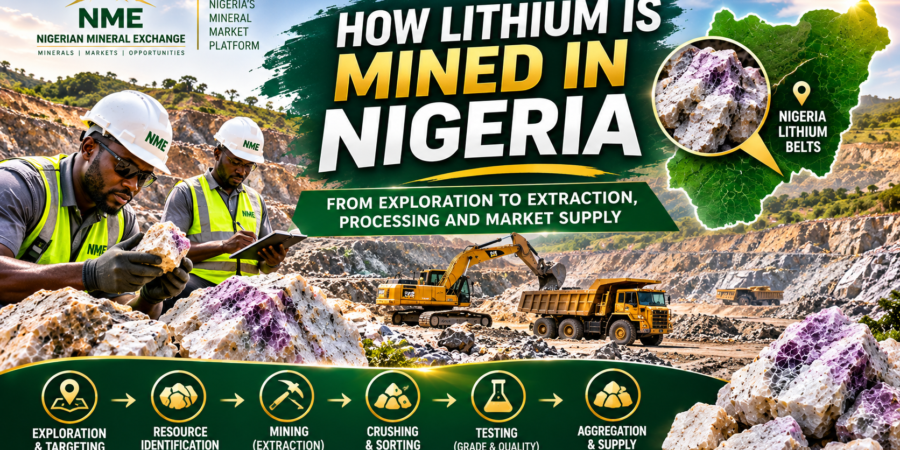
The question of how lithium is mined in Nigeria is a topical issue in the country because of the rapid rise of lithium as a strategic mineral; and which has transformed the way many people view mining. For decades, discussions about mining in Nigeria largely focused on commodities such as gold, tin, limestone, coal, and iron ore. Today, however, lithium has emerged as one of the most closely watched minerals in the country due to its role in battery manufacturing, electric vehicles, renewable energy storage systems, and the broader global energy transition.
As international interest in Nigeria’s lithium resources continues to grow, many investors, suppliers, buyers, and industry observers are asking an important question:
How is lithium actually mined in Nigeria?
The answer begins with geology. Lithium mining in Nigeria is primarily associated with hard-rock deposits found within pegmatite formations. Pegmatites are coarse-grained igneous rocks that can contain economically significant concentrations of lithium-bearing minerals such as spodumene, lepidolite, and amblygonite. These pegmatites occur across several states in Northern and Southern Nigeria, creating the foundation for the country’s emerging lithium industry.
Before mining can begin, exploration activities are required to identify and evaluate potential deposits. Exploration is often the least visible stage of mining, yet it is one of the most important. Geologists and exploration teams conduct geological mapping, sampling programs, trenching activities, laboratory testing, and other investigations to determine whether a particular area contains commercially viable lithium mineralization. This stage transforms geological possibilities into measurable opportunities. Without exploration, there is no mining.
Once a deposit demonstrates commercial potential, the focus shifts toward extraction. Unlike lithium brine operations found in countries such as Chile, Argentina, and Bolivia, Nigeria’s lithium resources are primarily mined from hard-rock deposits. This means that lithium-bearing rock must be excavated from the ground before it can enter the supply chain. Depending on the characteristics of the deposit, mining operations may use a combination of surface mining methods designed to access mineralized pegmatites efficiently and safely. The objective is to extract lithium-bearing material while minimizing unnecessary removal of non-mineralized rock.
The mining stage is often what most people imagine when they think about lithium production. Excavation equipment removes mineralized material, which is then transported for further handling and evaluation. However, mining is only one part of the process. The extracted material must still be sorted and assessed before it can move into commercial channels. This is where ore selection becomes important. Not all rock removed during mining contains the same concentration of lithium-bearing minerals. Operators therefore pay close attention to identifying material with the most attractive characteristics for commercial purposes.
As the industry becomes increasingly professionalized, quality management is becoming a more important aspect of mining operations. The market is gradually rewarding suppliers capable of maintaining:
quality, consistency, and reliability.
Once material has been extracted and sorted, it typically moves into the broader supply chain. This is where lithium mining intersects with lithium trade. Many people assume that mining ends when ore leaves the pit. In reality, the commercial journey is only beginning. Material often passes through several stages involving: stockpiling, aggregation, transportation, inventory management, quality verification, and procurement coordination before eventually reaching domestic or international buyers. These activities help convert mined material into commercially accessible inventory.
Aggregation has become particularly important within Nigeria’s lithium industry. Because mining activity occurs across multiple regions, supply is often fragmented among different operators and locations. Aggregation networks help consolidate material into larger inventory pools capable of supporting industrial procurement requirements. For international buyers, this creates greater visibility and sourcing efficiency. For suppliers, it improves access to larger commercial opportunities. As the industry matures, aggregation is likely to remain a critical component of the mining ecosystem.
Quality verification also plays a major role. Modern lithium procurement systems rely heavily on information. Buyers increasingly seek confidence regarding: ore grade, purity,
consistency, and inventory quality. Laboratory testing and assay reports therefore occupy an increasingly important position within the mining process. The objective is not simply to extract material but to demonstrate its characteristics in a way that supports commercial decision-making. This reflects a broader trend occurring throughout the global battery-mineral industry. Mining is becoming increasingly integrated with procurement. Extraction alone is no longer sufficient. The market increasingly values suppliers capable of providing both quality material and quality information.
Environmental and community considerations are also becoming more important. Across the world, governments, investors, and manufacturers are paying closer attention to the sustainability of mineral supply chains. Nigeria’s lithium industry is developing within this environment. As mining activities expand, there is growing recognition of the need to balance economic development with responsible environmental stewardship and community engagement. This balance will be important for attracting long-term investment and ensuring the industry’s sustainability. Mining communities themselves remain central to the industry’s future.
Across lithium-producing regions, local populations often provide labor, entrepreneurial activity, transportation services, accommodation, food supply, and numerous other economic contributions that support mining operations. As lithium development expands, these communities are likely to remain important stakeholders within the broader ecosystem.
The future of lithium mining in Nigeria may also extend beyond extraction. Around the world, countries are increasingly seeking to capture more value from critical minerals through processing, beneficiation, logistics, and industrial development. Nigeria is beginning to explore similar opportunities. The long-term success of the sector may therefore depend not only on how much lithium is mined but also on how effectively the country develops the supporting industries surrounding those resources. This includes: aggregation, warehousing, processing, procurement, market intelligence, logistics, and international trade. These activities collectively create the infrastructure of a modern mineral economy.
The Nigerian Mineral Exchange (NME) is actively supporting the development of this ecosystem by connecting suppliers, buyers, aggregators, logistics providers, investors, and procurement networks across Nigeria’s growing lithium sector. For international procurement groups, battery-material companies, commodity traders, mineral processors, and investors evaluating opportunities in Nigeria, NME provides support in supplier identification, procurement coordination, aggregation access, market intelligence, and supply-chain visibility.
NME also serves as a Foreign Buyer Representative and International Buyer Representative in Nigeria, helping international organizations establish trusted local market presence through supplier engagement, due diligence, sourcing coordination, logistics intelligence, procurement support, and market-entry assistance. This enables foreign buyers and investors to navigate Nigeria’s evolving lithium industry while maintaining reliable on-ground visibility into suppliers, logistics networks, and sourcing opportunities.
At the same time, NME continues to work with lithium suppliers across Northern Nigeria who are seeking access to serious buyers, structured procurement opportunities, and long-term commercial relationships. Organizations seeking sourcing support, supplier verification, procurement coordination, market-entry guidance, aggregation partnerships, or local buyer representation can engage NME directly through WhatsApp (+2348130799304).
Nigeria’s lithium mining industry remains in an early but rapidly evolving stage of development. New discoveries are attracting attention. Supply chains are expanding. Commercial networks are becoming more organized. And international interest continues to grow. Yet perhaps the most important lesson is that lithium mining is no longer just about extracting rock from the ground. It is about participating in a global battery-mineral supply chain that begins in Nigeria’s pegmatites and extends all the way to factories, technologies, and energy systems around the world.
Related Articles
- Source Lithium Ore in Nigeria
- Sell Lithium Ore in Nigeria
- Abuja and Regional Lithium Commerce in Nigeria
- Environmental Challenges of Lithium Mining in Nigeria
- Logistics Challenges Across Northern Nigeria’s Lithium Trade
- Lithium Mining in Nasarawa State
- The Global Lithium Race Explained
- Critical Minerals and Nigeria’s Future
- How to Source Lithium Ore in Nigeria in 2026
- State-by-State Lithium Opportunities in Nigeria
- How to Secure Large-Scale Lithium Ore Supply in Abuja: The NME Industrial Sourcing Guide
- Northern Nigeria Lithium Trade Ecosystem
- Lithium Transportation Corridors in Northern Nigeria
- Why Lithium Investors Are Watching Northern Nigeria
- Lithium Mining Investments in Northern Nigeria
- Can Nigeria Become Africa’s Lithium Powerhouse?
- Lithium Deposits in Kogi State
- Why Local Partnerships Matter in Lithium Trade
- Future Lithium Trade Routes Across Nigeria
- Security Considerations in Lithium Operations
- Northern Nigeria’s Lithium Mining Corridors
- Lithium Trade in Kano State
- Niger State and the Nigerian Lithium Economy
- Lithium and Energy Storage Technologies
- Nigeria’s Emerging Battery Minerals Economy


Leave a Reply