
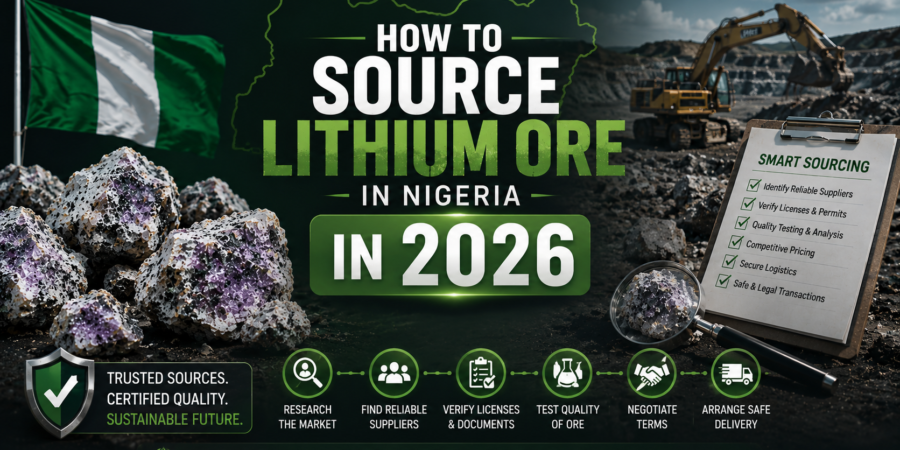
The Nigerian lithium market in 2026 looks very different from what it was only a few years ago. What initially began as scattered mineral trading activity has gradually evolved into a much larger supply-chain ecosystem attracting international buyers, battery-material companies, Chinese sourcing firms, commodity traders, and industrial procurement groups searching for long-term lithium supply opportunities.
At the same time, Nigeria’s mining sector is attracting growing investment tied to lithium processing and value-addition projects around Abuja and Nasarawa State, reflecting increasing international confidence in the country’s battery-mineral potential. For many buyers entering the Nigerian market in 2026, however, one reality becomes immediately clear: sourcing lithium ore in Nigeria is not simply about locating mineral deposits. The real challenge is understanding how the supply network operates.
Unlike highly centralized mining jurisdictions where supply is controlled by a few industrial producers, Nigeria’s lithium ecosystem still functions through a layered network involving mining communities, artisanal operators, local suppliers, regional aggregators, transport systems, warehousing channels, and procurement coordinators.
This means successful sourcing depends heavily on relationships, logistics coordination, aggregation access, supplier verification, and procurement intelligence.
Buyers who fail to understand this structure often struggle with inconsistent supply, fragmented procurement, logistics delays, unreliable assays or unstable sourcing relationships. The buyers achieving the strongest results in Nigeria today are usually not the ones searching for the cheapest ore alone. They are the ones building organized sourcing systems capable of supporting consistency, scalability, operational visibility, and long-term procurement continuity.
Across Northern Nigeria, lithium-related activity continues expanding around states such as Nasarawa, Kaduna, Kogi, Zamfara, Kebbi, Katsina, and surrounding mineral corridors. These regions collectively form part of Nigeria’s growing lithium supply ecosystem. However, material rarely moves directly from remote mining locations into international transactions without first passing through aggregation systems, transport corridors, warehousing channels, and procurement coordination structures.
This is one reason Abuja has become increasingly important within the lithium trade. Although the city is not necessarily one of Nigeria’s major extraction zones, Abuja is gradually evolving into a procurement coordination center, an aggregation destination, a warehousing corridor, and a commercial bridge connecting regional supply systems with international buyers. In practical terms, Abuja is becoming one of the most important commercial gateways into Nigeria’s lithium market.
For many foreign buyers, sourcing lithium successfully in 2026 now depends less on traveling directly to isolated mining communities, and more on connecting with reliable aggregation and procurement networks capable of organizing supply efficiently. Aggregation is becoming especially critical because much of Nigeria’s current lithium production still originates from fragmented artisanal and small-scale systems. Without aggregation, buyers often face challenges involving scattered inventory, inconsistent logistics, fragmented supplier communication, and unstable procurement coordination. Aggregation helps solve these problems by transforming dispersed regional supply into commercially organized inventory capable of supporting larger industrial procurement relationships.
This transition is gradually reshaping the Nigerian lithium market from opportunistic mineral trading toward infrastructure-driven supply-chain coordination.
Another major issue buyers must understand in 2026 is quality verification. Industrial procurement systems linked to battery manufacturing, mineral processing, renewable-energy infrastructure, and electric mobility supply chains are becoming far more selective. Professional buyers increasingly require reliable assays, procurement transparency, inventory consistency, moisture control, and technical verification before entering sourcing agreements.
Lithium concentration is commonly measured using Li₂O percentage (Lithium Oxide percentage). Most commercially traded lithium-bearing materials currently associated with Nigeria include Spodumene/Kunzite, Lepidolite, and Amblygonite. Different buyers prioritize different material specifications depending on refining systems, downstream processing requirements, and impurity thresholds. As a result, serious procurement systems increasingly prefer working with suppliers capable of providing consistent inventory, organized logistics, reliable assay reports, and structured communication.
Warehousing is also becoming increasingly important within the Nigerian lithium trade. In the early stage of the lithium rush, many transactions revolved around immediate buying and rapid movement. But in 2026, procurement systems are becoming more sophisticated. Buyers increasingly expect inventory visibility, organized storage, shipment coordination, and logistics planning. This is pushing the market toward more structured warehousing and aggregation systems, particularly around Abuja and nearby procurement corridors.
Another important reality shaping the 2026 market is the growing shift from short-term spot transactions toward long-term sourcing relationships. International buyers are increasingly searching for stable suppliers, scalable aggregation systems, and procurement partners capable of supporting continuity over time. This is gradually changing how sourcing negotiations occur across Nigeria’s lithium ecosystem. Price alone is no longer enough. Buyers increasingly evaluate operational reliability, supplier coordination, logistics organization, inventory consistency, and procurement discipline before establishing long-term commercial relationships.
The broader market itself is also becoming more strategic. Nigeria is no longer viewed simply as an isolated mining opportunity. The country is increasingly entering conversations surrounding African battery-mineral supply chains, lithium processing, regional value addition, and future industrial mineral corridors. This transition may significantly increase international procurement competition in the coming years.
The Nigerian Mineral Exchange (NME) is actively positioning within this evolving procurement ecosystem by helping connect verified lithium suppliers, aggregation systems, warehousing networks, logistics operators, and international buyers across Nigeria’s expanding lithium market. For international buyers, battery-material companies, Chinese sourcing firms, commodity traders, and industrial procurement groups seeking verified lithium suppliers, bulk sourcing opportunities, aggregation coordination, supplier due diligence, logistics support, or Nigeria lithium market-entry consulting, NME provides procurement coordination and sourcing support designed to simplify lithium sourcing in Nigeria.
Buyers seeking reliable lithium sourcing relationships in Nigeria in 2026 can contact NME directly through WhatsApp (+2348130799304) for supplier introductions, aggregation access, inventory sourcing, procurement coordination, and operational support. At the same time, NME is actively seeking steady lithium suppliers, aggregation partnerships, and long-term procurement relationships across Northern Nigeria. Suppliers looking for verified buyers, organized procurement systems, aggregation support, or direct lithium supply opportunities can also engage NME directly for immediate sourcing discussions.
The Nigerian lithium market is still evolving, but the direction is becoming increasingly clear. The future of sourcing in 2026 and beyond will likely depend less on isolated transactions and more on supply-chain organization, logistics coordination, aggregation systems, warehousing infrastructure, and long-term procurement relationships capable of supporting industrial-scale demand. Because in modern battery-mineral markets, successful sourcing is no longer simply about finding lithium. It is about understanding how the entire supply network functions behind the scenes.
Related Articles
- Understanding Li₂O Percentages in Lithium Trade
- Where to Buy Lithium Ore in Nigeria
- Lithium Ore Sellers in Kebbi State: Supply Your Lithium Ores to the Nigerian Mineral Exchange Abuja Warehouse
- Lithium Ore Sellers in Zamfara State: Supply Your Lithium Ores to the Nigerian Mineral Exchange Abuja Warehouse
- How to Sell Lithium Ore in Nigeria: Step-by-Step Guide for Miners
- 10 Common Reasons Lithium Ore Gets Rejected in Nigeria


Leave a Reply