
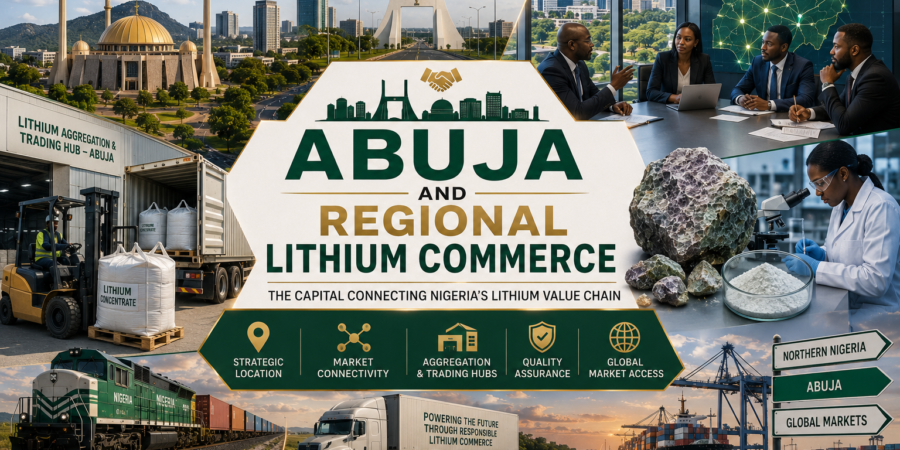
Abuja is not known as a mining city. Unlike many parts of Northern Nigeria, there are no major lithium mining communities within the Federal Capital Territory. The city is not known for mineral extraction, exploration camps, or artisanal mining activities. Yet Abuja is steadily becoming one of the most important locations in Nigeria’s emerging lithium economy. The reason is simple. Modern mineral industries are not built solely around mines. They are built around commerce. Every successful mining jurisdiction eventually develops a commercial center where decisions are made, investments are negotiated, procurement is coordinated, logistics are organized, and supply chains converge.
For Nigeria’s lithium industry, Abuja is increasingly assuming that role. As international attention shifts toward Nigeria’s battery minerals, the city is evolving into a regional commercial hub connecting mining communities across Northern Nigeria with domestic and international markets. This evolution is not accidental. Abuja occupies a strategic position within Nigeria’s political, administrative, and commercial landscape. It provides convenient access to many of the country’s emerging lithium-producing states while simultaneously serving as a meeting point for government agencies, investors, financial institutions, mining companies, consultants, logistics providers, and international business delegations. These characteristics make the city uniquely positioned to facilitate regional lithium commerce.
The distinction between mining and commerce is important. A lithium deposit creates the possibility of economic activity. Commerce transforms that possibility into business. Mining produces ore. Commerce creates contracts. Mining extracts resources. Commerce connects buyers and sellers. Mining generates supply. Commerce creates markets. Without commercial organization, even the richest mineral deposits struggle to achieve their full economic value. This is why commercial hubs play such an important role within global mining industries.
Across the world, major mining economies often rely on cities that coordinate rather than produce. These cities become centers for procurement, financing, legal services, logistics, technical consulting, commodity trading, insurance, quality assurance, and market intelligence. The mines may be hundreds of kilometers away. The commercial decisions are often made elsewhere. Abuja is gradually developing this type of role within Nigeria’s lithium sector. One of the city’s greatest advantages is its proximity to several important mining regions. States such as Nasarawa, Niger, Kogi, Kaduna, Plateau, and other parts of Northern Nigeria can be reached relatively efficiently from Abuja. This geographic position allows buyers, suppliers, aggregators, consultants, and investors to coordinate activities without necessarily operating directly within mining communities.
As the lithium industry expands, this accessibility is becoming increasingly valuable. The city also benefits from its concentration of professional services. Mining today is no longer simply about excavation. It is about contracts. Compliance. Investment. Due diligence. Environmental management. Laboratory analysis. Supply-chain management. Risk assessment. Commercial negotiations. These activities require lawyers, accountants, consultants, logistics specialists, financial advisers, technical experts, and market analysts. Abuja already possesses much of this professional infrastructure. This makes it an ideal location for coordinating complex commercial transactions.
Another reason Abuja is emerging as a regional lithium commerce hub is the growing international interest in Nigeria’s battery-mineral sector. Foreign buyers rarely begin their market assessment by travelling directly to mining communities. Instead, they typically seek meetings with consultants, procurement specialists, government institutions, logistics providers, and market facilitators capable of providing an overview of the industry before field visits are arranged. Abuja naturally serves this function. It provides a practical entry point into Nigeria’s mining sector. From the city, investors can evaluate opportunities, identify suppliers, conduct preliminary due diligence, and coordinate visits to mining locations across Northern Nigeria.
This role is becoming increasingly important as international procurement strategies evolve. Global buyers are no longer interested in isolated transactions. They are seeking structured sourcing relationships. They want verified suppliers. They want reliable logistics. They want transparency. They want professional representation within local markets. These requirements create demand for commercial institutions capable of connecting international capital with domestic supply.
The development of warehousing and aggregation activities further strengthens Abuja’s commercial importance. As lithium production expands across multiple states, commercial inventories increasingly need locations where material can be received, documented, sampled, verified, consolidated, and prepared for onward movement. While mining occurs in different regions, centralized commercial coordination improves efficiency for both buyers and suppliers. Abuja is well positioned to support these functions because of its accessibility and its role as a national business center.
Information is another critical component of regional commerce. Successful markets operate on reliable intelligence. Buyers require visibility into supplier capacity. Investors require knowledge of emerging opportunities. Mining companies require market analysis. Transport operators require shipment schedules. Procurement teams require inventory information. Without accurate information, commercial activity slows and uncertainty increases. This is why mining intelligence is becoming an essential part of the lithium economy. Data, market visibility, and commercial coordination are increasingly valuable assets. As Nigeria’s lithium industry matures, Abuja has the opportunity to become not only a trading hub but also an intelligence hub. A place where geological information meets commercial information. Where mining intersects with finance. Where local production connects with global demand. And where decisions shaping the future of Nigeria’s battery-mineral economy are increasingly made.
The Nigerian Mineral Exchange (NME) is actively contributing to this vision by operating as a commercial and market-intelligence platform connecting suppliers, buyers, aggregators, logistics providers, investors, processors, and procurement networks across Northern Nigeria. For international procurement groups, battery-material companies, commodity traders, mineral processors, manufacturers, and investors entering the Nigerian market, NME provides supplier identification, procurement coordination, aggregation support, logistics intelligence, supplier verification, due diligence support, and comprehensive supply-chain visibility.
NME also serves as a Foreign or International Buyer Representative in Nigeria, helping international organizations establish trusted local market presence through supplier engagement, commercial negotiations, sourcing coordination, logistics management, market-entry advisory services, and on-ground representation throughout Nigeria’s lithium-producing regions.
At the same time, NME works closely with miners, suppliers, warehouse operators, aggregators, logistics companies, and mining communities to build structured procurement networks that support long-term commercial partnerships between Nigerian suppliers and global buyers. Organizations seeking supplier verification, procurement coordination, logistics support, market-entry guidance, aggregation partnerships, or local buyer representation can engage NME directly through WhatsApp (+2348130799304).
Abuja’s importance within Nigeria’s lithium economy is not measured by the quantity of ore extracted within its boundaries. It is measured by the number of connections it creates. Connections between miners and markets. Between suppliers and buyers. Between investors and opportunities. Between Northern Nigeria’s mineral resources and the industries shaping the future of the global battery economy. That is the essence of regional commerce. And it is the role Abuja is increasingly positioned to play.
Related Articles
- Source Lithium Ore in Nigeria
- Sell Lithium Ore in Nigeria
- How to Source Lithium Ore in Nigeria in 2026
- How to Secure Large-Scale Lithium Ore Supply in Abuja: The NME Industrial Sourcing Guide
- Northern Nigeria Lithium Trade Ecosystem
- Why Lithium Investors Are Watching Northern Nigeria
- How Lithium Ore Is Measured and Verified
- Lithium Mining Investments in Northern Nigeria
- Can Nigeria Become Africa’s Lithium Powerhouse?
- Why Local Partnerships Matter in Lithium Trade
- Future Lithium Trade Routes Across Nigeria
- Security Considerations in Lithium Operations
- Lithium and Electric Vehicle Demand
- Northern Nigeria’s Lithium Mining Corridors
- Lithium Trade in Kano State
- Niger State and the Nigerian Lithium Economy
- Lithium and Energy Storage Technologies
- Nigeria’s Emerging Battery Minerals Economy



Leave a Reply