
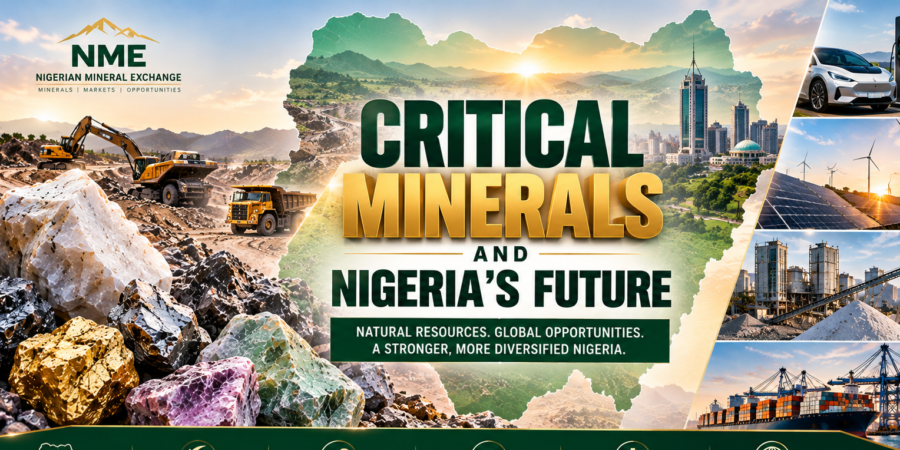
A profound shift is taking place in the global economy. For much of the twentieth century, economic power was often associated with oil fields, manufacturing centers, transportation networks, and financial institutions. These assets remain important, but a new layer of strategic importance is emerging beneath them. Minerals. Not just any minerals, but a specific category increasingly referred to as critical minerals.
These are the minerals considered essential for economic security, industrial development, technological advancement, energy systems, and national competitiveness. Around the world, governments are developing critical mineral strategies, investors are repositioning capital, manufacturers are securing supply chains, and countries are reassessing the strategic value of their natural resources.
In many ways, critical minerals are becoming the building blocks of the twenty-first-century economy. For Nigeria, this global transformation presents both an opportunity and a challenge. The opportunity lies in the country’s geological potential. The challenge lies in determining how that potential can be converted into long-term economic value. The conversation is no longer simply about mining. It is about positioning Nigeria within the industrial architecture of the future.
Critical minerals include a range of resources that support modern technologies and industrial systems. Depending on the jurisdiction, lists may vary, but they commonly include minerals associated with batteries, renewable energy infrastructure, advanced electronics, defense technologies, telecommunications systems, and industrial manufacturing. Lithium has emerged as one of the most visible examples. Its role in battery technologies has elevated it from a relatively specialized industrial mineral to a globally strategic resource. However, lithium is only one part of a broader critical-mineral landscape that includes numerous other commodities supporting the energy transition and advanced manufacturing.
This broader perspective is important because it changes how mining is viewed. Traditionally, mineral extraction was often considered a standalone industry. Today, critical minerals are increasingly viewed as components of interconnected industrial ecosystems. The value of a mineral is no longer determined solely by its geological characteristics. It is also influenced by its role within larger supply chains. This shift has profound implications for countries like Nigeria. The question is no longer: “What minerals does Nigeria possess?” The more important question is: “How can Nigeria position itself within the global supply chains built around those minerals?” The answer will likely shape the future of the mining sector for decades to come.
Nigeria enters this conversation with several important advantages. The country possesses significant mineral diversity, a large domestic market, a strategic geographic position, an expanding entrepreneurial ecosystem, and growing international attention. These factors create opportunities that extend beyond extraction.
In the emerging critical-mineral economy, value increasingly accumulates around ecosystems rather than isolated activities. Mining remains important, but so do processing, aggregation, logistics, market intelligence, technology, procurement, research, training, and industrial development. Countries that build capabilities across multiple stages of the value chain often capture greater long-term benefits than those focused exclusively on resource extraction.
This reality is particularly relevant for lithium. Much of the global discussion surrounding lithium focuses on electric vehicles and batteries. Yet batteries themselves represent only the visible end of a vast industrial network involving exploration, mining, transportation, processing, refining, manufacturing, logistics, and international trade. Every stage of that network creates economic opportunities. Nigeria’s future participation in the critical-mineral economy will depend on how effectively it engages with these broader opportunities. One of the most significant opportunities may lie in knowledge.
Critical minerals are creating demand not only for raw materials but also for information, intelligence, data, expertise, and coordination. Investors require market intelligence. Buyers require supplier visibility. Governments require resource data. Manufacturers require supply-chain transparency. The countries and organizations capable of providing these capabilities often become influential participants within the ecosystem, even when they are not the largest producers.
This observation is particularly relevant to the work being undertaken across the Nigerian mining sector today. Information is increasingly becoming infrastructure. Market intelligence is becoming infrastructure. Supply-chain visibility is becoming infrastructure. Resource databases are becoming infrastructure. In many ways, the future critical-mineral economy will be built as much on information systems as on physical assets. This is one reason the race for critical minerals is simultaneously a race for knowledge.
Another important dimension of Nigeria’s future relates to industrialization. Around the world, countries are seeking ways to move beyond the export of raw materials and participate more actively in value-added industries. The objective is not merely to produce minerals but to create economic activity around them. Critical minerals provide an opportunity to pursue this objective because they sit at the center of some of the fastest-growing industrial sectors in the world. The challenge is ensuring that resource development supports broader economic transformation rather than functioning as an isolated activity.
Fortunately, Nigeria possesses several structural advantages that can support this ambition. Its population creates a large labor force and consumer market. Its entrepreneurial culture supports innovation. Its strategic location strengthens access to regional markets. And its growing mining sector provides a foundation upon which additional industries can be built. The future of critical minerals in Nigeria therefore extends beyond geology. It touches manufacturing. It touches technology. It touches education. It touches infrastructure. And it touches national development.
This broader perspective also helps explain why governments around the world increasingly treat critical minerals as strategic assets. They are not merely commodities. They are inputs into future industries. The countries that understand this distinction often make different decisions about investment, policy, infrastructure, and industrial development.
Nigeria now has an opportunity to do the same. The country’s future role in the global critical-mineral economy will not be determined solely by the quantity of resources beneath the ground. It will be determined by the systems built around those resources. Those systems include supply chains, processing facilities, logistics networks, knowledge platforms, procurement structures, research capabilities, and commercial institutions. The stronger these systems become, the greater Nigeria’s ability to capture value from its mineral wealth.
The Nigerian Mineral Exchange (NME) is actively contributing to this emerging ecosystem by helping connect suppliers, buyers, aggregators, logistics providers, investors, processors, and procurement networks across Nigeria’s growing critical-mineral sector.
For international procurement groups, battery-material companies, commodity traders, mineral processors, manufacturers, and investors evaluating opportunities in Nigeria, NME provides support in supplier identification, procurement coordination, aggregation access, market intelligence, and supply-chain visibility.
NME also serves as a Foreign Buyer Representative and International Buyer Representative in Nigeria, helping international organizations establish trusted local market presence through supplier engagement, due diligence, sourcing coordination, logistics intelligence, procurement support, market-entry assistance, and on-ground representation. This enables foreign buyers and investors to navigate Nigeria’s evolving critical-mineral landscape while building informed sourcing and investment strategies.
At the same time, NME continues to work with suppliers, mining companies, aggregators, and industry stakeholders across Nigeria who are seeking access to serious buyers, structured procurement opportunities, and long-term commercial partnerships. Organizations seeking sourcing support, supplier verification, procurement coordination, market-entry guidance, aggregation partnerships, or local buyer representation can engage NME directly through WhatsApp (+2348130799304).
The future of critical minerals is not simply about what lies beneath the earth. It is about what nations choose to build above it. For Nigeria, the opportunity is larger than lithium. It is larger than mining. It is even larger than critical minerals themselves. The real opportunity is to participate in the construction of the industrial systems that will shape the global economy for decades to come. And that may ultimately prove to be the country’s most valuable resource of all.
Related Articles
- Source Lithium Ore in Nigeria
- Sell Lithium Ore in Nigeria
- Abuja and Regional Lithium Commerce in Nigeria
- Environmental Challenges of Lithium Mining in Nigeria
- Logistics Challenges Across Northern Nigeria’s Lithium Trade
- Lithium Mining in Nasarawa State
- The Global Lithium Race Explained
- How to Source Lithium Ore in Nigeria in 2026
- State-by-State Lithium Opportunities in Nigeria
- How to Secure Large-Scale Lithium Ore Supply in Abuja: The NME Industrial Sourcing Guide
- Northern Nigeria Lithium Trade Ecosystem
- Lithium Transportation Corridors in Northern Nigeria
- Why Lithium Investors Are Watching Northern Nigeria
- Lithium Mining Investments in Northern Nigeria
- Can Nigeria Become Africa’s Lithium Powerhouse?
- Lithium Deposits in Kogi State
- Why Local Partnerships Matter in Lithium Trade
- Future Lithium Trade Routes Across Nigeria
- Security Considerations in Lithium Operations
- Northern Nigeria’s Lithium Mining Corridors
- Lithium Trade in Kano State
- Niger State and the Nigerian Lithium Economy
- Lithium and Energy Storage Technologies
- Nigeria’s Emerging Battery Minerals Economy
Leave a Reply