
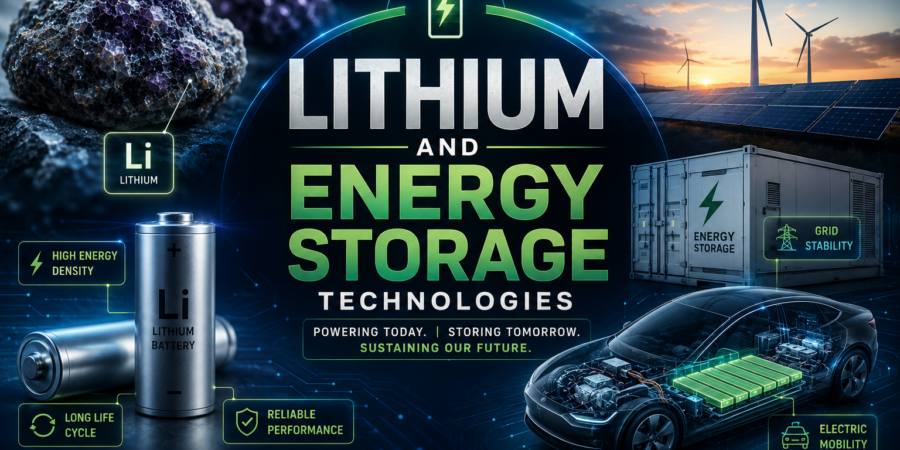
If electric vehicles explain part of the global lithium story, energy storage technologies explain the rest. Much of the public discussion surrounding lithium focuses on cars, buses, and transportation systems. Images of electric vehicles often dominate media coverage of the battery revolution. Yet one of the most important drivers of future lithium demand may be less visible. It is not found on highways. It is found inside power systems.
Across the world, governments, utilities, industries, and technology companies are investing heavily in energy storage. As renewable energy expands and electricity systems become more complex, the ability to store energy is becoming increasingly valuable. This is where lithium and energy storage technologies intersect. The relationship is reshaping not only the energy sector but also the global mining industry. To understand why, it is important to appreciate one of the biggest challenges facing modern electricity systems. Electricity must generally be consumed when it is produced. Unlike water, which can be stored in reservoirs, or fuel, which can be stored in tanks, electricity has traditionally been difficult to store on a large scale.
For decades, this limitation shaped how energy systems were designed. Power plants generated electricity. Consumers used it. The system functioned largely in real time. The rise of renewable energy has changed this equation. Solar and wind power are becoming increasingly important components of national energy strategies around the world. These technologies offer numerous advantages, but they also introduce a challenge. The sun does not shine continuously. The wind does not blow consistently. As a result, electricity generation can fluctuate even when demand remains constant. Energy storage technologies help bridge this gap.
By storing electricity when production exceeds demand and releasing it when needed, energy storage systems improve reliability, flexibility, and efficiency across power networks. In many respects, energy storage has become one of the key enabling technologies of the renewable-energy transition. And lithium has become one of the key enabling minerals behind energy storage. This connection helps explain why lithium is increasingly viewed as a strategic resource. The mineral is no longer important solely because of transportation. It is also becoming important because of the future architecture of electricity itself.
Around the world, utility companies, governments, industrial facilities, commercial enterprises, and infrastructure operators are investing in battery-storage projects. These systems help stabilize electricity networks, improve energy security, support renewable-energy integration, and provide backup power during disruptions. As deployment expands, demand for battery materials expands as well. The significance of this trend cannot be overstated. Electric vehicles represent one source of lithium demand. Energy storage technologies represent another. Together, they are creating a powerful demand foundation for the broader battery economy.
This is one reason why lithium has become central to discussions about future energy systems. The world is not merely electrifying transportation. It is also transforming the way electricity is generated, stored, distributed, and consumed. Energy storage sits at the center of that transformation. The implications extend far beyond developed economies. Many emerging markets face challenges relating to energy reliability, grid stability, and access to electricity. Energy storage technologies may play an increasingly important role in addressing these challenges by helping improve power availability and system resilience.
This creates opportunities for battery technologies in regions where reliable energy access remains a priority for economic development. Africa is particularly relevant within this conversation. The continent possesses enormous renewable-energy potential, significant demand for infrastructure development, and growing interest in energy security. As energy systems evolve, battery-storage technologies are likely to become increasingly important across many African markets. This broader context helps explain why global interest in battery minerals continues to expand.
The future demand for lithium is not dependent on a single industry. Instead, it is supported by multiple long-term trends occurring simultaneously. Transportation is becoming more electrified. Energy systems are becoming more storage-intensive. Industries are becoming more technologically sophisticated. And infrastructure is becoming increasingly dependent on reliable energy management. Each of these trends reinforces the strategic importance of lithium.
For Nigeria, this creates opportunities that extend beyond mining. The country’s growing lithium sector exists within a much larger global transformation. As energy-storage technologies expand, the importance of battery-mineral supply chains is likely to increase. This means opportunities may emerge not only in extraction but also in aggregation, logistics, procurement, market intelligence, processing, trade facilitation, investment support,
and supply-chain coordination. These activities form the commercial infrastructure connecting mineral resources to global energy systems. This perspective is important because it highlights the true scale of the opportunity. Lithium is not simply feeding a mining industry. It is feeding an energy revolution. The countries that successfully position themselves within this ecosystem may benefit from some of the most significant industrial developments of the coming decades.
Another important aspect of energy storage is its long-term nature. Unlike many commodity cycles driven by temporary market conditions, the growth of energy storage is closely linked to structural changes in how economies generate and manage power. As renewable-energy deployment expands and electricity demand increases, the need for storage solutions is likely to remain an important strategic priority. This provides a strong foundation for continued interest in battery minerals. The future energy system will require more than power generation. It will require energy management. And energy management increasingly requires storage.
The Nigerian Mineral Exchange (NME) is actively supporting the development of this ecosystem by connecting suppliers, buyers, aggregators, logistics providers, investors, processors, and procurement networks across Nigeria’s growing lithium sector.
For international procurement groups, battery-material companies, commodity traders, mineral processors, energy-storage supply-chain participants, and investors evaluating opportunities in Nigeria, NME provides support in supplier identification, procurement coordination, aggregation access, market intelligence, supplier verification, and supply-chain visibility.
NME also serves as a Foreign or International Buyer Representative in Nigeria, helping international organizations establish trusted local market presence through supplier engagement, due diligence, sourcing coordination, logistics intelligence, procurement support, market-entry assistance, and on-ground representation. This enables foreign buyers and investors to navigate Nigeria’s emerging lithium ecosystem while developing informed sourcing and investment strategies.
At the same time, NME continues to work with suppliers, mining companies, aggregators, and industry stakeholders across Nigeria who are seeking access to serious buyers, structured procurement opportunities, and long-term commercial partnerships.
Organizations and individuals seeking lithium ore buyers, sourcing support, supplier verification, procurement coordination, market-entry guidance, aggregation partnerships, or local buyer representation can engage NME directly through WhatsApp (+2348130799304).
The future of lithium is often associated with electric vehicles. Yet the larger story may be even more profound. Lithium is becoming an essential component of how the world stores energy. And in a future increasingly powered by renewable resources, the ability to store energy may prove just as important as the ability to generate it.
Related Articles
- Source Lithium Ore in Nigeria
- Sell Lithium Ore in Nigeria
- How to Source Lithium Ore in Nigeria in 2026
- How to Secure Large-Scale Lithium Ore Supply in Abuja: The NME Industrial Sourcing Guide
- We Are Buying Lithium Ore in Nigeria (From 1% Li₂O and Above) | Abuja Warehouse
- Lithium Pricing Mistakes Suppliers Make in Nigeria
- How Buyers Negotiate Lithium Prices in Nigeria
- How Global Lithium Demand Affects Nigerian Prices
- Spot Market vs Contract Lithium Prices in Nigeria
- What Makes Lithium Ore More Valuable?
- Factors Affecting Lithium Ore Prices in Nigeria
- Why Local Partnerships Matter in Lithium Trade
- Developing Sustainable Lithium Supply Networks in Nigeria
- Lithium Procurement Strategy for Foreign Buyers in Nigeria
- Nigeria’s Emerging Battery Minerals Economy
Leave a Reply