
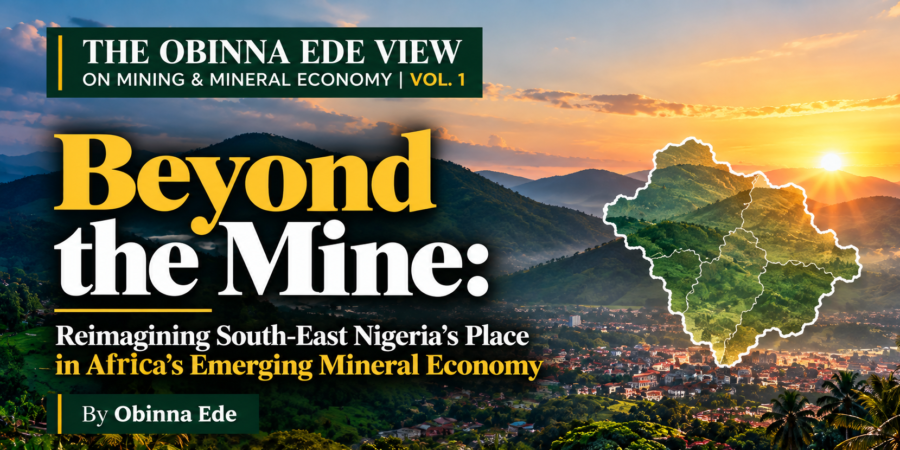
THE OBINNA EDE VIEW ON MINING & MINERAL ECONOMY | VOL. 1
A Strategic Perspective on the South-East Region’s Place in Nigeria’s Emerging Mineral Economy
By Obinna Ede
Mining Ecosystem Development Strategist, Founder & System Architect of the Nigerian Mineral Exchange (NME)
The South-East does not need to become Nigeria’s biggest mining province. It needs to become one of Nigeria’s most important mineral-economy regions.
There is a conversation about mining in Nigeria that needs to change. It is a conversation that has remained trapped in the ground. Where are the minerals? Who owns the mineral title? Who has the mining lease? How many tons can be extracted? How much can the government collect in royalties? How much of the ore can be exported?
These are legitimate questions. But they are not sufficient questions for a country entering a period in which minerals are becoming increasingly important to energy, technology, manufacturing, infrastructure, geopolitics and industrial competitiveness. Mining is no longer simply about taking something from beneath the earth and selling it. It is about building an economic system around the mineral.
That distinction is particularly important for South-East Nigeria. The five states of Abia, Anambra, Ebonyi, Enugu and Imo are not generally regarded as Nigeria’s great mining frontier. Northern Nigeria dominates much of the country’s current conversation around gold, lithium and other minerals. The South-West is increasingly appearing on the mineral-trade and lithium map. Nasarawa and other parts of North-Central Nigeria are developing increasingly important mining, aggregation and processing activities.
The South-East, meanwhile, possesses mineral resources of its own, including lead-zinc, limestone, coal, clay, kaolin, glass sand, gypsum and other industrial and metallic minerals documented by Nigeria’s geological authorities. Ebonyi, in particular, has a significant lead-zinc geological story, while official geological work continues to identify mineralized structures and investment targets across the zone.
Yet the bigger opportunity for the South-East may not lie in becoming another region of pits, excavators and ore trucks. It may lie in becoming something far more consequential: a major node in Nigeria’s emerging mineral value chain. And that requires a fundamental change in how the region thinks about mining.
The mining industry is bigger than the mine
There is a persistent mental picture of mining in Nigeria. A deposit is discovered. Someone obtains a mining title. An excavator enters the site. Ore is dug out. A truck carries it away. A buyer pays. Perhaps the mineral is exported. End of story.
That is not a mining economy. That is only the beginning of one. A modern mineral economy stretches across an extraordinarily long chain: geological intelligence, exploration, drilling, mine development, extraction, aggregation, transportation, warehousing, sampling, assaying, beneficiation, processing, refining, manufacturing, equipment supply, engineering, technology, finance, insurance, certification, environmental management, workforce development, commodity trading, market intelligence, export services and eventually recycling and circular-economy activities.
Each link can create businesses. Each link can create jobs. Each link can create intellectual property. Each link can generate taxes and commercial activity. Each link can produce entrepreneurs. And each link can become the basis of an industrial strategy.
This is not merely a theoretical argument. African development institutions are increasingly framing the continent’s mineral opportunity precisely in these terms. In 2026, the African Development Bank convened African governments and institutions around critical-mineral value chains and beneficiation, explicitly linking minerals with industrialization, infrastructure, digitalization, job creation and regional economic resilience. The Bank has also stressed the need to move beyond extraction into processing, manufacturing and regional value chains.
The implication is profound. The future mining economy will not be divided simply between mining states and non-mining states. There will increasingly be resource-producing jurisdictions, processing jurisdictions, manufacturing jurisdictions, logistics jurisdictions, technology jurisdictions, knowledge jurisdictions, financial jurisdictions and commercial jurisdictions. And some places will occupy several positions simultaneously. South-East Nigeria should be thinking about where it wants to sit.
The question is no longer: Where is the mineral?
This is where the South-East needs to begin thinking differently. Suppose a lithium deposit is located in a community hundreds of kilometers away in Kebbi State. Does that mean the economic opportunity belongs only to the State where the lithium is located? Of course not. Someone must explore it. Someone must finance exploration. Someone must provide geological services. Someone must drill. Someone must supply equipment. Someone must aggregate the material. Someone must test and certify it. Someone must transport it. Someone must warehouse it. Someone must process it. Someone must finance the inventory. Someone must insure the cargo. Someone must build the processing plant.
Someone must manufacture equipment for the plant. Someone must develop the software that tracks the material. Someone must recruit and train the workforce. Someone must connect the producer with buyers. Someone must provide market intelligence. Someone must manage environmental compliance. Someone must provide legal, accounting and engineering services. Someone must ultimately manufacture products from the processed material.
The mine may be in one state. The economy around the mine can spread across many states. That is the opportunity. The strategic question for the South-East should therefore not be: “How many large mineral deposits do we have?” It should be: “What parts of Nigeria’s mineral economy can we become exceptionally good at?” That is a much more entrepreneurial question.
The global lithium race teaches an important lesson
Consider lithium. The global conversation around lithium is often presented as a competition for deposits. But the deeper competition is over industrial position. As I argued in The Global Lithium Race Explained, the contest is ultimately not just about who possesses lithium but who can build the ecosystems around it: exploration, aggregation, processing, logistics, technology, market intelligence, manufacturing and supply-chain coordination.
That lesson extends far beyond lithium. A country can possess enormous mineral resources and still capture surprisingly little economic value if it remains primarily an exporter of raw materials. Conversely, a jurisdiction without the largest deposits can capture substantial value by becoming a processing, manufacturing, technology, logistics or commercial center.
Africa is currently wrestling with precisely this problem. The African Development Bank has noted that much of the continent’s mineral output continues to leave Africa with limited processing, and has emphasized local value addition and industrialization as a means of retaining more economic value on the continent. So when the world enters a new mineral cycle, the question is not simply who has the rocks. It is: Who has the ecosystem? That is where the South-East should begin.
South-East Nigeria has a peculiar advantage
The South-East has something that cannot easily be created by government decree. It has a deeply rooted entrepreneurial culture. Across generations, people from the region have built businesses in manufacturing, commerce, transportation, distribution, engineering, construction, finance and trade. The region has also developed important centers of commercial and industrial activity. That entrepreneurial DNA should be brought into the mineral economy.
Mining should not be presented to the South-East as an entirely foreign industry requiring everyone to become a mine owner. It should be presented as the next industrial system into which existing entrepreneurial capabilities can plug. This distinction matters. A businessman who understands distribution can become a mineral logistics entrepreneur. An industrialist, like Innoson, can manufacture mining equipment.
A banker can develop mineral-finance products. An engineer can build processing machinery. A software developer can build mineral-traceability systems. A university can develop mining and mineral-processing research programs. A laboratory can provide assaying and certification. A transport company can specialize in mineral logistics. A lawyer can specialize in mineral transactions. An investor can finance aggregation. A manufacturer can consume processed minerals. A trader can build mineral procurement networks. A young graduate can become a GIS analyst, drone operator, data scientist or mining-technology entrepreneur. None of these people needs to own a mine. And that is precisely the point.
The industrial contradiction in South East
There is another question the South-East must confront. The region wants to be industrial. It has a long history of manufacturing and commerce and possesses an entrepreneurial population capable of building businesses under difficult conditions. But what does industry consume? Raw materials: metals, minerals, industrial minerals, energy, chemicals, construction materials, and specialty materials.
If a region builds downstream industries while remaining disconnected from the upstream mineral economy that supplies those industries, it leaves a strategic vulnerability in its own industrial architecture. Imagine building a manufacturing economy while somebody else controls the knowledge, sourcing networks, processing infrastructure and supply chains for many of the raw materials your industries need. That is not necessarily fatal, but it amounts to a strategic weakness created by one’s own choices.
The South-East therefore needs to begin asking a more sophisticated industrial question: What mineral inputs does our industrial economy consume, where do they come from, who mines them, who processes them, and what part of that supply chain can we capture? This is how mining policy becomes industrial policy. And industrial policy becomes economic strategy.
Aba and Nnewi should not be looking at mining from the outside
Consider Aba and Nnewi. The two cities are widely associated with manufacturing, entrepreneurship and an extraordinary culture of commercial production, but they have developed different areas of industrial strength. Nnewi has built a formidable reputation around vehicle manufacturing, engineering, machinery, spare parts and industrial production. At the same time, Aba is particularly renowned for its leather products, shoes, bags, clothing and a vast ecosystem of small and medium-scale manufacturers. The question, therefore, is not whether these cities can suddenly become mining-equipment manufacturing centres. It is whether they can identify the enormous markets within the mining economy that naturally align with what they already know how to produce.
Consider personal protective equipment alone. A modern mining operation requires an enormous and continuously replenished range of protective gear: safety boots, helmets, overalls, gloves, reflective vests, protective clothing, safety goggles, masks, ear protection, rainwear, workwear and many other specialized items. Multiply these requirements across thousands of mines, quarries, processing plants, exploration companies, contractors and mineral logistics operators, and the market becomes substantial. Aba, with its established footwear, leather, garment and apparel manufacturing ecosystem, could potentially develop into a major African production centre for mining workwear and protective gear. Instead of simply making shoes and clothing for general consumers, manufacturers could develop specialized industrial boots, reinforced workwear, high-visibility garments, gloves and other mining-specific protective products for the Nigerian and wider African markets.
Nnewi presents a different but complementary opportunity. Its established reputation in vehicle manufacturing, engineering, spare parts, machinery and industrial production gives the city a natural point of entry into the mining-equipment and mining-services market. Mining depends heavily on vehicles, haulage systems, mechanical components, power systems, pumps, maintenance equipment, workshop machinery and other engineering products. Nnewi’s industrial ecosystem could therefore look beyond the traditional automotive and spare-parts markets and identify the equipment, components and maintenance needs that mining companies across Nigeria and Africa increasingly require.
This is how the South-East can enter the mining economy intelligently: not by trying to become something it is not, but by connecting what it already does exceptionally well to the rapidly expanding needs of the mineral industry. Aba does not need to become a mining town, and Nnewi does not need to become a mining jurisdiction. They can become suppliers to the mining economy. And once that connection is made, mining is no longer an industry happening somewhere in a distant community. It becomes a vast new market for South-East manufacturing power.
Ebonyi demonstrates why extraction alone is not enough
Ebonyi provides perhaps the clearest entry point. The state’s geological resources include lead-zinc, limestone, and a range of other minerals; and the Nigerian Geological Survey Agency has undertaken geological and geophysical work in the state specifically relevant to mineral exploration. Its regional gravity work has identified structures of interest and highlighted opportunities for further investigation relating to lead-zinc, baryte, limestone and other resources.
But imagine if the conversation about Ebonyi’s lead-zinc industry went beyond: “How much lead-zinc can Ebonyi mine?” What if the question became: “How much of the lead-zinc value chain can the South-East build around Ebonyi?” That immediately creates a different thought process and agenda. Ore characterization, aggregation, concentration, beneficiation, processing, laboratories, and industrial minerals trading. Other value chain along the line includes, metal and chemical production, manufacturing, recycling, technical services, environmental management, workforce training, research, logistics, and finance. The mine becomes an anchor. The economy is everything around it.
Enugu has another role to play
Enugu’s mining history and geological profile give it an interesting position, but its greatest strategic asset may not be the coal or other minerals, but its human and institutional capital. The Nigerian Geological Survey Agency’s work in Enugu has included regional gravity surveying that identified mineralized structures and areas of interest for further investigation. The state’s geological map also records a range of mineral resources, including coal, limestone, glass sand, clay, kaolin, gypsum and iron-related occurrences.
But Enugu does not have to define its mining future solely through extraction. It could become a center for: mineral research, mining engineering, geospatial technology, mineral processing, environmental services, professional training and mining innovation. This is particularly important because the mineral economy of tomorrow will require much more than manual labour. It will require geoscientists who understand data. Engineers who understand automation. Software developers who understand geological systems. Environmental scientists who understand mine rehabilitation. Technicians who understand processing machinery. Entrepreneurs who understand commodity markets. Universities that understand the future of industrial materials. The South-East should be preparing this workforce before the demand becomes overwhelming.
Anambra has another strategic asset: commercial intelligence
Anambra’s commercial culture presents another opportunity. Mineral markets are not simply physical markets. They are information markets. Who has material? What grade? What quantity? What specification? Where is it? Is it legally sourced? Has it been tested? Who can process it? Who is buying? What is the prevailing price? What are the transport costs? What are the export requirements? Can the material be financed? Can the transaction be insured? Can the supplier deliver consistently?
In an increasingly sophisticated mineral economy, trusted information becomes infrastructure. This is why mineral marketplaces, commodity intelligence platforms, traceability systems, digital procurement networks and mineral-data businesses will become increasingly important. The South-East’s commercial culture should not overlook this opportunity. The next generation of mineral entrepreneurs will not carry shovels and diggers. They will carry laptops.
Imo can participate through technology, services and processing
Imo, too, should not be trapped in the question of whether it possesses a mineral deposit large enough to justify a mining identity. The Nigerian Geological Survey Agency has specifically identified high-grade kaolin and marcasite exploration in Imo State, placing the state within Nigeria’s broader industrial-mineral exploration landscape. These are not necessarily the kinds of resources that will suddenly transform Imo into a giant mining province, but they demonstrate an important point: the state already has a geological basis from which to build a broader mineral economy.
But the deeper opportunity for Imo may lie beyond extraction. The state possesses an important technological asset in the Federal University of Technology, Owerri (FUTO), one of Nigeria’s leading technology-focused institutions and the first university of technology established in the country. Its academic ecosystem includes geology, metallurgical and materials engineering, chemical engineering, environmental management, surveying and geoinformatics, information technology, logistics and supply-chain management, among other disciplines that intersect naturally with the modern mineral economy.
This creates an interesting possibility. Imo could deliberately position itself as a technical and knowledge-services hub for Nigeria’s mineral economy. Mining companies increasingly need geological and geospatial services, mineral testing, engineering design, materials expertise, environmental assessment, processing research, equipment maintenance, supply-chain management and digital systems. These are precisely the kinds of capabilities that can grow around universities, laboratories, engineering firms and technology companies. The mineral does not have to be beneath the office building for the business to participate in the mineral economy.
Take mineral processing. Nigeria’s challenge is increasingly moving from simply identifying and extracting minerals to finding ways of processing more of them domestically and developing industries around them. The NGSA has itself partnered with the National Agency for Science and Engineering Infrastructure (NASENI) around the domestication of mineral processing and the development of local manufacturing, reflecting the wider policy direction toward retaining more value within Nigeria. Imo could position itself within that transition by encouraging companies and research institutions to develop practical processing technologies for industrial minerals, materials testing, beneficiation and mineral-based products.
The opportunity also extends into mining technology and digital services. Modern exploration increasingly depends on geospatial data, remote sensing, geophysics, geochemistry, drilling data and digital geological information. The NGSA itself provides services spanning geological mapping, geophysical and geochemical surveys, remote sensing, laboratory services, drilling and environmental work, demonstrating how broad the technical services surrounding mineral development have become. Imo’s technology ecosystem could produce private companies capable of serving these needs, not only within the state, but across Nigeria and eventually across Africa.
There is also a workforce opportunity. A serious mineral economy requires geologists, metallurgists, materials engineers, chemical engineers, environmental specialists, GIS professionals, surveyors, data analysts, laboratory technicians, equipment technicians, logistics managers and technology entrepreneurs. Imo can train people for these roles even when the mines themselves are located elsewhere. Indeed, the existence of such a technical ecosystem means that a graduate trained in Owerri could work on a lithium project in Nasarawa, a lead-zinc operation in Ebonyi, a gold project in the North-West or a mineral-processing plant anywhere in Africa.
This is the kind of thinking that can turn Imo’s apparent disadvantage into an advantage. The state does not have to compete for the title of Nigeria’s biggest lithium mining jurisdiction. It can compete to become one of the places where Nigeria’s mining industry obtains the knowledge, technology, technical services and processing expertise it needs. The mine may be somewhere else. The engineers can be in Imo. The laboratory can be in Imo. The software company can be in Imo. The research team can be in Imo. The processing technology can be developed in Imo. The next generation of mineral-economy professionals can be trained in Imo.
That is the broader lesson. Industries do not always need to sit directly on top of the mineral deposit. What matters is whether a region can identify the valuable functions surrounding the mineral and build competitive capabilities around them. For Imo, the opportunity may therefore be less about becoming a landscape of mines and more about becoming part of the intellectual, technological, technical and processing infrastructure that makes Nigeria’s emerging mineral economy work.
The Five states should stop thinking as five isolated economies
This may be the most important policy idea in the entire argument. Abia, Anambra, Ebonyi, Enugu and Imo should not necessarily compete with one another to become the mining state of the South-East. They should ask a different question: What would happen if the five states functioned as one regional mineral-economic system? Imagine a regional architecture in which:
Ebonyi strengthens mineral production, beneficiation and mineral-based industrial activity.
Enugu develops mining research, technical education, engineering and mineral technology.
Abia leverages manufacturing and fabrication capabilities to serve mining and processing industries.
Anambra develops mining equipment manufacturing, mineral commerce, trading, distribution, finance and entrepreneurial networks.
Imo strengthens technical services, processing, research, innovation and supporting industries.
These are not rigid assignments. They are strategic possibilities. The point is not to divide the mining industry into five boxes. The point is to recognize that regional economic systems become stronger when different locations specialize and connect. One state does not need to do everything. The region can build a network.
The logistics opportunity is bigger than it appears
Minerals move. That simple fact creates an enormous industry. If production expands in Northern Nigeria, material must move toward aggregation centers, processors, industrial consumers and export channels. If mineral processing expands in North-Central Nigeria, inputs and finished materials need transportation. If manufacturing expands in the South-East, industrial inputs need to arrive reliably. That creates opportunities for: warehousing, haulage, fleet management, mineral cargo handling, inventory management, weighing and measurement, insurance, route intelligence, security, digital tracking, quality verification, and trade finance.
The mineral economy is therefore also a logistics economy. The African Development Bank and other multilateral institutions are increasingly emphasizing corridor-based approaches that connect mining areas with processing hubs and markets because infrastructure and logistics are fundamental to building competitive mineral value chains. South-East Nigeria should not wait for someone else to define those corridors. It should study them.
The technology opportunity may be the most valuable of all
There is an even more interesting frontier. What if the South-East became one of Nigeria’s centers for mining technology? Consider the possibilities. Artificial intelligence for geological interpretation. GIS and remote sensing. Drone-based exploration. Digital mine management. Mineral traceability. Supply-chain verification. Digital mineral marketplaces. Commodity intelligence. Automated sampling systems. Environmental monitoring. Mine-safety technology. Fleet optimization. Mineral laboratory information systems. Geological data platforms. Predictive maintenance. Processing optimization. Etc.
The Nigerian Geological Survey Agency itself is investing in integrated geoscience information, including remote sensing, geological, geochemical and geophysical data, because credible geological information is fundamental to investment and mineral development. This should tell us something: data is becoming part of the mineral economy.
The South-East has no geological reason why it cannot participate in that economy. A software company in Enugu can build mining technology for a mine in Zamfara. An engineering firm in Aba can build equipment for a lithium processor in Nasarawa. A trading company in Onitsha can aggregate minerals produced hundreds of kilometers away in Bauchi. A university in the region can develop processing technology for a mineral occurring in another state. Geography does not have to be destiny.
Workforce development is itself a mining industry
There is another misconception worth killing. When governments talk about mining employment, they often imagine miners. But a sophisticated mineral economy needs an enormous range of professionals. Geologists. Mining engineers. Metallurgists. Geophysicists. Geochemists. GIS specialists. Remote-sensing analysts. Drone operators. Data scientists. Software engineers. Mechanical engineers. Electrical engineers. Welders. Fabricators. Laboratory analysts. Environmental scientists.
It also demands health and safety professionals. Logistics managers. Commodity traders. Procurement specialists. Financial analysts. Insurance professionals. Lawyers. Accountants. Export specialists. ESG professionals. Researchers. Technical journalists. Digital marketers. The list goes on. That means a regional mineral strategy can become a workforce-development strategy. And that is exactly the kind of economic multiplier a region like the South-East should be interested in.
Then there is capital
Mining is capital intensive. But the financing opportunity is much larger than financing mines. There is equipment finance. Inventory finance. Trade finance. Warehouse finance. Receivables finance. Export finance. Processing-plant finance. Logistics finance. Insurance. Private equity. Venture capital for mining technology. Working capital for mineral aggregation. The South-East has produced generations of entrepreneurs and commercial investors. Why should its capital remain largely outside the mineral economy?
There is no reason every investor needs to buy a mining lease. An investor might instead finance a processing plant. Or a mineral laboratory. Or a fleet. Or an equipment manufacturer. Or a mineral marketplace. Or a warehouse. Or a mineral-traceability company. Or a regional mineral trading business. This is where mining becomes commerce.
The billionaire question
Perhaps this is where the conversation becomes uncomfortable. The South-East has produced extraordinarily successful entrepreneurs and billionaires. Some have built manufacturing empires. Some have built trading networks. Some have built financial institutions. Some have built telecommunications and technology businesses. Some have built construction and industrial companies. And some have built massive hospitality empires.
But where are the major South-East mineral houses? Where are the companies that say: We are building Nigeria’s largest mineral-processing group. We are building West Africa’s mining-equipment company. We are building Africa’s mineral logistics network. We are building the region’s mineral-finance platform. We are building a battery-materials company. We are building a continental mineral-trading company.
There are certainly businesses and individuals participating in mining across the region. The argument is not that nobody is involved. The argument is that the scale of participation does not yet match the scale of the opportunity. That should change. The emerging global mineral economy is too important to be left entirely to foreign mining companies, traditional commodity traders and entrepreneurs from other parts of the country. South-East capital should enter the room.
But the region must not repeat Africa’s old mistake
There is an important warning here. The answer is not simply to rush into mining and repeat the extractive model. The South-East should not seek to become another region that digs, trucks and exports. That would miss the point. The region should pursue strategic participation across the value chain.
The objective should be: more value captured locally, more skills developed locally, more technology created locally, more businesses built locally, more industrial inputs produced locally, and more regional economic linkages created locally. That is the difference between having a mining industry and having a mineral economy.
What should South-East governments actually do?
This argument is not a call for state governments to start issuing mining licences.
The constitutional and statutory framework places mineral ownership and the administration of mineral titles at the federal level. The Nigerian Minerals and Mining Act vests property in and control of mineral resources in the Government of the Federation.
But this is precisely where the conversation needs to become more intelligent. Federal ownership of mineral resources does not prevent state governments from developing the economic ecosystem around those resources. In fact, Nigeria’s own mining policy history recognizes the importance of federal-state cooperation and state participation in the broader growth of the sector.
A South-East government does not need to control a mineral title to build processing parks, industrial estates, mineral laboratories, technical training centers, mining-equipment clusters, logistics infrastructure, research programs, technology hubs, investment incentives, industrial power infrastructure, road and rail connections, environmental services, data and innovation platforms; or workforce-development programs.
The question should therefore no longer be: “Is mining on the Exclusive Legislative List?” That question is legally relevant but economically incomplete. The better question is: “Within the constitutional framework, how can our state capture more value from Nigeria’s mineral economy?” That is the question of a serious economic planner.
The South-East needs a Mineral Economy Strategy, not another mining slogan
What might such a strategy look like? It would begin with mapping. Not just mineral deposits, but value-chain opportunities. Where are the minerals? Where are the industries? Where are the universities? Where are the technical skills? Where are the roads? Where are the logistics corridors? Where are the industrial estates? Where are the power sources? Where are the laboratories? Where are the investors? Where are the ports and export routes? Where are the manufacturing clusters? Where are the technology companies? Where are the financial institutions?
Then the region should identify the intersections. That is where the opportunities are. A South-East Mineral Economy Strategy could ultimately define priority clusters around mineral processing, mining equipment, mineral logistics, geoscience and data, mining technology, workforce development, mineral trading, commodity finance, industrial mineral manufacturing and environmental services.
The objective would not be to create government-owned businesses everywhere. It would be to create the conditions under which private capital sees the mineral economy as an investable industrial frontier. That distinction is critical. Government should build the ecosystem. Entrepreneurs should build the companies.
The South-East could become a mineral gateway
There is an even larger possibility. The South-East should not think only about minerals physically located within the five states. Nigeria’s mineral economy is national. The South-East can participate in minerals produced elsewhere. This is already the logic of modern industrial geography. Singapore did not need to own any oil field to become a major petroleum-trading and refining center. Switzerland did not need to own the world’s gold deposits to become deeply important to the global gold economy. The Netherlands did not need to grow every commodity passing through Rotterdam to become a major trading and logistics power.
Economic value is often created at intersections. The South-East can think the same way. It can become an intersection between mineral producers and manufacturers; mineral producers and processors; Nigeria and international buyers; geology and technology; mining and engineering; raw materials and industry; African resources and African manufacturing. That is a much bigger ambition than simply becoming another mining jurisdiction.
The African opportunity
The timing could hardly be more interesting. Africa is under increasing pressure to move beyond the historical model of exporting raw materials and importing finished products. The African Union’s Green Minerals Strategy and the work of institutions such as the African Development Bank increasingly emphasize beneficiation, value addition, regional value chains and mineral-based industrialization.
Africa is not merely sitting on minerals. It is sitting at the beginning of supply chains that will influence energy systems, transportation, manufacturing, construction and technology. That creates an enormous opportunity for regions that can position themselves intelligently. The South-East should therefore not think of its mineral future merely in Nigerian terms. It should ask: what role can South-East Nigeria play in Africa’s mineral industrialization?
That is the larger question. A processing company in Ebonyi could serve Nigerian markets. An equipment manufacturer in Abia could serve West Africa. A mining-technology company in Enugu could serve African mines. A mineral trading company in Anambra could connect African producers to international buyers. A research institution in Imo could develop technologies for mineral processing across the continent. A mineral logistics company based in the region could build corridors extending far beyond the South-East. This is where regional thinking becomes continental ambition.
The real race is for position
The global mineral race is often presented as a race between countries with deposits. That is too simplistic. The real race is for position within the value chain. One country may have the deposit. Another may have the processing plant. Another may manufacture the equipment. Another may provide the technology. Another may finance the transaction. Another may dominate the commodity exchange. Another may provide the logistics. Another may manufacture the final product. And another may control the data.
The economic winner is not necessarily the place where the first shovel enters the ground. It may be the place where the greatest number of high-value economic functions converge. This is the central lesson South-East Nigeria should absorb.
The region does not need to own every mine
There is a dangerous inferiority complex that can emerge whenever mining is discussed. People look at a state without a world-class lithium deposit and conclude that it has no place in the lithium economy. That is like saying a city without an oil field cannot participate in the petroleum economy. It is simply too narrow. A mineral economy is an ecosystem. And ecosystems reward specialization.
The South-East has a chance to decide what it wants to be exceptionally good at. Perhaps it will become known for mining technology. Perhaps equipment. Perhaps processing. Perhaps mineral trading. Perhaps logistics. Perhaps technical skills. Perhaps finance. Perhaps data. Perhaps industrial mineral manufacturing. Perhaps several of these simultaneously. The objective should not be to imitate another region. It should be to build a distinctive competitive position.
A new South-East mining imagination
Imagine, for a moment, a different South-East ten years from now. A mining entrepreneur in Nasarawa needs specialized processing equipment. Part of it is manufactured in Nnewi. A mineral company in Ebonyi needs laboratory services. A technical company in Enugu provides them. A lithium processor in another part of Nigeria needs software for supply-chain traceability. A technology company in the South-East provides it. An international buyer needs verified mineral suppliers in Nigeria. A commercial platform headquartered in the region connects them.
A university in the zone trains geospatial analysts, metallurgists, mining engineers and mineral-processing specialists. A logistics company moves minerals across the country. A financial institution structures inventory finance. A manufacturing company consumes locally processed mineral inputs. A research center develops improved processing technology. Young entrepreneurs build businesses around every layer of the system.
At that point, something important has happened. The South-East has entered the mining industry without needing to become a landscape of mines. It has become part of the architecture.
The choice before the South-East
There is no guarantee that the South-East will capture this opportunity. Entrepreneurial history alone is not enough. The region will need strategic coordination. Governments will need to think beyond annual budgets. Universities will need to think beyond conventional curricula. Industrialists will need to look beyond their existing businesses. Investors will need to look beyond familiar sectors. Young people will need to see mining as a technology and industrial opportunity rather than merely a physically demanding occupation.
And perhaps most importantly, the region will need to stop thinking about mining as an industry belonging to somebody else. Because it doesn’t. Mining is a national economic system. And every serious industrial region should have a place within that system.
Beyond the mine
The greatest mistake the South-East could make would be to wait for someone to announce that it has become a “mining region.” It does not need permission to become a mineral-economy region. It needs strategy. It needs entrepreneurs. It needs industrialists. It needs engineers. It needs universities. It needs investors. It needs policymakers willing to think beyond the mine.
The mineral deposits beneath Nigeria belong within the national constitutional and legal framework. But the economic activities generated around those minerals are far broader than extraction itself. And that is where the opportunity lies.
The South-East can choose to remain a spectator while other regions produce, aggregate, process and trade Nigeria’s minerals. Or it can recognize what is already becoming obvious across the continent: the mineral economy is becoming one of the defining industrial opportunities of the twenty-first century.
Africa is increasingly discussing how to move from extraction to transformation. Nigeria is building better geological intelligence and exploring ways to develop its mineral value chains. Global demand for critical minerals is reshaping investment, manufacturing and geopolitics. The South-East therefore has a decision to make. It can ask: “Where are our mines?” Or it can ask the far more powerful question: “Where in the mineral economy do we want to stand?”
The first question above leads to the ground. The second leads to an economy. And perhaps that is the mental shift the South-East needs most. It does not need to own every mine. It needs to own pieces of the system. That is how a region becomes economically relevant to a mineral boom without waiting for the minerals themselves to appear beneath its streets. That is how mining becomes industry. That is how industry becomes an ecosystem. And that is how the South-East can move beyond the mine, and claim a meaningful place in Africa’s emerging mineral economy.
About the Author
Obinna Ede is a Mining Ecosystem Development Strategist and Founder/CEO of the Nigerian Mineral Exchange (NME), a digital marketplace and trade infrastructure platform focused on connecting Nigeria’s mining industry through technology, market systems, research, media and stakeholder collaboration. His work centres on building institutional frameworks, knowledge systems and market structures capable of accelerating the formalization, integration and sustainable development of Nigeria’s mineral economy.
Related Articles:
Informal Mining in Nigeria: The Great Misunderstood Reality of a Nation’s Hidden Economy
The Nigerian Media and the Dangerous Simplification of “Illegal Mining”
Building Nigeria’s Mineral Market Infrastructure: The Nigerian Mineral Exchange Vision
Before Licenses and Regulations: The Cultural Roots of Informal Mining in Nigeria
The Missing Link in Nigeria’s Mining Formalization Policy: Traditional Rulers and Local Governments
Leave a Reply