
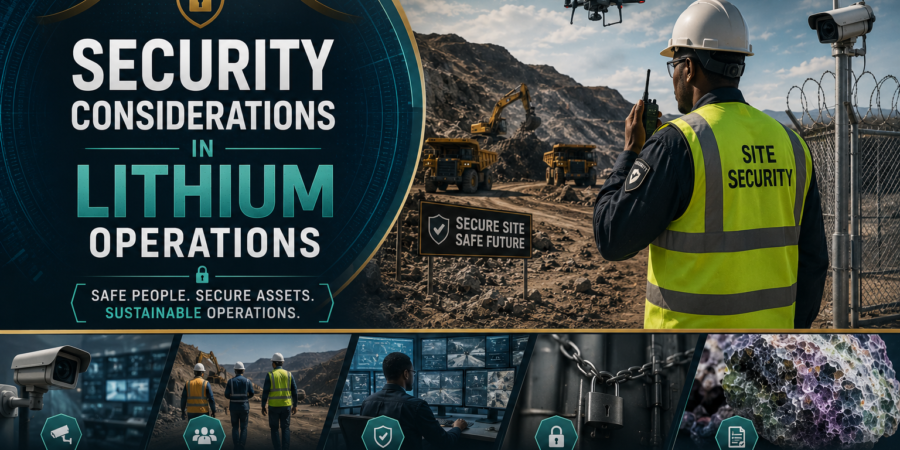
Security is one of the least understood aspects of the mining industry. For many people, the word immediately suggests guards, fences, surveillance equipment, or physical protection of mining sites. While these measures certainly have their place, security within a modern lithium operation extends much further. For investors, buyers, mining companies, and procurement organizations, security is about protecting the entire value chain. It involves safeguarding people, assets, information, commercial relationships, logistics, and supply continuity.
As Nigeria’s lithium industry continues to attract international attention, security is becoming an increasingly important component of successful mining and trading operations. Companies entering the market are no longer evaluating only geological potential or commercial opportunity. They are also assessing operational resilience and the ability of supply chains to function reliably over the long term. This broader understanding of security is transforming how mining projects are planned and managed.
The first consideration is operational security. Every mining operation depends on the ability to conduct daily activities in an organized and predictable manner. Equipment must be protected. Personnel must work within structured operational procedures. Materials must be properly handled and documented. Visitors must be managed responsibly. Operational discipline reduces risk while improving productivity and investor confidence. In many successful mining jurisdictions, operational security begins with professional management rather than physical infrastructure.
Community relationships represent another critical dimension of security. Mining does not occur in isolation. Operations are established within communities where people live, work, own land, and depend on local economic activities. Building constructive relationships with host communities is therefore one of the most effective long-term security strategies available to mining companies. Open communication, transparency, respect for local stakeholders, and responsible engagement often contribute significantly to operational stability. Communities that benefit from responsible mining activities are more likely to become long-term partners in industry development.
Supply-chain security has also become increasingly important. International buyers require confidence that materials originate from credible sources and move through organized commercial channels. They want assurance that procurement processes are transparent, documentation is reliable, and suppliers can deliver consistently. Supply-chain security therefore extends beyond physical transportation. It includes supplier verification. Commercial documentation. Inventory visibility. Quality assurance. Traceability. And procurement integrity. These elements strengthen buyer confidence while supporting long-term commercial relationships.
Transportation security deserves particular attention because lithium frequently moves across multiple locations before reaching its final destination. Ore may travel from mining communities to aggregation centres, then to warehouses, and eventually to processors or export channels. Every movement introduces operational considerations that require planning and coordination. Reliable transport scheduling, accurate documentation, professional handling procedures, and effective communication all contribute to secure and efficient logistics. As transportation networks become more organized, the resilience of the overall supply chain improves.
Information security is another area receiving increasing attention. The modern lithium industry depends heavily on data. Exploration results, supplier databases, procurement records, logistics schedules, commercial contracts, pricing information, and market intelligence all represent valuable business assets. Protecting this information has become essential for companies seeking to maintain competitive advantage and operational continuity. In today’s mining industry, information is often as valuable as physical infrastructure.
Commercial security also plays a significant role. Long-term lithium operations depend on trusted business relationships. Companies entering new markets must conduct appropriate due diligence before engaging suppliers, service providers, logistics partners, or commercial intermediaries. Verifying counterparties, understanding contractual obligations, confirming operational capabilities, and assessing commercial credibility all contribute to reducing business risk. Professional due diligence protects both domestic businesses and international investors.
Environmental and regulatory compliance should also be viewed through a security lens. Operations that maintain responsible environmental practices and comply with applicable legal and regulatory requirements are generally better positioned for long-term sustainability. Regulatory uncertainty, compliance failures, or environmental disputes can disrupt production and affect commercial relationships. Good governance therefore strengthens operational security.
Workforce development is equally important. Employees who understand operational procedures, safety standards, commercial responsibilities, and reporting systems contribute significantly to a secure working environment. Continuous training helps build a culture where risk management becomes part of everyday operations rather than an afterthought. Security is ultimately a shared responsibility. Management establishes systems. Employees follow procedures. Communities support responsible operations. Logistics providers maintain reliable transportation. Buyers promote transparent procurement. Each participant contributes to the resilience of the broader lithium ecosystem.
For Northern Nigeria, strengthening security across these different dimensions will be essential as the industry continues to grow. International investors increasingly favour jurisdictions where commercial risks are well managed, supply chains operate transparently, and business relationships are supported by professional institutions. Security therefore becomes more than a protective measure. It becomes a competitive advantage. The jurisdictions capable of combining resource potential with operational reliability are often the ones that attract sustained investment and long-term procurement partnerships.
The Nigerian Mineral Exchange is actively supporting secure and transparent lithium commerce by connecting verified suppliers, buyers, aggregators, logistics providers, investors, processors, and procurement organizations across Nigeria’s growing battery-mineral sector. For international procurement groups, battery-material companies, commodity traders, mineral processors, manufacturers, and investors entering the Nigerian market, NME provides supplier identification, market intelligence, procurement coordination, supplier verification, due diligence support, aggregation access, and comprehensive supply-chain visibility to help reduce commercial risk and improve sourcing confidence.
NME also serves as a Foreign or International Buyer Representative in Nigeria, helping international organizations establish trusted local market presence through supplier engagement, commercial due diligence, sourcing coordination, logistics intelligence, procurement management, market-entry advisory services, and on-ground representation throughout Nigeria’s lithium-producing regions.
At the same time, NME works with miners, suppliers, warehouse operators, logistics providers, aggregators, and mining communities to encourage structured commercial relationships built on transparency, professionalism, and long-term collaboration. Organizations seeking supplier verification, procurement coordination, due diligence, market-entry support, aggregation partnerships, or local buyer representation can engage NME directly through WhatsApp (+2348130799304).
The future of Nigeria’s lithium industry will depend on more than resource potential. It will depend on trust. Trust between miners and communities. Trust between suppliers and buyers. Trust between investors and local partners. And trust throughout the supply chain. Strong security practices help create that trust. And in the modern battery-mineral economy, trust is one of the most valuable assets any industry can possess.
Related Articles
- Source Lithium Ore in Nigeria
- Sell Lithium Ore in Nigeria
- How to Source Lithium Ore in Nigeria in 2026
- How to Secure Large-Scale Lithium Ore Supply in Abuja: The NME Industrial Sourcing Guide
- Northern Nigeria Lithium Trade Ecosystem
- Why Lithium Investors Are Watching Northern Nigeria
- How Lithium Ore Is Measured and Verified
- Can Nigeria Become Africa’s Lithium Powerhouse?
- Why Local Partnerships Matter in Lithium Trade
- Future Lithium Trade Routes Across Nigeria
- Lithium and Electric Vehicle Demand
- Northern Nigeria’s Lithium Mining Corridors
- Lithium Trade in Kano State
- Niger State and the Nigerian Lithium Economy
- Lithium and Energy Storage Technologies
- Nigeria’s Emerging Battery Minerals Economy
Leave a Reply