
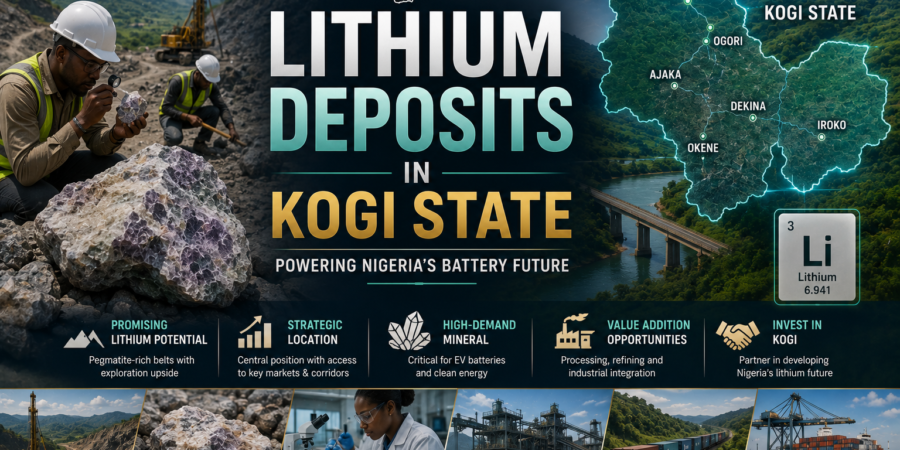
When discussions about Nigeria’s lithium future take place, certain states attract attention because of ongoing mining activities, while others attract attention because of their strategic potential. Kogi State belongs to both categories. Situated at the crossroads of Northern and Southern Nigeria, Kogi occupies a unique position within the country’s mineral landscape. The state has long been recognized for its diverse mineral resources and strategic location, but growing interest in lithium is adding a new dimension to its importance within Nigeria’s emerging battery-mineral economy.
Today, Kogi is increasingly appearing in conversations about exploration, mining investment, mineral trade, and the future of critical minerals in Nigeria. The significance of lithium deposits in Kogi State extends beyond geology. In the modern mineral economy, deposits are only the starting point. What ultimately determines economic impact is the ability to transform geological resources into commercial opportunities. This requires a combination of exploration, investment, infrastructure, logistics, market access, and commercial organization. Kogi’s position within Nigeria gives it distinct advantages in this regard.
The state occupies a strategic corridor connecting several parts of the country. Major transportation routes pass through Kogi, linking Northern Nigeria with the South and providing access to important commercial centers. For a mineral industry increasingly focused on supply chains and logistics, this connectivity matters. Minerals are valuable when they can reach markets efficiently. The growing attention directed toward lithium deposits in Kogi reflects broader changes occurring within the global economy. Around the world, demand for battery minerals continues to increase as electric vehicles, energy-storage systems, and advanced technologies become more widespread. This demand is encouraging exploration companies, investors, and procurement organizations to search for new sources of supply. Nigeria is becoming part of that search. And states such as Kogi are benefiting from increased visibility.
One of the most important aspects of lithium development is exploration. Before a mineral resource can support commercial activity, it must first be identified, evaluated, and understood. Exploration creates the knowledge upon which future investment decisions are based. As geological understanding improves, opportunities become clearer. This process is particularly important in emerging jurisdictions where the full extent of mineral potential may still be evolving. For Kogi State, continued exploration activity represents an important pathway toward attracting long-term investment.
Yet the future value of lithium deposits in Kogi may not be determined solely by what is found beneath the ground. It may also be determined by what is built above it. Successful mineral economies depend on ecosystems. These ecosystems include miners, suppliers, logistics providers, laboratories, equipment operators, consultants, financiers, aggregators, buyers, and numerous supporting businesses. Together, they create the infrastructure that allows mineral resources to participate in commercial markets.
Kogi possesses characteristics that could support the development of such an ecosystem. Its location provides access to multiple markets. Its transportation links facilitate movement of goods and services. Its growing mining profile attracts attention from industry stakeholders. And its position within Nigeria’s broader economic network creates opportunities for integration into emerging supply chains. This integration is becoming increasingly important because global lithium buyers are evolving.
The modern procurement environment is no longer focused solely on resource availability. Buyers increasingly evaluate reliability, logistics, supplier verification, inventory visibility, and supply-chain transparency. As a result, regions capable of supporting organized commercial activity often enjoy advantages over regions that rely solely on geological potential. Kogi’s opportunity therefore extends beyond mining. It extends into trade. It extends into logistics. It extends into aggregation. And it extends into the broader battery-mineral ecosystem that is gradually taking shape across Nigeria.
Another reason Kogi is strategically important is its ability to serve as a connecting point within the national mineral economy. As lithium supply chains become more organized, states that facilitate movement between production regions and commercial centers may become increasingly valuable. In many successful mining jurisdictions around the world, logistical positioning has proven just as important as resource availability. The ability to connect resources with buyers often creates lasting competitive advantages. This reality is reshaping how mineral opportunities are viewed. Investors are no longer evaluating deposits in isolation. They are evaluating ecosystems. They are assessing infrastructure. They are studying supply chains. And they are looking for regions capable of supporting long-term commercial growth.
Kogi’s combination of mineral potential and strategic location places it within this conversation. The state’s future role in the lithium industry may therefore be larger than many currently imagine. It may become an important contributor not only to mineral production but also to the commercial networks supporting Nigeria’s participation in the global battery economy.
The Nigerian Mineral Exchange (NME) is actively supporting the development of this ecosystem by connecting suppliers, buyers, aggregators, logistics providers, investors, processors, and procurement networks across Kogi State and the wider Nigerian lithium market. For international procurement groups, battery-material companies, commodity traders, mineral processors, manufacturers, and investors evaluating opportunities in Kogi State, NME provides support in supplier identification, procurement coordination, aggregation access, market intelligence, supplier verification, and supply-chain visibility.
NME also serves as a Foreign or International Buyer Representative in Nigeria, helping international organizations establish trusted local market presence through supplier engagement, due diligence, sourcing coordination, logistics intelligence, procurement support, market-entry assistance, and on-ground representation. At the same time, NME continues to work with miners, suppliers, aggregators, warehouse operators, and industry stakeholders seeking access to serious buyers, structured procurement opportunities, and long-term commercial partnerships.
Organizations seeking sourcing support, supplier verification, procurement coordination, market-entry guidance, aggregation partnerships, or local buyer representation can engage NME directly through WhatsApp (+2348130799304).
Lithium deposits in Kogi State represent more than a geological opportunity. They represent part of a larger transformation taking place across Nigeria’s mining sector. As the global demand for battery minerals continues to grow, the states that successfully connect resources with markets will be positioned to benefit most. Kogi has the potential to become one of those states. And that possibility makes it one of the locations worth watching in Nigeria’s emerging lithium economy.
Related Articles
- Source Lithium Ore in Nigeria
- Sell Lithium Ore in Nigeria
- Abuja and Regional Lithium Commerce in Nigeria
- How to Source Lithium Ore in Nigeria in 2026
- How to Secure Large-Scale Lithium Ore Supply in Abuja: The NME Industrial Sourcing Guide
- Northern Nigeria Lithium Trade Ecosystem
- Why Lithium Investors Are Watching Northern Nigeria
- Lithium Mining Investments in Northern Nigeria
- Can Nigeria Become Africa’s Lithium Powerhouse?
- Why Local Partnerships Matter in Lithium Trade
- Future Lithium Trade Routes Across Nigeria
- Security Considerations in Lithium Operations
- Northern Nigeria’s Lithium Mining Corridors
- Lithium Trade in Kano State
- Niger State and the Nigerian Lithium Economy
- Lithium and Energy Storage Technologies
- Nigeria’s Emerging Battery Minerals Economy


Leave a Reply