
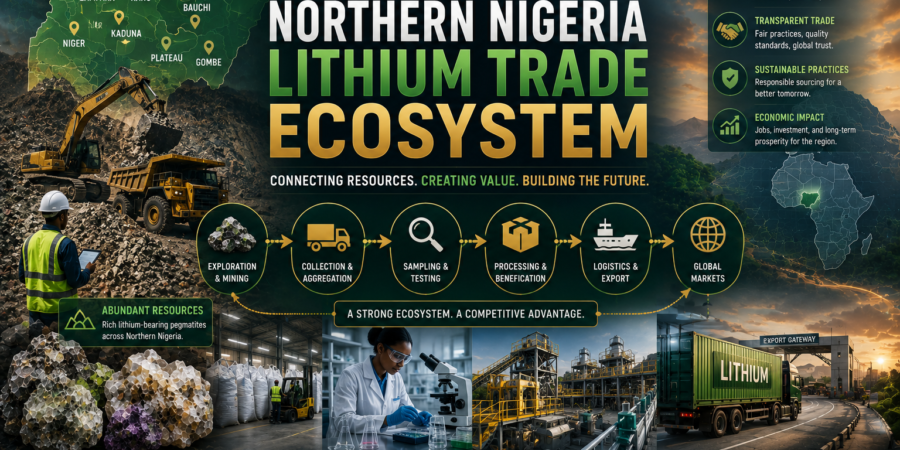
When people discuss lithium in Northern Nigeria, the conversation often begins with geology. Attention is directed toward mineralized pegmatites, exploration activities, lithium-bearing rocks, and mining locations scattered across different states. While these factors are undoubtedly important, they tell only part of the story. Minerals do not create industries on their own. Industries emerge when networks of people, businesses, institutions, infrastructure, and commercial relationships develop around those minerals. This is why understanding Northern Nigeria’s lithium future requires looking beyond mining sites and examining something much larger: the lithium trade ecosystem.
The word “ecosystem” is particularly important. A mine can produce lithium-bearing ore, but it cannot by itself create a sustainable industry. For lithium to move from the ground into domestic and international markets, a wide range of participants must work together. Miners, aggregators, transporters, warehouse operators, buyers, exporters, consultants, laboratories, logistics providers, regulators, financiers, and market facilitators all play roles within the same commercial network. Collectively, these participants form the lithium trade ecosystem.
Northern Nigeria is gradually becoming the center of this emerging ecosystem. The region possesses several advantages that support its growing importance. It hosts many of the areas attracting exploration and mining interest. It contains numerous mining communities with long histories of mineral production. It benefits from strategic transportation corridors linking mining regions to commercial centers. Most importantly, it is increasingly attracting the attention of buyers and investors seeking access to battery-mineral opportunities.
What is developing is not merely a mining sector. It is a commercial network. And commercial networks often become more valuable than the resources that originally created them. A useful way to understand the ecosystem is to follow the journey of lithium ore after it leaves the ground. Mining is only the beginning. Once material is extracted, it enters a chain of activities involving sorting, handling, transportation, storage, aggregation, quality assessment, negotiation, procurement, and eventual delivery to buyers. Every stage creates opportunities for businesses and service providers.
A transporter moving ore from a mining location is part of the ecosystem. A warehouse operator storing inventory is part of the ecosystem. A laboratory conducting material analysis is part of the ecosystem. An exporter coordinating international shipments is part of the ecosystem. A consultant helping a foreign investor understand the market is part of the ecosystem. The industry functions because these activities connect with one another. This interconnectedness is one reason the Northern Nigeria lithium trade ecosystem is becoming increasingly important.
As global demand for battery minerals continues to grow, buyers are looking for more than just suppliers. They are looking for organized markets. Procurement teams want visibility. Investors want reliable information. Commodity traders want efficient logistics. Industrial buyers want confidence that supply chains can perform consistently. The stronger the ecosystem becomes, the easier it becomes to satisfy these expectations. This creates a competitive advantage.
One of the most important developments within the ecosystem is aggregation. Northern Nigeria’s lithium production is often distributed across multiple locations and operators. Individual suppliers may possess commercially viable material but lack the volume necessary to attract larger buyers independently. Aggregation helps solve this challenge. By consolidating material from multiple sources, aggregation networks create inventories capable of supporting larger procurement requirements. This improves market access for suppliers while creating sourcing efficiency for buyers. In many respects, aggregation serves as the bridge between fragmented production and structured trade.
The importance of logistics cannot be overstated either. A lithium deposit may possess significant value, but that value cannot be fully realized unless material can move efficiently through the supply chain. Road networks, transportation providers, storage facilities, handling systems, and commercial coordination all influence how effectively lithium reaches the market. This is one reason why Abuja is emerging as a critical commercial hub within the broader Northern Nigeria lithium ecosystem. Although most mining activity occurs outside the city, Abuja increasingly functions as a meeting point where suppliers, buyers, investors, aggregators, consultants, and logistics providers interact. The city is gradually becoming a center of coordination rather than extraction. That distinction is important because modern mineral industries rely heavily on coordination.
The future lithium economy will depend not only on production but also on information. This is where market intelligence becomes increasingly valuable. As the industry grows, participants require reliable information regarding suppliers, buyers, pricing trends, logistics options, regulatory developments, and investment opportunities. Access to information reduces uncertainty and helps markets operate more efficiently. In many ways, intelligence has become a form of infrastructure. The countries and regions that organize information effectively often gain advantages within global supply chains. Northern Nigeria’s lithium ecosystem is gradually moving in this direction.
The evolution of buyer relationships is another important feature of the ecosystem. In the early stages of industry development, transactions are often opportunistic and short-term in nature. As industries mature, procurement relationships become more structured. Buyers seek reliability. Suppliers seek continuity. Partnerships become increasingly important. This shift is already visible within parts of the lithium market. International buyers are showing growing interest in establishing long-term sourcing relationships rather than relying exclusively on isolated transactions. Such relationships strengthen the ecosystem by encouraging investment, planning, and commercial stability. The rise of foreign interest is also reshaping the ecosystem.
Commodity traders, mineral processors, battery-material companies, and investment groups from different parts of the world are evaluating opportunities within Northern Nigeria. These organizations often require local representation, supplier verification, due diligence, logistics support, and market-entry assistance. As a result, new opportunities are emerging for service providers capable of helping international participants navigate the market. This is one reason why the ecosystem extends far beyond mining itself. Increasingly, value is being created through facilitation, coordination, intelligence, and connectivity.
The future growth of the ecosystem will depend on its ability to become more organized, transparent, and efficient. The stronger these foundations become, the more attractive the region will be to buyers, investors, and industrial partners. This process is already underway. What is emerging in Northern Nigeria is not simply a collection of lithium projects. It is the early formation of a commercial ecosystem connected to one of the world’s most important growth industries.
The Nigerian Mineral Exchange (NME) is actively supporting this ecosystem by helping connect suppliers, buyers, aggregators, logistics providers, investors, processors, and procurement networks across Northern Nigeria and the wider Nigerian lithium market. For international procurement groups, battery-material companies, commodity traders, mineral processors, manufacturers, and investors evaluating sourcing opportunities in Nigeria, NME provides support in supplier identification, procurement coordination, aggregation access, market intelligence, supplier verification, and supply-chain visibility.
NME also serves as a Foreign or International Buyer Representative in Nigeria, helping international organizations establish trusted local market presence through supplier engagement, due diligence, sourcing coordination, logistics intelligence, procurement support, market-entry assistance, and on-ground representation. This enables foreign buyers and investors to navigate Northern Nigeria’s evolving lithium trade ecosystem while building informed sourcing and investment strategies.
At the same time, NME continues to work with miners, suppliers, aggregators, warehouse operators, and industry stakeholders across Northern Nigeria who are seeking access to serious buyers, structured procurement opportunities, and long-term commercial partnerships.
Organizations ore individuals seeking lithium ore buyers, sourcing support, supplier verification, procurement coordination, market-entry guidance, aggregation partnerships, or local buyer representation can engage NME directly through WhatsApp (+2348130799304).
The future of Northern Nigeria’s lithium industry will not be determined solely by the quality of its mineral deposits. It will be determined by the quality of the ecosystem that develops around those deposits. Because in the modern battery-mineral economy, the most valuable asset is often not the resource itself. It is the network that connects the resource to the world.
Related Articles
- Source Lithium Ore in Nigeria
- Sell Lithium Ore in Nigeria
- How to Source Lithium Ore in Nigeria in 2026
- How to Secure Large-Scale Lithium Ore Supply in Abuja: The NME Industrial Sourcing Guide
- We Are Buying Lithium Ore in Nigeria (From 1% Li₂O and Above) | Abuja Warehouse
- Lithium Pricing Mistakes Suppliers Make in Nigeria
- How Buyers Negotiate Lithium Prices in Nigeria
- How Global Lithium Demand Affects Nigerian Prices
- Spot Market vs Contract Lithium Prices in Nigeria
- What Makes Lithium Ore More Valuable?
- Factors Affecting Lithium Ore Prices in Nigeria
- Why Local Partnerships Matter in Lithium Trade
- Developing Sustainable Lithium Supply Networks in Nigeria
- Lithium Procurement Strategy for Foreign Buyers in Nigeria
- Lithium and Electric Vehicle Demand
- Lithium and Energy Storage Technologies
- Nigeria’s Emerging Battery Minerals Economy
Leave a Reply