
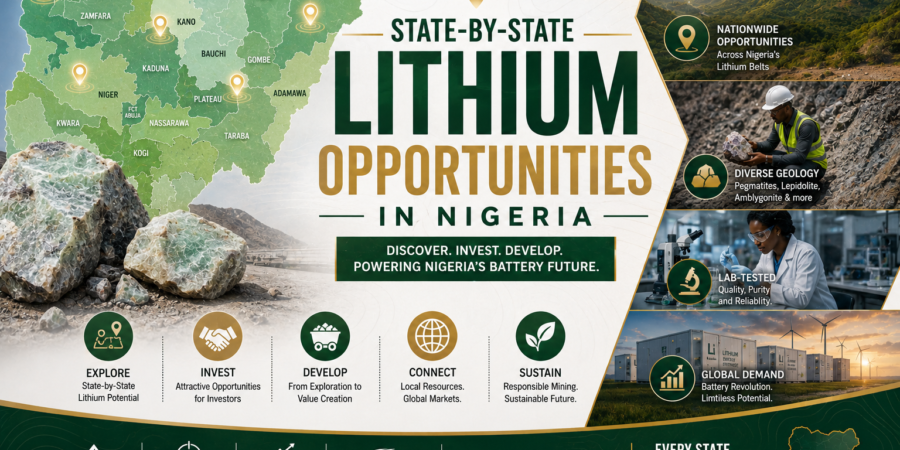
The global search for lithium has transformed what was once a relatively obscure mineral into one of the world’s most strategically important resources. From electric vehicles and energy-storage systems to renewable-energy infrastructure and advanced technologies, lithium now sits at the center of a rapidly evolving industrial landscape. As countries seek reliable sources of battery minerals, attention is increasingly turning toward regions capable of supporting future supply chains.
Nigeria has become part of that conversation. Over the past several years, growing international interest has highlighted the country’s lithium potential and positioned Nigeria as an emerging participant within the global battery-mineral economy. Yet one of the most important realities often overlooked is that Nigeria’s lithium opportunity is not concentrated in a single location. It is distributed across multiple states.
This geographic diversity is one of Nigeria’s greatest strengths. Rather than relying on a single mining district, the country possesses a network of states that collectively contribute to exploration, mining, logistics, trade, aggregation, and supply-chain development. Each state offers distinct advantages, creating opportunities for investors, buyers, suppliers, and service providers. Understanding Nigeria’s lithium future therefore requires a state-by-state perspective.
Nasarawa State has emerged as one of the most visible participants in Nigeria’s lithium industry. The state’s proximity to Abuja provides a significant commercial advantage. Mining activities can connect relatively easily to procurement networks, logistics providers, investors, consultants, and commercial service providers operating within the Federal Capital Territory. Nasarawa also benefits from an established mining culture and a growing reputation as one of Nigeria’s most active mineral-producing regions. As a result, the state has become a focal point for discussions about lithium sourcing, aggregation, and future battery-mineral development.
Kaduna State represents a different type of opportunity. Traditionally known for agriculture, manufacturing, and commerce, Kaduna occupies an important position within Northern Nigeria’s transportation and economic network. The state’s strategic location enhances its potential role within mineral supply chains. While exploration interest continues to evolve, Kaduna’s greatest strength may ultimately lie in its ability to support logistics, trade facilitation, and commercial coordination within the broader lithium economy.
Kogi State benefits from a unique geographic position at the crossroads of Northern and Southern Nigeria. This location provides access to multiple transportation corridors and commercial markets. As lithium supply chains become increasingly sophisticated, Kogi’s ability to connect production areas with buyers and processors may become one of its most important advantages. The state represents an example of how logistics and market access can complement geological potential.
Niger State is often described as a mining giant because of its immense geographic size and mineral diversity. The state’s extensive land area creates opportunities for exploration and resource development across multiple locations. At the same time, its strategic position within Nigeria strengthens its potential role in transportation and supply-chain integration. As global demand for battery minerals expands, Niger State is well positioned to contribute both resources and infrastructure to the country’s emerging lithium economy.
Plateau State offers a different type of advantage. Few regions in Nigeria possess such a deep mining heritage. For generations, Plateau has been associated with mineral production, geological exploration, and mining entrepreneurship. This history provides an existing ecosystem of mining knowledge, technical experience, and industry participation. While much attention historically focused on tin and related minerals, the rise of lithium presents an opportunity for Plateau to leverage its mining legacy within a new generation of mineral markets.
Beyond these leading states, other states such as, Kebbi, Zamfara, Kwara, and Oyo are also becoming increasingly relevant. Several areas across Northern and Western Nigeria contain pegmatitic formations associated with lithium mineralization. As exploration activity continues and geological understanding improves, additional opportunities may emerge across the country.
This is one reason why investors remain interested in Nigeria’s lithium story. The sector remains in an evolving phase. New information continues to emerge. And the full extent of the country’s lithium potential is still being evaluated. What makes Nigeria particularly interesting is that the opportunity extends far beyond extraction. The future lithium economy will require a wide range of supporting industries. Transportation providers will be needed to move material. Aggregators will be needed to consolidate supply. Warehouses will be needed to manage inventory. Laboratories will be needed to support quality verification. Consultants will be needed to facilitate market entry. Procurement specialists will be needed to connect buyers with suppliers.
These opportunities exist regardless of where mining occurs. In many cases, the greatest economic value may be created not at the mine itself but within the ecosystem surrounding it. This perspective is increasingly important because global lithium buyers are becoming more sophisticated. They are not simply looking for deposits. They are looking for supply chains. They want visibility into sourcing networks. They want supplier verification. They want reliable logistics. And they want confidence that commercial relationships can be maintained over the long term. States capable of supporting these requirements will likely play increasingly important roles within Nigeria’s battery-mineral economy.
The evolution of the industry may therefore depend as much on coordination as on geology. Nigeria’s greatest advantage may ultimately be its diversity. Different states bring different strengths. Some contribute mineral resources. Others contribute logistics. Others contribute commercial infrastructure. Together, they form the foundation of a national lithium ecosystem. This ecosystem is gradually becoming one of the country’s most promising mining opportunities.
The Nigerian Mineral Exchange (NME) is actively supporting this ecosystem by helping connect suppliers, buyers, aggregators, logistics providers, investors, processors, and procurement networks across Nigeria’s emerging lithium-producing states. For international procurement groups, battery-material companies, commodity traders, mineral processors, manufacturers, and investors evaluating opportunities across Nigeria, NME provides support in supplier identification, procurement coordination, aggregation access, market intelligence, supplier verification, and supply-chain visibility.
NME also serves as a Foreign Buyer Representative and International Buyer Representative in Nigeria, helping international organizations establish trusted local market presence through supplier engagement, due diligence, sourcing coordination, logistics intelligence, procurement support, market-entry assistance, and on-ground representation. At the same time, NME continues to work with miners, suppliers, aggregators, warehouse operators, and industry stakeholders across Nigeria who are seeking access to serious buyers, structured procurement opportunities, and long-term commercial partnerships.
Organizations seeking sourcing support, supplier verification, procurement coordination, market-entry guidance, aggregation partnerships, or local buyer representation can engage NME directly through WhatsApp (+2348130799304).
The future of Nigeria’s lithium industry will not be written by a single state. It will be written by a network of states, communities, businesses, and supply chains working together to connect mineral resources with global markets. That is what makes Nigeria’s lithium opportunity unique. And it is why the country’s state-by-state lithium story may ultimately become one of the most important chapters in Africa’s emerging battery-mineral economy.
Related Articles
- Source Lithium Ore in Nigeria
- Sell Lithium Ore in Nigeria
- Abuja and Regional Lithium Commerce in Nigeria
- Environmental Challenges of Lithium Mining in Nigeria
- Logistics Challenges Across Northern Nigeria’s Lithium Trade
- How to Source Lithium Ore in Nigeria in 2026
- How to Secure Large-Scale Lithium Ore Supply in Abuja: The NME Industrial Sourcing Guide
- Northern Nigeria Lithium Trade Ecosystem
- Lithium Transportation Corridors in Northern Nigeria
- Why Lithium Investors Are Watching Northern Nigeria
- Lithium Mining Investments in Northern Nigeria
- Can Nigeria Become Africa’s Lithium Powerhouse?
- Lithium Deposits in Kogi State
- Why Local Partnerships Matter in Lithium Trade
- Future Lithium Trade Routes Across Nigeria
- Security Considerations in Lithium Operations
- Northern Nigeria’s Lithium Mining Corridors
- Lithium Trade in Kano State
- Niger State and the Nigerian Lithium Economy
- Lithium and Energy Storage Technologies
- Nigeria’s Emerging Battery Minerals Economy
Leave a Reply