
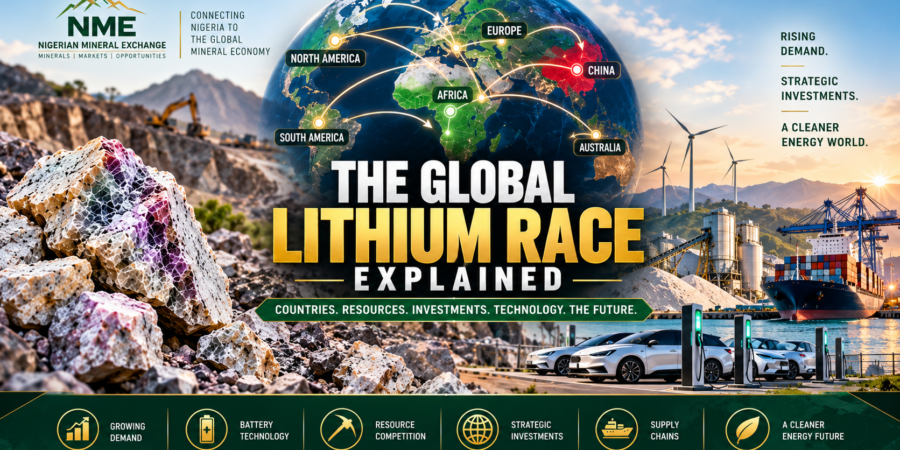
The phrase “global lithium race” appears frequently in headlines, investment reports, government policy documents, and mining conferences. At first glance, the term may sound dramatic. After all, lithium is just one mineral among many. Why would governments, multinational corporations, investors, automobile manufacturers, technology companies, and mining firms around the world be competing for access to it? The answer lies in a fundamental transformation taking place within the global economy.
The world is entering an era increasingly defined by electrification, energy storage, advanced manufacturing, and technological innovation. At the center of that transformation sits a mineral that, until relatively recently, attracted only limited public attention. That mineral is lithium. The global lithium race is not really about lithium alone. It is about the industries lithium makes possible.
To understand the race, it helps to begin with a simple observation. Every major technological shift creates demand for specific resources. The industrial revolution accelerated demand for coal. The automobile age increased demand for oil. The information age expanded demand for semiconductors and rare materials used in electronics. The emerging energy-transition economy is driving demand for battery minerals. Lithium has become one of the most important among them because of its role in rechargeable battery technologies.
Electric vehicles, grid-scale energy storage systems, consumer electronics, telecommunications infrastructure, and countless emerging technologies depend on batteries. And batteries depend on lithium. This connection explains why governments and industries are paying unprecedented attention to lithium supply chains. The race intensified as countries began recognizing that future economic competitiveness may depend on access to battery technologies. The transition toward electric mobility is one example.
Automobile manufacturers around the world are investing billions of dollars in electric vehicle production. Entire supply chains are being redesigned to support this shift. As production expands, demand for battery materials expands alongside it. Suddenly, a mineral that was once considered relatively specialized became central to one of the largest industrial transformations in modern history. But the global lithium race is about more than vehicles. It is also about energy. Many countries are increasing their reliance on renewable energy sources such as solar and wind power. While these technologies generate electricity, they also create a challenge. Energy production does not always align perfectly with energy demand. Batteries help solve this problem by storing electricity for use when needed.
As renewable energy systems expand, demand for energy-storage technologies continues growing. That growth reinforces the importance of lithium. The race is therefore not merely about transportation. It is also about the future structure of energy systems themselves.
Another factor driving competition is supply-chain security. The modern economy depends on highly interconnected global supply networks. Governments and corporations have become increasingly aware of the risks associated with supply disruptions, geopolitical tensions, and concentrated sources of critical materials. As a result, countries are actively seeking to diversify access to strategic minerals. This has transformed lithium from a commercial commodity into a geopolitical resource. The objective is no longer simply to buy lithium. The objective is to secure reliable, long-term access to lithium supply.
This shift has reshaped investment patterns around the world. Mining companies are expanding exploration programs. Governments are introducing critical-mineral policies. Automotive manufacturers are investing directly in upstream supply chains. Financial institutions are increasing exposure to battery-mineral projects. And countries with lithium resources are attracting growing international attention.
The competition is not limited to mining. In fact, one of the most interesting aspects of the global lithium race is that it extends across the entire value chain. Many people assume the race is about discovering the largest deposits. While resource availability is important, long-term success often depends on much more than geology. The real competition increasingly involves exploration, processing, refining, manufacturing, logistics, technology, market intelligence, and supply-chain coordination. The countries that capture the greatest value from lithium are often those that build capabilities across multiple stages of the ecosystem. This is why discussions about lithium increasingly include industrial policy, infrastructure development, processing capacity, workforce skills, and technological innovation. The race is not merely about who has lithium. It is about who can create the most value from lithium.
Africa has become increasingly important within this global landscape. The continent possesses significant mineral potential and is attracting growing interest from investors, mining companies, battery manufacturers, and governments seeking diversified sources of supply. Several African countries are emerging as important participants in global battery-mineral supply chains, and interest in the region continues to expand.
Nigeria is part of this story. The country’s growing lithium sector has attracted attention from commodity traders, procurement groups, battery-material companies, investors, and exploration firms. Lithium-bearing pegmatites across parts of Northern Nigeria are increasingly being viewed within the context of global supply-chain diversification. Yet Nigeria’s opportunity extends beyond resource extraction. The larger opportunity lies in building an ecosystem around those resources. Mining remains important, but so do aggregation, logistics, procurement, market intelligence, supplier verification, processing, and commercial coordination.
These activities create the infrastructure that transforms mineral resources into economic value. In many respects, the future winners of the global lithium race may not necessarily be the countries with the largest deposits. They may be the countries with the strongest ecosystems. This distinction is particularly important because the battery economy is still evolving. Supply chains are being built. New technologies are emerging. Investment patterns are shifting. And the rules of competition are still being written. Countries that position themselves effectively during this period may enjoy significant advantages in the years ahead. The global lithium race therefore represents more than competition for a mineral. It represents competition for a place within the industrial architecture of the future.
The Nigerian Mineral Exchange (NME) is actively supporting Nigeria’s participation in this evolving ecosystem by connecting suppliers, buyers, aggregators, logistics providers, investors, processors, and procurement networks across the country’s growing lithium sector. For international procurement groups, battery-material companies, commodity traders, mineral processors, manufacturers, and investors evaluating opportunities in Nigeria, NME provides support in supplier identification, procurement coordination, aggregation access, market intelligence, and supply-chain visibility.
NME also serves as a Foreign Buyer Representative and International Buyer Representative in Nigeria, helping international organizations establish trusted local market presence through supplier engagement, due diligence, sourcing coordination, logistics intelligence, procurement support, market-entry assistance, and on-ground representation. This enables foreign buyers and investors to navigate Nigeria’s emerging lithium ecosystem while developing informed sourcing and investment strategies.
At the same time, NME continues to work with suppliers, mining companies, aggregators, and industry stakeholders across Nigeria who are seeking access to serious buyers, structured procurement opportunities, and long-term commercial partnerships. Organizations seeking sourcing support, supplier verification, procurement coordination, market-entry guidance, aggregation partnerships, or local buyer representation can engage NME directly through WhatsApp (+2348130799304).
The global lithium race is often described as a contest for resources. In reality, it is something larger. It is a contest for industrial relevance. It is a contest for technological influence. It is a contest for participation in the next generation of global supply chains. And for countries that recognize the scale of that opportunity, lithium may prove to be far more than a mineral. It may become a gateway into the industries that define the future.
Related Articles
- Source Lithium Ore in Nigeria
- Sell Lithium Ore in Nigeria
- Abuja and Regional Lithium Commerce in Nigeria
- Environmental Challenges of Lithium Mining in Nigeria
- Logistics Challenges Across Northern Nigeria’s Lithium Trade
- Lithium Mining in Nasarawa State
- How to Source Lithium Ore in Nigeria in 2026
- State-by-State Lithium Opportunities in Nigeria
- How to Secure Large-Scale Lithium Ore Supply in Abuja: The NME Industrial Sourcing Guide
- Northern Nigeria Lithium Trade Ecosystem
- Lithium Transportation Corridors in Northern Nigeria
- Why Lithium Investors Are Watching Northern Nigeria
- Lithium Mining Investments in Northern Nigeria
- Can Nigeria Become Africa’s Lithium Powerhouse?
- Lithium Deposits in Kogi State
- Why Local Partnerships Matter in Lithium Trade
- Future Lithium Trade Routes Across Nigeria
- Security Considerations in Lithium Operations
- Northern Nigeria’s Lithium Mining Corridors
- Lithium Trade in Kano State
- Niger State and the Nigerian Lithium Economy
- Lithium and Energy Storage Technologies
- Nigeria’s Emerging Battery Minerals Economy
Leave a Reply