
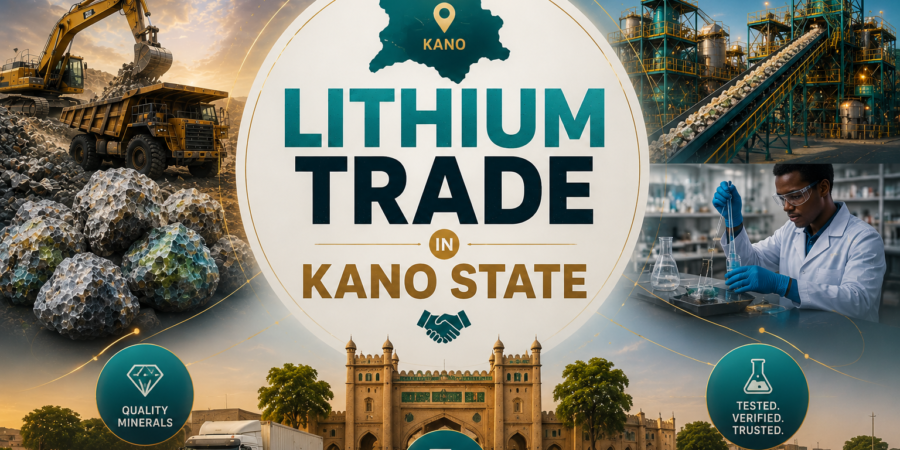
When most people think about lithium in Northern Nigeria, their attention is naturally drawn toward mining locations. They think about mineral deposits, exploration activities, and communities where lithium-bearing pegmatites are found. Yet the success of any mineral industry depends on more than the location of the resource itself. Minerals generate value when they move. They move from mining sites to aggregation centers. From aggregation centers to warehouses. From warehouses to processors, exporters, and industrial buyers. In other words, minerals become part of trade.
This is why Kano is becoming increasingly relevant within conversations about Nigeria’s emerging lithium economy. The ancient city may not be known primarily as a lithium-producing location, but it possesses something equally important. It possesses a long history as one of West Africa’s most important commercial centers. For centuries, Kano has functioned as a trading hub connecting producers, merchants, transporters, financiers, and regional markets. Long before modern mineral supply chains emerged, the city was already facilitating commerce across vast geographic regions. Today, that commercial heritage provides an interesting advantage as Nigeria’s lithium sector continues to develop.
The future lithium economy will not be built solely around mining sites. It will also be built around trade corridors. And Kano occupies a strategic position within those corridors. One of the reasons Kano matters is geography. The city serves as a gateway between numerous parts of Northern Nigeria and broader regional markets. Transportation networks connecting different mining regions frequently intersect with commercial routes linked to Kano. This creates opportunities for the city to play a growing role in the movement of lithium ore, mining inputs, equipment, and related services.
In mineral industries around the world, cities that facilitate trade often become just as important as locations where extraction occurs. This is because supply chains require coordination. A buyer seeking lithium ore is not simply looking for a mine. The buyer is looking for a network capable of delivering material reliably and efficiently. Kano’s commercial infrastructure helps support that network. The rise of lithium trade is also creating opportunities for businesses that have no direct involvement in mining. Transport operators, warehouse providers, equipment suppliers, financial intermediaries, consultants, logistics companies, and commercial service providers all stand to benefit from increased activity within the sector. This broader economic impact is one reason why mineral development often extends far beyond the mining industry itself. As trade expands, ecosystems emerge. And ecosystems create opportunities.
Another factor supporting Kano’s relevance is its entrepreneurial culture. The city has long been recognized as one of Nigeria’s leading centers of commerce and enterprise. Generations of traders have built extensive networks connecting Kano to markets across Nigeria, West Africa, and beyond. These networks may prove increasingly valuable as lithium trade becomes more organized. Modern mineral supply chains depend heavily on relationships. Suppliers need buyers. Buyers need reliable sourcing channels. Investors need local knowledge. And international procurement teams need trusted market access. Commercial cities such as Kano naturally become important meeting points within these relationships.
The growing international interest in Nigerian lithium further strengthens this dynamic. As foreign buyers and investors explore opportunities within the country’s battery-mineral sector, they often seek local partners capable of helping them understand the market. This includes assistance with sourcing, logistics, due diligence, supplier verification, and procurement coordination. The more active the lithium trade becomes, the greater the demand for these services. This is why trade infrastructure matters. A mining industry cannot grow efficiently if information flows poorly. It cannot attract investment if buyers struggle to identify suppliers. And it cannot compete internationally if procurement systems remain fragmented.
The strongest mineral economies are usually supported by strong commercial ecosystems. Kano possesses many of the characteristics needed to contribute to such an ecosystem. There is also a broader strategic dimension to consider. As global demand for battery minerals continues expanding, competition among sourcing destinations is increasing. Buyers are not merely seeking resources. They are seeking efficient supply chains. Countries and regions that can provide reliable procurement pathways often enjoy significant advantages. This reality creates opportunities for commercial centers that can support aggregation, logistics coordination, inventory management, and trade facilitation.
Kano’s long-standing experience as a trading city positions it well within this context. The future role of the city may therefore extend beyond traditional commerce into emerging battery-mineral supply chains. Perhaps the most important point is that lithium trade should not be viewed as a standalone activity. It is part of a larger transformation taking place across Northern Nigeria. Mining communities are becoming more connected to markets. Supply chains are becoming more organized. International interest is increasing. And commercial infrastructure is gradually adapting to support a new generation of mineral opportunities.
Within this evolving landscape, cities such as Kano have the potential to become important nodes connecting resources to markets. The future winners in the lithium economy may not necessarily be the regions that produce the most ore. They may be the regions that build the strongest connections between producers and buyers. That is where trade becomes important. And that is why Kano deserves attention within discussions about Nigeria’s emerging lithium industry.
The Nigerian Mineral Exchange is actively supporting the development of this ecosystem by connecting suppliers, buyers, aggregators, logistics providers, investors, processors, and procurement networks across Kano, Northern Nigeria, and the wider Nigerian lithium market. For international procurement groups, battery-material companies, commodity traders, mineral processors, manufacturers, and investors evaluating sourcing opportunities in Nigeria, NME provides support in supplier identification, procurement coordination, aggregation access, market intelligence, supplier verification, and supply-chain visibility.
NME also serves as a Foreign or International Buyer Representative in Nigeria, helping international organizations establish trusted local market presence through supplier engagement, due diligence, sourcing coordination, logistics intelligence, procurement support, market-entry assistance, and on-ground representation. This enables foreign buyers and investors to navigate Nigeria’s evolving lithium trade ecosystem while building informed sourcing and investment strategies.
At the same time, NME continues to work with miners, suppliers, aggregators, warehouse operators, and industry stakeholders across Northern Nigeria who are seeking access to serious buyers, structured procurement opportunities, and long-term commercial partnerships. Organizations seeking sourcing support, supplier verification, procurement coordination, market-entry guidance, aggregation partnerships, or local buyer representation can engage NME directly through WhatsApp (+2348130799304).
The future of lithium trade in Kano will not be determined by geology alone. It will be determined by the city’s ability to leverage its greatest historical strength- commerce. Because while mineral deposits create opportunities, it is trade that transforms opportunities into industries.
Related Articles
- Source Lithium Ore in Nigeria
- Sell Lithium Ore in Nigeria
- How to Source Lithium Ore in Nigeria in 2026
- How to Secure Large-Scale Lithium Ore Supply in Abuja: The NME Industrial Sourcing Guide
- Northern Nigeria Lithium Trade Ecosystem
- How Lithium Ore Is Measured and Verified
- What Makes Lithium Ore More Valuable?
- Factors Affecting Lithium Ore Prices in Nigeria
- Can Nigeria Become Africa’s Lithium Powerhouse?
- Why Local Partnerships Matter in Lithium Trade
- Developing Sustainable Lithium Supply Networks in Nigeria
- Lithium Procurement Strategy for Foreign Buyers in Nigeria
- Lithium and Electric Vehicle Demand
- Northern Nigeria’s Lithium Mining Corridors
- Niger State and the Nigerian Lithium Economy
- Lithium and Energy Storage Technologies
- Nigeria’s Emerging Battery Minerals Economy

Leave a Reply