
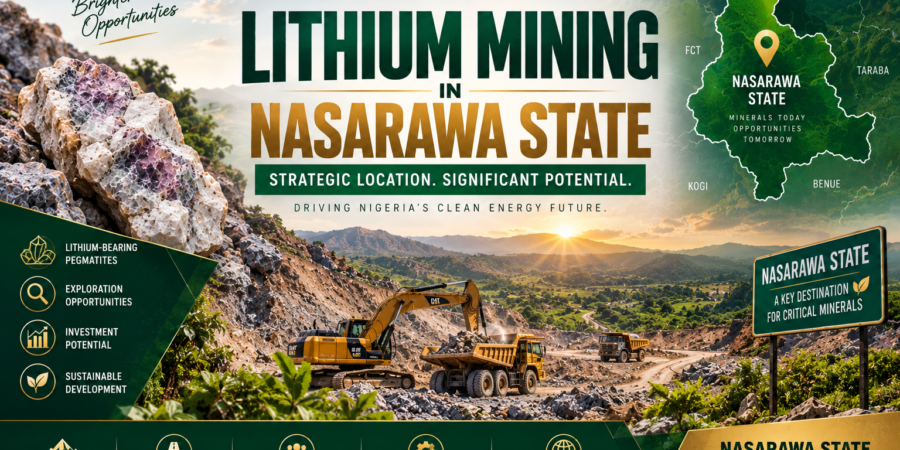
If there is one state that has become synonymous with the modern revival of Nigeria’s mining sector, it is Nasarawa State. For years, the state has occupied a unique position within Nigeria’s solid minerals industry. Located in the North-Central region of the country and bordering the Federal Capital Territory, Nasarawa has steadily built a reputation as one of Nigeria’s most active mining destinations. From gemstones and industrial minerals to metallic resources, the state has attracted miners, investors, traders, and researchers seeking opportunities within the country’s growing mineral economy.
Today, lithium is adding a new chapter to that story. As global demand for battery minerals continues to increase, Nasarawa State is becoming an increasingly important part of discussions surrounding Nigeria’s lithium future. The state is attracting attention not simply because of its geology, but because it occupies a strategic position within a rapidly evolving mineral ecosystem that connects exploration, mining, trade, logistics, investment, and industrial development. In many respects, Nasarawa sits at the intersection of Nigeria’s traditional mining industry and its emerging battery-mineral economy. The significance of lithium mining in Nasarawa extends beyond the mineral itself.
Around the world, lithium has become one of the most sought-after commodities due to its role in rechargeable batteries, electric vehicles, energy-storage systems, and other technologies supporting the global energy transition. As countries and industries search for reliable sources of supply, regions capable of supporting lithium production are receiving unprecedented attention. Nasarawa has emerged as one of the locations benefiting from this trend. The state’s growing visibility reflects broader developments occurring across Nigeria’s mining sector. Increased exploration activity, greater investor interest, expanding market awareness, and the search for new battery-mineral supply chains have all contributed to the attention now focused on lithium-bearing areas within the state.
However, mining is only one part of the equation. One of the reasons Nasarawa is particularly important is its proximity to Abuja. This location creates commercial advantages that many mining jurisdictions struggle to replicate. Material produced within Nasarawa can be connected relatively efficiently to procurement networks, logistics providers, aggregators, consultants, government institutions, financial services, and commercial stakeholders operating within the Federal Capital Territory.
This proximity strengthens the state’s position within the broader lithium value chain. Modern mining industries depend on connectivity. A mineral deposit may create opportunity, but infrastructure, logistics, and market access determine how effectively that opportunity can be converted into economic value. Nasarawa benefits from its ability to connect mining activity with commercial activity. This is one reason why the state continues attracting attention from both domestic and international stakeholders.
The rise of lithium mining is also creating opportunities beyond extraction itself. As mining activities expand, demand grows for transportation services, warehousing, aggregation facilities, equipment suppliers, technical consultants, laboratory services, community-relations specialists, environmental professionals, and numerous other supporting industries. These activities form the ecosystem surrounding mining. In many successful jurisdictions around the world, the ecosystem ultimately becomes just as important as the resource.
This dynamic is already beginning to emerge in Nasarawa. The state is increasingly becoming a meeting point where miners, suppliers, investors, buyers, and service providers interact. Such interactions contribute to the development of a more organized and commercially viable industry. For local communities, the implications can be significant. Mining often acts as a catalyst for broader economic activity. Increased movement of people, goods, services, and capital can stimulate local businesses and create opportunities that extend beyond the mining sector itself. When managed responsibly, lithium development has the potential to contribute to regional economic growth while supporting broader efforts to diversify Nigeria’s economy.
At the same time, the future success of lithium mining in Nasarawa will depend on more than production volumes. Investors increasingly pay attention to governance, environmental management, community engagement, supply-chain transparency, and operational reliability. Buyers want confidence in sourcing relationships. Financial institutions seek stability. International markets increasingly reward professionalism and consistency. These trends are reshaping the global mining industry.
The jurisdictions that attract the greatest long-term investment are often those that combine resource potential with strong commercial systems. Nasarawa possesses many of the ingredients required to pursue this path. The state’s mining heritage, strategic location, growing visibility, and access to commercial networks position it favorably within Nigeria’s evolving battery-mineral economy.
Yet perhaps the most important observation is that lithium mining in Nasarawa should not be viewed as an isolated development. It forms part of a larger transformation taking place across Nigeria. The country is gradually moving from being viewed primarily as a resource holder toward becoming a participant in global critical-mineral supply chains. This shift creates opportunities not only for miners but also for entrepreneurs, service providers, logistics operators, technology companies, consultants, researchers, and investors. Nasarawa’s role in this transformation may prove particularly significant because of its ability to connect resources with markets.
The future of the lithium industry will depend on more than what is extracted from the ground. It will depend on how effectively resources are connected to buyers, processors, investors, and industrial supply chains. That is where commercial ecosystems become critical. The Nigerian Mineral Exchange is actively supporting this ecosystem by connecting suppliers, buyers, aggregators, logistics providers, investors, processors, and procurement networks across Nasarawa State and the wider Nigerian lithium market.
For international procurement groups, battery-material companies, commodity traders, mineral processors, manufacturers, and investors evaluating opportunities in Nasarawa, NME provides support in supplier identification, procurement coordination, aggregation access, market intelligence, supplier verification, and supply-chain visibility. NME also serves as a Foreign Buyer Representative and International Buyer Representative in Nigeria, helping international organizations establish trusted local market presence through supplier engagement, due diligence, sourcing coordination, logistics intelligence, procurement support, market-entry assistance, and on-ground representation.
At the same time, NME continues to work with miners, suppliers, aggregators, warehouse operators, and industry stakeholders seeking access to serious buyers, structured procurement opportunities, and long-term commercial partnerships.
Organizations seeking sourcing support, supplier verification, procurement coordination, market-entry guidance, aggregation partnerships, or local buyer representation can engage NME directly through WhatsApp (+2348130799304).
Lithium mining in Nasarawa State represents more than a mineral opportunity. It represents an opportunity to participate in one of the fastest-growing segments of the global resource economy. As demand for battery minerals continues to expand, the state is increasingly positioned to play an important role in connecting Nigeria’s mineral potential with the industries shaping the future.
Related Articles
- Source Lithium Ore in Nigeria
- Sell Lithium Ore in Nigeria
- Abuja and Regional Lithium Commerce in Nigeria
- Environmental Challenges of Lithium Mining in Nigeria
- Logistics Challenges Across Northern Nigeria’s Lithium Trade
- How to Source Lithium Ore in Nigeria in 2026
- State-by-State Lithium Opportunities in Nigeria
- How to Secure Large-Scale Lithium Ore Supply in Abuja: The NME Industrial Sourcing Guide
- Northern Nigeria Lithium Trade Ecosystem
- Lithium Transportation Corridors in Northern Nigeria
- Why Lithium Investors Are Watching Northern Nigeria
- Lithium Mining Investments in Northern Nigeria
- Can Nigeria Become Africa’s Lithium Powerhouse?
- Lithium Deposits in Kogi State
- Why Local Partnerships Matter in Lithium Trade
- Future Lithium Trade Routes Across Nigeria
- Security Considerations in Lithium Operations
- Northern Nigeria’s Lithium Mining Corridors
- Lithium Trade in Kano State
- Niger State and the Nigerian Lithium Economy
- Lithium and Energy Storage Technologies
- Nigeria’s Emerging Battery Minerals Economy
Leave a Reply