
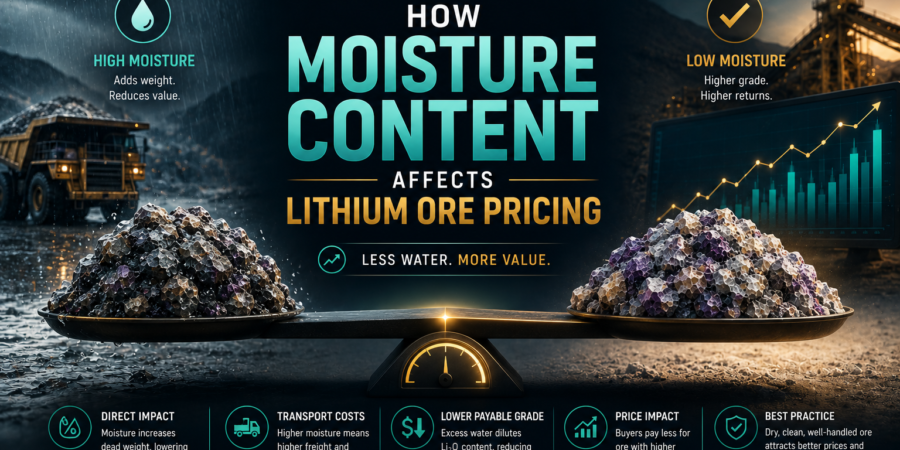
When suppliers think about lithium pricing, their attention naturally gravitates toward grade. Questions about Li₂O percentage, ore purity, assay results, and buyer specifications tend to dominate commercial discussions. These factors are undeniably important, but they are not the only variables influencing how buyers determine value. One factor that often receives less attention than it deserves is moisture content. At first glance, moisture may appear to be a minor technical issue. After all, a supplier might reasonably ask why a small amount of water in ore should significantly affect pricing. Yet within modern mineral supply chains, moisture content can have important commercial implications that extend far beyond simple laboratory measurements.
For many international buyers, moisture is not merely a quality issue. It is a valuation issue. To understand why, it helps to think about what buyers are actually purchasing. When a procurement company acquires lithium ore, its objective is to obtain lithium-bearing material that can move through transportation networks, aggregation systems, processing facilities, and ultimately into downstream industrial applications. The buyer is paying for mineral value. Water does not contribute to that value. If a shipment contains excessive moisture, part of the shipment’s weight consists of water rather than lithium-bearing material. From a buyer’s perspective, this creates an important economic consideration because transportation, handling, storage, and logistics costs are often calculated according to weight.
In simple terms, buyers generally prefer paying to move lithium rather than paying to move water. This is one reason moisture content frequently becomes part of pricing discussions. The issue becomes even more significant when large volumes are involved. A small difference in moisture percentage may seem insignificant within a single sample. However, when applied across truckloads, warehouses, aggregation centers, or export shipments, the commercial impact can become substantial. For industrial procurement systems operating at scale, such differences matter. This helps explain why many buyers evaluate moisture levels alongside grade, purity, consistency, and assay results.
Moisture content can also influence storage conditions. Lithium ore often moves through multiple stages before reaching its final destination. Material may spend time at mine sites, aggregation facilities, warehouses, transportation hubs, and procurement centers. Excessive moisture can complicate inventory management during these stages. Buyers generally prefer material that can be stored and handled efficiently with minimal operational uncertainty. As a result, moisture management is becoming an increasingly important aspect of professional supply-chain operations.
This trend is particularly relevant as Nigeria’s lithium industry evolves from fragmented trading activity toward more organized procurement systems. In the early stages of market development, many transactions focused primarily on securing available material. Today, buyers are becoming more selective. They are increasingly evaluating not only what is being supplied but also how it is being handled throughout the supply chain. This shift reflects broader changes occurring across the global battery-mineral industry. As procurement systems become more sophisticated, operational discipline is becoming a competitive advantage.
Moisture content also affects buyer confidence. Procurement decisions involve risk assessment. Whenever buyers encounter uncertainty regarding inventory quality, storage conditions, or material characteristics, they tend to become more cautious during negotiations. This caution can influence commercial outcomes. Conversely, suppliers capable of demonstrating consistent handling practices and reliable quality control often strengthen their position within the market. This is one reason professional inventory management is becoming increasingly valuable. The market is gradually rewarding suppliers who understand that value creation continues long after extraction has taken place. Mining the material is only the first step. The way that material is stored, managed, transported, documented, and presented can influence how buyers perceive its overall quality.
Aggregation networks are playing an important role in this evolution. Because much of Nigeria’s lithium supply originates from decentralized mining areas, aggregation systems help create more organized inventory pools capable of supporting industrial procurement requirements. These systems can also contribute to improved inventory management practices, including better control over factors such as moisture and material consistency. As aggregation becomes more established, buyers may gain greater confidence in the quality and reliability of available supply. This confidence can influence valuation.
The relationship between moisture content and pricing also illustrates a broader lesson about modern lithium procurement. The highest-value material is not necessarily the material with the highest assay result alone. Increasingly, buyers are seeking a combination of: quality, consistency, reliability, operational discipline,
and supply-chain professionalism. Every factor that reduces uncertainty can contribute to commercial attractiveness. Moisture management is one of those factors.
Abuja’s emergence as a coordination hub within Nigeria’s lithium economy reflects this broader professionalization of the market. The city is becoming an important meeting point for suppliers, aggregators, logistics providers, procurement professionals, and international buyers. As commercial activity becomes more organized, discussions surrounding inventory management, quality assurance, and operational standards are becoming increasingly common. This environment encourages suppliers to think beyond extraction and consider the broader commercial requirements of modern procurement systems.
The Nigerian Mineral Exchange (NME) is actively supporting this transition by helping connect suppliers, buyers, aggregators, logistics providers, and procurement networks across Nigeria’s growing lithium ecosystem. For international procurement groups, battery-material companies, commodity traders, mineral processors, and investors evaluating sourcing opportunities in Nigeria, NME provides support in supplier identification, procurement coordination, aggregation access, and market intelligence.
NME also serves as a Foreign or International Buyer Representative in Nigeria, helping international organizations establish trusted local procurement visibility through supplier engagement, due diligence, sourcing coordination, logistics intelligence, and market-entry support. This enables foreign buyers to better understand supply-chain realities, inventory conditions, and sourcing opportunities within Nigeria’s evolving lithium market.
At the same time, NME works closely with lithium suppliers across Northern Nigeria who are seeking access to serious buyers, structured procurement opportunities, and long-term commercial relationships. Organizations and individuals seeking lithium buyers, sourcing support, supplier verification, procurement coordination, market-entry guidance, aggregation partnerships, or local buyer representation can engage NME directly through WhatsApp (+2348130799304).
As Nigeria’s lithium industry continues maturing, moisture content is likely to become an increasingly important consideration within commercial negotiations. Not because moisture alone determines value, but because it reflects a larger principle shaping modern battery-mineral markets. Buyers are increasingly rewarding suppliers who can deliver not only quality material, but also quality systems. And in today’s lithium economy, the quality of those systems often influences pricing just as much as the quality of the ore itself.
Related Articles
- Source Lithium Ore in Nigeria
- Sell Lithium Ore in Nigeria
- How to Source Lithium Ore in Nigeria in 2026
- How to Secure Large-Scale Lithium Ore Supply in Abuja: The NME Industrial Sourcing Guide
- We Are Buying Lithium Ore in Nigeria (From 1% Li₂O and Above) | Abuja Warehouse
- Strategic States in Nigeria’s Lithium Economy
- How NME Supports Lithium Procurement in Nigeria
- Why Northern Nigeria Could Dominate Lithium Supply
- What Is the Minimum Lithium Grade Buyers Accept?
- Battery-Grade Lithium Explained
- Forecasting Nigeria’s Lithium Market Potential
- How Buyers Negotiate Lithium Prices in Nigeria
- How Global Lithium Demand Affects Nigerian Prices
- Spot Market vs Contract Lithium Prices in Nigeria
- What Makes Lithium Ore More Valuable?
- Factors Affecting Lithium Ore Prices in Nigeria
- Why Local Partnerships Matter in Lithium Trade
- Developing Sustainable Lithium Supply Networks in Nigeria
- Lithium Procurement Strategy for Foreign Buyers in Nigeria



Leave a Reply