
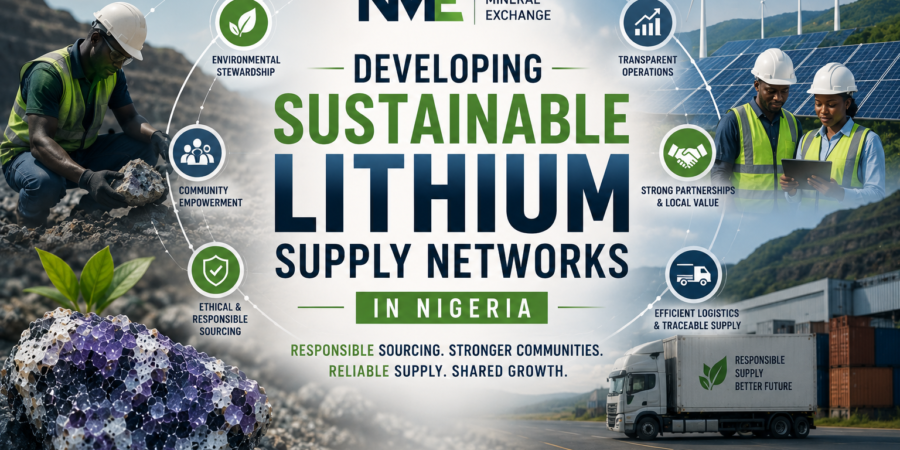
Nigeria’s lithium industry is moving into a more serious phase. The early wave of excitement surrounding lithium discoveries created rapid buying activity, speculative trading, and aggressive procurement interest across parts of Northern Nigeria. But as the market matures, a more important question is beginning to emerge: Can Nigeria build a sustainable lithium supply network capable of supporting long-term industrial demand? That question may ultimately determine whether the country becomes a short-term extraction frontier, or a durable participant within the global battery-mineral economy.
Sustainability in this context goes beyond environmental discussions alone. It also involves supply continuity, logistics reliability, aggregation efficiency, procurement transparency, operational coordination, and long-term commercial stability. Modern battery supply chains do not function effectively on uncertainty. Industrial buyers linked to electric vehicle manufacturing, battery production, energy storage systems, and renewable infrastructure increasingly require predictable sourcing systems, scalable inventory, logistics coordination, and operational discipline. This is where the Nigerian lithium market is now evolving.
One of the biggest realities shaping Nigeria’s lithium economy is decentralization. Much of the current supply still originates from artisanal miners, local cooperatives, regional suppliers, and fragmented mining communities operating across multiple states. This decentralized structure has advantages. It allows broad participation in the mineral economy and creates multiple regional supply channels rather than dependence on a single corridor. At the same time, fragmented supply systems can become difficult to scale without coordination.
Sustainable lithium supply networks therefore depend heavily on the development of aggregation systems, logistics infrastructure, warehousing coordination, procurement visibility, and stronger buyer-supplier integration. Without these systems, the market risks remaining unstable, inconsistent, and overly dependent on opportunistic transactions.
Aggregation is becoming especially important within this transition. In practical terms, aggregation helps transform scattered artisanal production into organized commercial inventory capable of supporting industrial procurement systems. This process creates inventory visibility, logistics coordination, supply continuity, and procurement scalability. As international buyers become more selective, organized aggregation networks may become one of the defining pillars of Nigeria’s future lithium economy.
Transportation infrastructure is another major component of sustainability. Mineral extraction alone does not create a functioning supply chain. Materials must move efficiently through mining communities, regional transportation corridors, aggregation centers, warehouses, and procurement systems before reaching export-linked commercial channels. Northern Nigeria already supports extensive movement involving agriculture, livestock, solid minerals, and interstate commerce. Lithium is gradually integrating into these broader economic corridors. However, sustainable supply systems will require continued improvements involving transportation coordination, road accessibility, inventory movement, and logistics planning. The regions capable of supporting efficient movement systems may eventually become the strongest long-term procurement corridors within the Nigerian lithium economy.
Warehousing is also becoming increasingly important. As the market matures, buyers increasingly expect inventory organization, moisture control, material traceability, shipment coordination, and operational transparency. Warehousing helps stabilize the supply chain by creating inventory structure, procurement visibility, and logistics coordination. This is gradually transforming warehousing from a basic storage function into strategic supply-chain infrastructure.
Quality verification is another critical part of sustainability. Industrial procurement systems increasingly require reliable assays, consistent inventory, technical transparency, and procurement discipline before establishing long-term sourcing relationships. Professional buyers commonly evaluate Li₂O percentage, mineral consistency, impurities, and moisture levels. Lithium concentration is commonly measured using Li₂O percentage (Lithium Oxide percentage).
Reliable testing systems strengthen buyer confidence, pricing stability, and procurement continuity across the broader supply chain. Most commercially discussed lithium-bearing materials currently associated with Nigeria include Spodumene/Kunzite, Lepidolite, and Amblygonite. As procurement systems become more industrialized, technical understanding and quality coordination will become increasingly important across every layer of the supply network.
Another important issue is information and market transparency. Many emerging mineral economies experience instability because suppliers and buyers operate within fragmented information environments characterized by weak pricing visibility, inconsistent procurement intelligence, and limited technical coordination. Sustainable supply networks require stronger systems for communication, procurement visibility, supplier coordination, and operational trust. Over time, the market will likely favor organizations capable of improving transparency, supply-chain intelligence, and procurement coordination across regional networks.
Abuja’s growing importance reflects many of these broader changes. The city is increasingly functioning as a procurement coordination center, an aggregation destination, a warehousing corridor, and a commercial bridge connecting regional mining communities with national and international buyers. As the lithium market becomes more organized, centralized coordination hubs like Abuja may become increasingly important for maintaining operational structure, logistics visibility, and procurement efficiency.
Another factor shaping long-term sustainability is the gradual shift away from speculative trading. The first phase of Nigeria’s lithium rush was driven heavily by rapid buying activity, short-term sourcing, and opportunistic mineral transactions. The next phase is becoming more infrastructure-driven. Industrial procurement systems increasingly prioritize: reliability, consistency, operational discipline, and long-term sourcing relationships rather than short-term speculative movement. This transition favors organizations capable of building scalable supply-chain systems, logistics coordination mechanisms, aggregation infrastructure, and procurement platforms.
The Nigerian Mineral Exchange (NME) is actively positioning within this evolving ecosystem by helping connect suppliers, aggregation systems, logistics operators, warehousing infrastructure, and international procurement relationships across Nigeria’s growing lithium economy. NME is currently seeking steady lithium suppliers, regional aggregation partnerships, and structured procurement relationships across Northern Nigeria. Suppliers looking for verified buyers, organized procurement systems, aggregation coordination, or direct lithium supply opportunities can contact NME directly through WhatsApp (08130799304) for immediate sourcing discussions and commercial engagement.
At the same time, international buyers, battery-material firms, Chinese sourcing companies, commodity traders, and industrial procurement groups seeking verified suppliers, procurement coordination, logistics support, aggregation visibility, or Nigeria lithium market-entry consulting can also engage NME directly for sourcing assistance and strategic procurement coordination within Nigeria’s evolving lithium ecosystem.
Nigeria’s lithium future will likely depend less on temporary excitement and more on whether durable systems are built around movement, coordination, logistics, aggregation, warehousing, and procurement reliability. The countries that eventually dominate future battery-mineral economies may not simply be those with mineral deposits underground. They may be the ones that build the most organized and sustainable supply systems above ground. Nigeria now has an opportunity to move in that direction.
Related Articles
- How to Source Lithium Ore in Nigeria in 2026
- How to Secure Large-Scale Lithium Ore Supply in Abuja: The NME Industrial Sourcing Guide
- How NME Supports Lithium Procurement in Nigeria
- Why Northern Nigeria Could Dominate Lithium Supply
- What Lithium Buyers Look For Before Purchase
- Informal Mining and Lithium Supply Networks in Nigeria
- Why Local Partnerships Matter in Lithium Trade
- Understanding Li₂O Percentages in Lithium Trade
- Where to Buy Lithium Ore in Nigeria
- Building Nigeria’s Mineral Market Infrastructure: The Nigerian Mineral Exchange Vision
- Nigeria’s Critical Minerals and the Global Energy Transition
- Top Mining Opportunities in Nigeria: A Guide for Investors and Industry Participants
- Lithium Procurement Challenges in Nigeria


Leave a Reply