
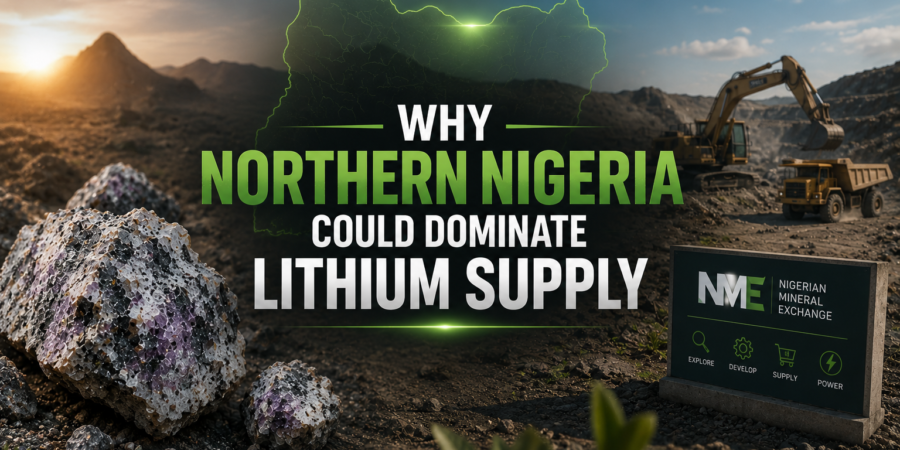
The global search for lithium is no longer driven by curiosity alone. It is now driven by industrial urgency. As electric vehicles, battery storage systems, renewable infrastructure, and energy-transition technologies expand across the world, the pressure to secure reliable lithium supply is intensifying rapidly. Governments, manufacturers, commodity traders, and battery companies are increasingly competing for access to stable sourcing corridors, scalable mineral supply, and long-term procurement relationships.
Within this changing global landscape, Northern Nigeria is gradually emerging as a region with the potential to become one of Africa’s most important lithium supply corridors. This possibility is not based solely on geology. Many countries possess mineral deposits. What determines long-term supply dominance is usually something much broader: logistics, aggregation, transportation, procurement systems, commercial coordination, and the ability to organize fragmented supply into scalable industrial inventory.
That is where Northern Nigeria’s growing significance becomes especially important. One of the region’s major advantages is scale. Northern Nigeria covers an enormous geographic area connected through longstanding commercial and transportation networks. For decades, these corridors have supported extensive movement involving agriculture, livestock, construction materials, manufactured goods, and solid minerals. Lithium is now beginning to integrate into these broader movement systems.
This existing commercial foundation gives the region an advantage many outside observers underestimate. In emerging mineral economies, supply dominance rarely comes only from mineral occurrence. It comes from the ability to move material consistently across functioning economic corridors. Northern Nigeria already possesses many of those movement systems.
Another important factor is the decentralized nature of the Nigerian lithium market itself. Much of the current supply originates from artisanal miners, local cooperatives, regional suppliers, and fragmented extraction communities. At first glance, this fragmentation may appear like a weakness. In reality, it could become one of the region’s biggest long-term advantages if properly organized. Why? Because decentralized supply systems can create wider regional participation, broader supply networks, and more flexible sourcing capacity across multiple corridors simultaneously.
The real challenge is coordination. This is why aggregation is becoming increasingly important within Northern Nigeria’s lithium economy. Aggregation systems help transform scattered mineral production into organized commercial inventory capable of supporting industrial procurement systems. As aggregation networks mature, the region’s fragmented mining structure could evolve into a highly scalable supply ecosystem.
This transition is already beginning quietly across parts of Northern Nigeria. A growing number of procurement activities now revolve around inventory consolidation, warehousing, transportation coordination, and regional supply-chain organization rather than isolated mining activity alone. In many ways, Northern Nigeria is gradually shifting from a collection of mining locations into an interconnected supply corridor.
Another reason the region could become highly influential is its strategic position within West Africa. As global procurement companies search for diversified lithium sources outside traditional jurisdictions, Nigeria offers several advantages: geographic scale, population size, commercial connectivity, and growing integration into international mineral conversations. Northern Nigeria, in particular, sits at the center of multiple transportation and trade corridors capable of supporting regional aggregation, interstate movement, logistics coordination, and export-linked procurement systems.
Over time, these advantages may become increasingly important as global competition for lithium intensifies. Abuja’s growing role also strengthens the region’s future potential. The city is rapidly emerging as a procurement coordination hub, an aggregation destination, a warehousing center, and a commercial bridge linking regional supply systems with international buyers. In mature commodity markets, commercial influence often gravitates toward coordination centers, not necessarily extraction sites alone.
Abuja is beginning to occupy that position within Nigeria’s lithium economy. As procurement systems become more structured, the city’s importance may continue expanding because buyers increasingly prioritize operational visibility, logistics organization, centralized coordination, and procurement efficiency. This shift is gradually transforming the broader lithium economy from speculative mineral trading into infrastructure-driven supply-chain development.
Another factor strengthening Northern Nigeria’s future position is the rapid evolution of global procurement behavior. In the early phase of the lithium rush, many buyers operated aggressively and opportunistically, focusing mainly on securing raw supply quickly. That environment is changing. Industrial procurement systems now increasingly demand reliability, consistency, inventory visibility, warehousing infrastructure, and logistics coordination before entering long-term sourcing relationships. This favors regions capable of building organized supply systems, not merely extraction activity alone. Northern Nigeria appears to be moving steadily in that direction.
Quality verification is also becoming more integrated into the region’s evolving supply structure. International buyers increasingly evaluate Li₂O percentage, mineral consistency, impurity levels, and moisture content before procurement agreements proceed. Lithium concentration is commonly measured using Li₂O percentage (Lithium Oxide percentage). Most commercially discussed lithium-bearing materials currently associated with Northern Nigeria include Spodumene/Kunzite, Lepidolite, and Amblygonite.
As industrial demand grows, procurement systems are becoming increasingly selective and technically structured. This is gradually pushing the market toward stronger organization, better inventory systems, improved warehousing, and more disciplined logistics coordination.
Another important point often overlooked is that Northern Nigeria is still relatively early in its lithium development cycle. Many of the region’s aggregation systems, procurement networks, logistics corridors, and warehousing structures are only beginning to emerge. This creates enormous room for growth. The organizations capable of building supply-chain coordination systems, procurement visibility, logistics infrastructure, and aggregation networks may eventually occupy some of the most strategically valuable positions within Africa’s future battery-mineral economy.
The Nigerian Mineral Exchange (NME) is actively positioning within this evolving ecosystem by helping connect suppliers, aggregation networks, warehousing systems, logistics operators, and international procurement relationships across Northern Nigeria’s growing lithium economy. NME is currently seeking long-term lithium suppliers, aggregation partnerships, and structured procurement relationships across lithium-producing regions.
Suppliers looking for verified buyers, organized procurement systems, aggregation coordination, or direct lithium supply opportunities can contact NME directly through WhatsApp (+2348130799304) for immediate sourcing discussions.
At the same time, international buyers, battery-material companies, Chinese sourcing firms, commodity traders, and industrial procurement groups seeking verified suppliers, regional sourcing support, procurement coordination, logistics visibility, or Nigeria lithium market-entry consulting can also engage NME directly for strategic sourcing support and operational coordination within Nigeria’s evolving lithium market.
Northern Nigeria’s future dominance in lithium supply is not guaranteed. It will depend heavily on infrastructure development, logistics coordination, aggregation efficiency, procurement transparency, and long-term supply-chain organization. But the structural foundations are beginning to emerge. And as global competition for battery minerals intensifies, the region may increasingly find itself positioned not at the margins of the lithium economy, but near the center of it.
Related Articles
- How to Source Lithium Ore in Nigeria in 2026
- How to Secure Large-Scale Lithium Ore Supply in Abuja: The NME Industrial Sourcing Guide
- Understanding Li₂O Percentages in Lithium Trade
- Where to Buy Lithium Ore in Nigeria
- Lithium Ore Sellers in Kebbi State: Supply Your Lithium Ores to the Nigerian Mineral Exchange Abuja Warehouse
- Lithium Ore Sellers in Zamfara State: Supply Your Lithium Ores to the Nigerian Mineral Exchange Abuja Warehouse
- How to Sell Lithium Ore in Nigeria: Step-by-Step Guide for Miners
- 10 Common Reasons Lithium Ore Gets Rejected in Nigeria
- How Chinese Buyers Source Lithium in Nigeria


Leave a Reply