
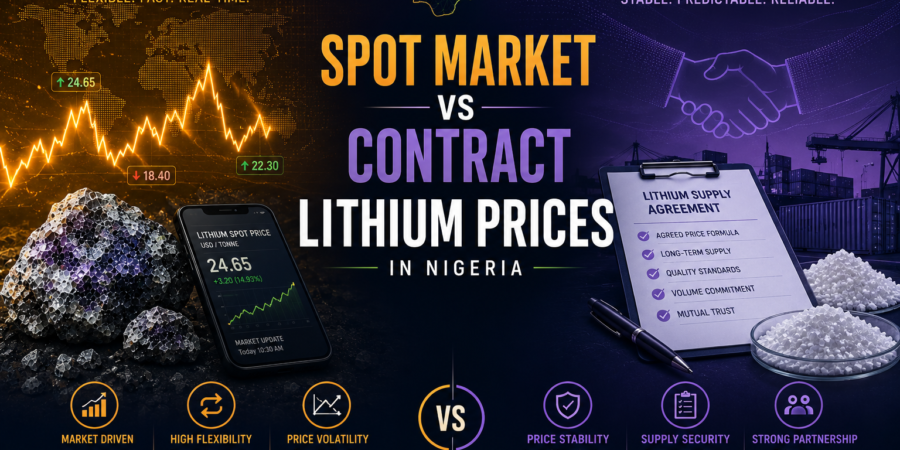
As Nigeria’s lithium industry becomes more integrated into global battery-mineral supply chains, suppliers are increasingly encountering two different pricing systems that shape how lithium is bought and sold around the world. The first is the spot market. The second is the contract market. Understanding the difference between these two systems is important because they often influence not only pricing outcomes but also how buyers approach procurement, how suppliers plan production, and how long-term commercial relationships are built.
For many participants entering the lithium industry, the distinction can seem confusing at first. Yet it sits at the center of how modern mineral procurement operates. The spot market is the simpler of the two concepts. A spot transaction is essentially an immediate or near-term purchase agreement. A buyer identifies available material, evaluates the quality, negotiates a price, and purchases the inventory for delivery within a relatively short timeframe. In a spot market environment, pricing tends to reflect current market conditions.
If demand is strong and buyers are competing aggressively for available supply, spot prices may rise quickly. If supply exceeds demand, spot prices can weaken just as rapidly. This responsiveness is one reason spot markets attract attention. They provide a real-time reflection of market sentiment. For suppliers, spot transactions can create opportunities to benefit from periods of strong demand and favorable pricing conditions. When buyers urgently need inventory, competition for available material can intensify, sometimes creating attractive commercial opportunities for suppliers.
However, spot markets also carry uncertainty. The same market forces that can drive prices upward can also push them downward. Suppliers relying exclusively on spot transactions may experience significant fluctuations in revenue depending on broader market conditions. This volatility is one reason many industrial buyers prefer not to depend entirely on spot-market sourcing. Instead, they increasingly use contract-based procurement systems.
Contract pricing operates differently. Rather than purchasing material on a shipment-by-shipment basis, buyers and suppliers establish longer-term commercial arrangements that define how supply will be provided over an extended period. The objective is stability. A contract relationship allows both parties to plan more effectively. Buyers gain greater confidence regarding future supply availability. Suppliers gain greater visibility regarding future demand.
In industries such as battery manufacturing, mineral processing, and chemical production, this predictability can be extremely valuable. Production facilities cannot easily operate on uncertainty alone. They require reliable access to raw materials. As a result, many large procurement systems increasingly prioritize long-term sourcing relationships rather than relying exclusively on the spot market. This trend is becoming more visible within Nigeria’s lithium sector. As international buyers deepen their involvement in the country, the conversation is gradually shifting from “What inventory is available today?” toward “Who can support our supply requirements over the next several years?”
That shift has important implications for suppliers. Under a contract-based approach, buyers often evaluate factors that extend beyond the quality of a single shipment. They become increasingly interested in supply continuity, operational reliability, logistics coordination, inventory management, and procurement professionalism. The focus moves from isolated transactions toward long-term commercial capability.
This is one reason consistency is becoming increasingly valuable within the Nigerian lithium market. A supplier seeking contract opportunities must demonstrate more than the ability to deliver material once. The supplier must demonstrate the ability to deliver repeatedly. This requirement influences how buyers assess risk. In a spot transaction, the buyer is primarily evaluating the current shipment. In a contract arrangement, the buyer is evaluating the future. Questions about resource availability, supply scalability, quality consistency, transportation systems, aggregation networks, and operational discipline become increasingly important.
As a result, the suppliers best positioned to participate in long-term procurement relationships are often those capable of operating within organized supply-chain structures. Aggregation plays a particularly important role here. Much of Nigeria’s lithium supply originates from decentralized mining areas spread across multiple states. Aggregation systems help consolidate this fragmented supply into commercially meaningful inventory capable of supporting larger procurement requirements. For buyers considering long-term sourcing arrangements, aggregation provides greater confidence that supply commitments can be fulfilled consistently over time. This is one reason aggregation is becoming an increasingly strategic component of the lithium economy.
The rise of commercial coordination hubs such as Abuja reflects the same broader trend. Although Abuja is not primarily a mining location, it is increasingly becoming a center for procurement coordination, supplier engagement, aggregation activities, logistics planning, and commercial negotiations. These functions become particularly important when procurement relationships extend beyond individual transactions and into long-term supply arrangements.
Another important distinction between spot and contract pricing involves market visibility. Spot prices often receive more attention because they appear to provide immediate indications of market conditions. However, many of the world’s largest lithium procurement relationships operate through negotiated agreements rather than purely through spot-market transactions. As a result, the visible market is not always the entire market. Some of the most significant commercial relationships are built through long-term partnerships designed to reduce uncertainty for both buyers and suppliers.
This is increasingly relevant for Nigeria because the country’s lithium sector remains in a development phase. As the industry matures, more procurement activity is likely to shift toward structured sourcing arrangements that emphasize stability, reliability, and long-term collaboration. The suppliers who understand this evolution early may be better positioned to participate in future growth opportunities.
The Nigerian Mineral Exchange (NME) is actively supporting this transition by helping connect suppliers, buyers, aggregators, logistics providers, and procurement networks across Nigeria’s growing lithium ecosystem. For international procurement groups, battery-material companies, commodity traders, mineral processors, and investors evaluating sourcing opportunities in Nigeria, NME provides support in supplier identification, procurement coordination, aggregation access, and market intelligence.
NME also serves as a Foreign or International Buyer Representative in Nigeria, helping international organizations establish trusted local procurement visibility through supplier engagement, due diligence, sourcing coordination, logistics intelligence, and market-entry support. This allows foreign buyers to evaluate both spot-market opportunities and long-term supply partnerships with greater confidence and local market insight.
At the same time, NME works with lithium suppliers across Northern Nigeria who are seeking access to serious buyers, structured procurement opportunities, and long-term commercial relationships. Organizations or individuals seeking buyers, sourcing support, supplier verification, procurement coordination, market-entry guidance, aggregation partnerships, or local buyer representation can engage NME directly through WhatsApp (+2348130799304).
As Nigeria’s lithium industry continues evolving, both spot and contract pricing will likely play important roles within the market. The spot market will continue providing flexibility and immediate trading opportunities. Contract relationships will continue providing stability and long-term supply assurance. Understanding how these two systems interact is essential because the future lithium economy will not be built solely on individual transactions. It will be built on the relationships, procurement structures, and supply-chain systems that connect those transactions into sustainable commercial networks.
Related Articles
- How to Source Lithium Ore in Nigeria in 2026
- How to Secure Large-Scale Lithium Ore Supply in Abuja: The NME Industrial Sourcing Guide
- We Are Buying Lithium Ore in Nigeria (From 1% Li₂O and Above) | Abuja Warehouse
- Strategic States in Nigeria’s Lithium Economy
- How NME Supports Lithium Procurement in Nigeria
- Why Northern Nigeria Could Dominate Lithium Supply
- What Is the Minimum Lithium Grade Buyers Accept?
- Battery-Grade Lithium Explained
- Forecasting Nigeria’s Lithium Market Potential
- What Lithium Buyers Look For Before Purchase
- How Buyers Negotiate Lithium Prices in Nigeria
- Informal Mining and Lithium Supply Networks in Nigeria
- Why Local Partnerships Matter in Lithium Trade
- Developing Sustainable Lithium Supply Networks in Nigeria
- Lithium Procurement Strategy for Foreign Buyers in Nigeria



Leave a Reply