
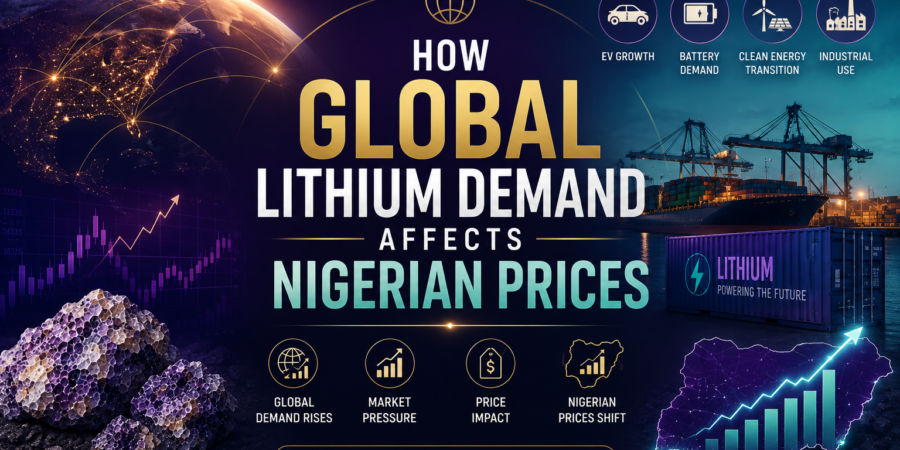
A miner in Nasarawa, an aggregator in Abuja, and a buyer evaluating supply opportunities in Nigeria may sometimes feel disconnected from events taking place in China, Europe, or North America. In reality, they are not. One of the defining characteristics of the modern lithium industry is that local prices are increasingly influenced by global developments. A procurement manager negotiating a lithium purchase in Nigeria today is often responding not only to local market conditions but also to forces operating across the international battery economy.
This is because lithium has become one of the most globally interconnected minerals of the twenty-first century. Unlike many traditional commodities that are consumed primarily within local or regional markets, lithium sits at the center of an international industrial ecosystem that includes electric vehicles, battery manufacturing, energy storage systems, consumer electronics, and renewable energy infrastructure. As a result, demand signals originating thousands of kilometers away can eventually influence pricing discussions taking place in Nigerian mining communities. Understanding this relationship is becoming increasingly important for suppliers, buyers, and investors seeking to participate effectively in Nigeria’s growing lithium economy.
At its core, lithium pricing is driven by the balance between supply and demand. When global demand for lithium grows faster than available supply, buyers become more aggressive in securing material. Competition for inventory increases, procurement systems expand their sourcing efforts, and new jurisdictions attract attention from international buyers searching for additional supply. Nigeria benefits from this environment because rising global demand often encourages buyers to explore emerging sourcing destinations.
The opposite can also occur. When global supply expands rapidly or demand growth slows, buyers generally become more selective. Procurement systems may delay purchases, negotiate more aggressively, or focus on established supplier relationships. In such environments, price pressure can emerge across multiple producing regions, including Nigeria. This dynamic explains why lithium prices can sometimes move independently of local mining activity. A supplier may see no major change within a particular mining area and still experience shifts in buyer behavior because the factors driving those decisions are occurring elsewhere in the global supply chain.
The strongest driver of lithium demand today remains the battery industry. Electric vehicles have fundamentally altered the lithium market over the last decade. As governments, manufacturers, and consumers continue investing in electrification, battery production has expanded significantly across several major economies. Every new battery manufacturing facility creates additional demand for raw materials moving through the broader supply chain.
While Nigerian lithium ore may be several steps removed from a finished battery, it ultimately participates in the same economic system. This means developments within battery manufacturing can eventually influence procurement decisions taking place in Nigeria. Energy storage systems are creating a second major source of demand.
As renewable energy deployment accelerates globally, large-scale battery storage projects are becoming increasingly important for balancing electricity grids and supporting energy reliability. These systems require substantial quantities of battery materials, further strengthening long-term demand for lithium-related products. For Nigerian suppliers, this trend is important because it expands the number of industries competing for lithium supply. The result is a market that increasingly operates on a global scale rather than a purely regional one.
China occupies a particularly important position within this equation. A significant portion of the world’s battery manufacturing, mineral processing, and lithium refining capacity is concentrated within Chinese industrial supply chains. Consequently, purchasing decisions made by Chinese processors and battery manufacturers often influence procurement activity across multiple continents. This helps explain why Nigerian suppliers frequently encounter Chinese sourcing companies, commodity traders, and procurement representatives operating within the local market.
These organizations are responding to demand originating much further downstream in the battery value chain. As Nigeria’s lithium sector continues developing, its relationship with international procurement systems is likely to deepen. This is one reason pricing discussions increasingly involve more than simply local supply conditions. Buyers are paying attention to battery demand, processing capacity, global inventory levels, electric vehicle production, and international market sentiment. All of these factors can influence how aggressively procurement systems pursue new supply opportunities.
However, global demand alone does not determine price. The way Nigeria organizes its supply chain also matters. As international buyers search for reliable sourcing opportunities, they are increasingly looking beyond geology and evaluating the broader procurement environment. Questions about supply continuity, aggregation systems, logistics coordination, supplier verification, and inventory visibility are becoming increasingly important. This means that even in periods of strong global demand, suppliers who cannot meet industrial procurement requirements may struggle to capture the full value of market opportunities.
Conversely, suppliers operating within organized sourcing networks may be better positioned to benefit when demand strengthens. This is one reason aggregation is becoming increasingly important within Nigeria’s lithium economy. Aggregation helps transform fragmented regional supply into commercially organized inventory capable of supporting industrial procurement systems. As global demand increases, buyers generally prefer sourcing environments that provide visibility, consistency, and operational reliability. The organizations capable of providing these characteristics often become more attractive procurement partners.
Abuja’s growing role within the lithium industry reflects this broader trend. Although the city is not primarily a mining center, it is increasingly becoming a coordination hub where suppliers, aggregators, logistics providers, procurement professionals, and international buyers interact. As the market matures, such coordination centers may play an increasingly important role in connecting global demand with Nigerian supply.
Another important trend is the growing preference for long-term procurement relationships. In the early stages of lithium market development, many transactions were opportunistic. Today, industrial buyers increasingly seek predictable supply arrangements that reduce procurement risk and improve operational planning. This shift creates opportunities for suppliers capable of demonstrating consistency, reliability, quality control, and supply continuity. As global demand continues evolving, these attributes may become just as important as the lithium itself.
The Nigerian Mineral Exchange (NME) is positioning itself within this changing environment by helping connect suppliers, buyers, aggregators, logistics providers, and procurement networks across Nigeria’s growing lithium ecosystem.
For international procurement groups, battery-material companies, commodity traders, mineral processors, and investors evaluating opportunities within Nigeria, NME provides support in supplier identification, procurement coordination, aggregation access, and market intelligence.
NME also serves as a Foreign or International Representative in Nigeria, supporting international organizations seeking on-ground procurement visibility, supplier engagement, due diligence, sourcing coordination, logistics intelligence, and market-entry support without the immediate need to establish a local operational presence.
At the same time, NME continues to engage with lithium suppliers across Northern Nigeria who are interested in accessing structured procurement opportunities and developing long-term commercial relationships with serious buyers.
Organizations or individuals seeking buyers, sourcing support, supplier verification, procurement coordination, market-entry guidance, aggregation partnerships, or local buyer representation can engage NME directly through WhatsApp (+2348130799304).
As Nigeria becomes more integrated into global battery-mineral supply chains, understanding international demand dynamics will become increasingly important. Because the future price of lithium ore in Nigeria will not be determined solely by what happens at the mine site. It will also be shaped by decisions being made in battery factories, processing plants, energy-storage projects, and procurement offices around the world.
Related Articles
- How to Source Lithium Ore in Nigeria in 2026
- How to Secure Large-Scale Lithium Ore Supply in Abuja: The NME Industrial Sourcing Guide
- We Are Buying Lithium Ore in Nigeria (From 1% Li₂O and Above) | Abuja Warehouse
- Strategic States in Nigeria’s Lithium Economy
- How NME Supports Lithium Procurement in Nigeria
- Why Northern Nigeria Could Dominate Lithium Supply
- What Is the Minimum Lithium Grade Buyers Accept?
- Battery-Grade Lithium Explained
- Forecasting Nigeria’s Lithium Market Potential
- What Lithium Buyers Look For Before Purchase
- How Buyers Negotiate Lithium Prices in Nigeria
- Spot Market vs Contract Lithium Prices in Nigeria
- Informal Mining and Lithium Supply Networks in Nigeria
- Why Local Partnerships Matter in Lithium Trade
- Developing Sustainable Lithium Supply Networks in Nigeria
- Lithium Procurement Strategy for Foreign Buyers in Nigeria

Leave a Reply