
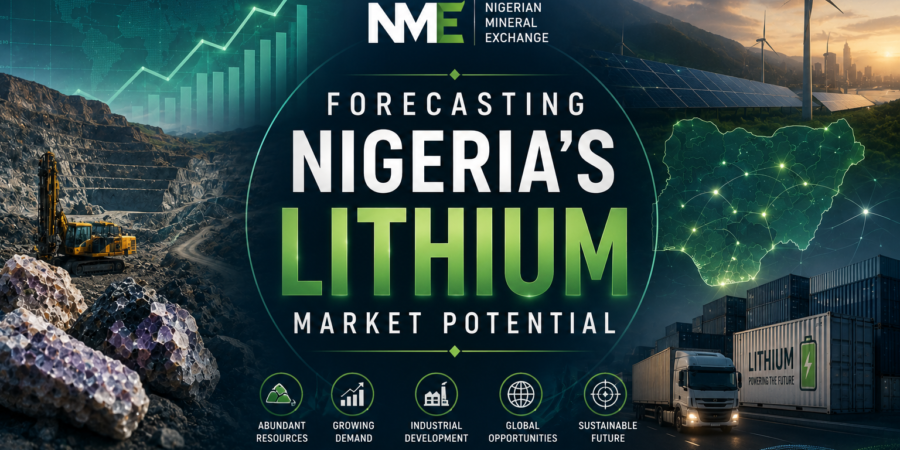
Every emerging mining industry eventually reaches a point where a fundamental question begins to dominate discussions among investors, suppliers, policymakers, and international buyers: “How big can this become?” Nigeria’s lithium sector has now reached that stage.
Over the past few years, lithium has evolved from a relatively obscure mineral discussed mainly within geological circles into one of the most closely watched commodities in the global energy transition. As electric vehicles, battery storage systems, renewable energy infrastructure, and advanced manufacturing industries continue expanding, countries with lithium resources are attracting unprecedented attention from investors and procurement organizations. Nigeria is increasingly part of that conversation. Yet forecasting the country’s lithium market potential requires looking beyond headlines and examining the structural forces shaping the industry’s future.
The first reason for optimism is straightforward. Global demand for lithium continues to grow. Although lithium markets have experienced periods of volatility and price corrections, the long-term demand outlook remains supported by the expansion of battery manufacturing, energy storage systems, and electrification technologies. Industry forecasts continue to anticipate substantial growth in lithium consumption over the coming decades, driven by both electric vehicles and large-scale battery storage applications. Demand from energy storage systems is emerging as an especially important growth driver alongside the electric vehicle sector.
This matters because Nigeria is not developing its lithium sector in isolation. The country’s future is increasingly linked to a global market that is expected to require vast quantities of battery minerals. Even as supply expands in different regions, the long-term challenge for the industry remains securing reliable and diversified sources of material.
The second reason Nigeria’s market potential is attracting attention lies in the country’s geological endowment. Lithium-bearing pegmatites have been identified across multiple states, particularly within Northern Nigeria. Over time, continued exploration is likely to improve understanding of resource quality, distribution, and commercial viability. Industry observers increasingly view Nigeria as one of Africa’s emerging lithium jurisdictions, capable of contributing meaningfully to future global supply chains.
However, geology alone does not determine market potential. Many countries possess mineral resources but fail to convert those resources into sustainable industries. The more important question is whether supporting systems emerge around those resources. This is where the future of Nigeria’s lithium industry becomes particularly interesting.
The country’s long-term opportunity may extend far beyond mining. A great deal of attention has been focused on extraction, but the larger economic opportunity lies within the broader ecosystem that develops around lithium. This includes aggregation, logistics, warehousing, procurement, quality assurance, processing, market intelligence, supplier verification, and export coordination. As the industry matures, these supporting activities may generate as much economic significance as mining itself. In many respects, Nigeria’s greatest opportunity may be to become a supply-chain hub rather than simply a source of raw material. Recent investments provide some indication of this direction.
Government efforts to encourage local value addition and investments in lithium processing facilities suggest a growing recognition that greater value can be captured when minerals move further along the industrial chain before export. Nigeria has already attracted significant investment into lithium processing projects and beneficiation initiatives. This shift is strategically important. The countries that capture the greatest benefits from critical minerals are often not those that simply extract them. They are the countries that build commercial, industrial, and logistical ecosystems around them. Nigeria has an opportunity to pursue that path.
Another reason for optimism is geography. Nigeria occupies a strategic position within West Africa and possesses one of the continent’s largest economies. With sufficient infrastructure and investment, the country could potentially serve not only domestic lithium production but also broader regional supply-chain functions. Some analysts have suggested that Nigeria could eventually emerge as a regional processing and logistics hub for critical minerals.
The rise of Abuja as a commercial coordination center reflects this possibility. While Abuja is not a major mining location, it is increasingly becoming a point where suppliers, aggregators, logistics providers, investors, and international buyers interact. Over time, such coordination hubs can play a significant role in improving market efficiency, procurement visibility, and commercial organization.
Yet a realistic forecast must also acknowledge challenges. No emerging mining industry develops without obstacles. Nigeria’s lithium sector must continue addressing issues relating to infrastructure, logistics, security management, formalization, processing capacity, and market organization. The Federal Government has undertaken several reforms aimed at strengthening the mining sector, encouraging investment, improving governance, promoting local processing, and combating illegal mining. These efforts are important because long-term market potential depends not only on resource availability but also on the strength of the institutions governing the sector.
It is also important to recognize that global lithium markets remain cyclical. The industry has experienced both dramatic booms and significant downturns over the past several years. Recent market developments demonstrate that while long-term demand remains strong, pricing can fluctuate substantially as supply and demand adjust. Analysts generally expect continued volatility even as the long-term outlook remains positive.
For Nigeria, this means success cannot be built solely around commodity prices. The stronger strategy is to build durable industry infrastructure that remains valuable across different market cycles. This includes reliable supplier networks, efficient logistics systems, aggregation capacity, market intelligence platforms, procurement coordination mechanisms, and investor-friendly commercial structures.
These assets continue creating value regardless of short-term price movements. Looking ahead, the most significant indicator of Nigeria’s lithium market potential may not be the number of tons mined. It may be the extent to which the country develops the institutions, supply chains, and commercial ecosystems required to support a modern battery-mineral economy. That process is already underway.
The Nigerian Mineral Exchange (NME) is positioning itself within this emerging ecosystem by helping connect suppliers, buyers, aggregators, logistics providers, and procurement networks across Nigeria’s growing lithium market. For international procurement groups, battery-material companies, commodity traders, mineral processors, and investors evaluating opportunities in Nigeria, NME provides support in supplier identification, procurement coordination, aggregation access, and market intelligence.
NME also serves as a Foreign Buyer or International Buyer Representative in Nigeria, helping international organizations establish an effective on-ground presence through supplier engagement, due diligence, procurement coordination, logistics visibility, market-entry support, and local representation. This enables foreign buyers to navigate Nigeria’s evolving lithium sector with greater confidence while building long-term sourcing relationships.
At the same time, NME continues to engage with lithium suppliers across Northern Nigeria who are seeking access to serious buyers, structured procurement opportunities, and long-term commercial partnerships. Organizations or individuals seeking lithium buyers, sourcing support, supplier verification, procurement coordination, market-entry guidance, aggregation partnerships, or local buyer representation can engage NME directly through WhatsApp (+2348130799304).
The future of Nigeria’s lithium industry remains unwritten, but one thing is increasingly clear: The country’s opportunity is larger than lithium alone. It is the opportunity to build a strategic position within one of the world’s most important emerging industrial supply chains, and the nations that successfully build those positions are often the ones that capture the greatest long-term value.
Related Articles
- How to Source Lithium Ore in Nigeria in 2026
- How to Secure Large-Scale Lithium Ore Supply in Abuja: The NME Industrial Sourcing Guide
- Strategic States in Nigeria’s Lithium Economy
- How NME Supports Lithium Procurement in Nigeria
- Why Northern Nigeria Could Dominate Lithium Supply
- What Is the Minimum Lithium Grade Buyers Accept?
- What Lithium Buyers Look For Before Purchase
- Informal Mining and Lithium Supply Networks in Nigeria
- Why Local Partnerships Matter in Lithium Trade
- Developing Sustainable Lithium Supply Networks in Nigeria
- Lithium Procurement Strategy for Foreign Buyers in Nigeria


Leave a Reply