
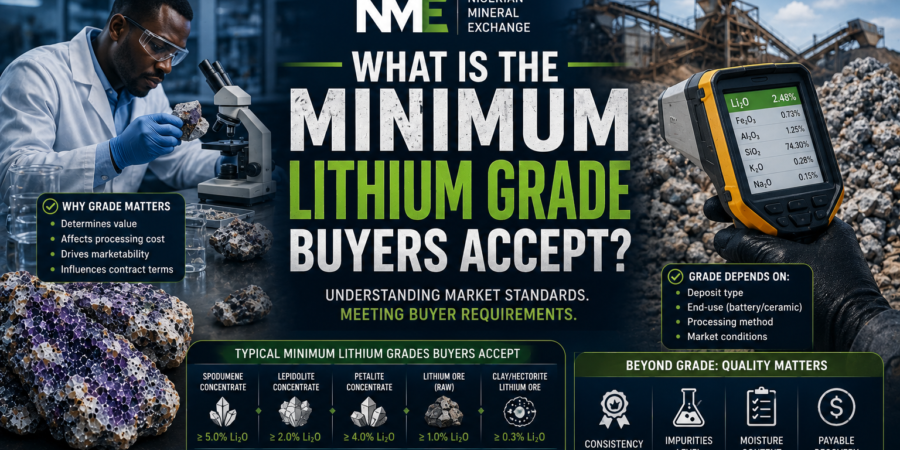
One of the most common questions within Nigeria’s growing lithium industry is: what is the minimum lithium grade buyers accept? This question is extremely important because many suppliers, miners, and aggregators often assume that any lithium-bearing material automatically has strong commercial value. But in reality, lithium buyers carefully evaluate ore quality before making purchasing decisions.
In most lithium transactions, one of the first things buyers assess is lithium grade. The lithium grade helps determine commercial viability, processing potential, transportation economics, and overall profitability. Understanding how lithium grades work can help suppliers avoid rejection, negotiate more effectively, prepare materials properly, and participate more professionally within Nigeria’s evolving lithium market. This guide explains what lithium grades mean, how buyers evaluate them, and the factors influencing minimum acceptable lithium grades in Nigeria.
What Is Lithium Grade?
Lithium grade refers to the concentration of lithium present within the ore. In lithium trading, this is commonly expressed as Li₂O percentage (Lithium Oxide percentage). The Li₂O percentage helps buyers estimate how much lithium is contained in the material, processing efficiency, and potential commercial value. Generally, higher Li₂O percentages attract stronger commercial interest, while lower grades may require additional processing or beneficiation.
However, lithium grade alone does not determine value. Buyers also consider mineral type, impurities, moisture, logistics, consistency, and processing requirements.
The Most Common Lithium Ore Types in Nigeria
Nigeria’s emerging lithium industry is commonly associated with Spodumene/Kunzite, Lepidolite, and Amblygonite. Each mineral type have different lithium concentrations, associated minerals, processing characteristics, and market demand. Because of this, buyers do not evaluate all lithium-bearing materials in the same way. Proper mineral identification and laboratory testing are therefore very important before entering supply discussions.
Why Minimum Grade Matters to Buyers
Lithium buyers are not simply buying mineralized rocks. They are evaluating lithium concentration, processing economics, transportation costs, and potential profitability. Low-grade materials may become commercially difficult because transportation costs remain high, processing becomes less efficient, recovery rates may decline, and waste volumes increase. This is why every buyer usually establishes minimum acceptable grades before purchasing.
Is There One Universal Minimum Grade?
No. There is no single universal lithium grade accepted by all buyers. Minimum acceptable grades vary depending on buyer objectives, processing technology, export markets, logistics costs, and commercial strategy. Some buyers may focus on high-grade direct shipping ore, while others may accept lower-grade materials for beneficiation or blending. This is why suppliers should avoid assuming that all buyers operate under the same standards.
Why High-Grade Lithium Ore Is Preferred
Higher-grade lithium ore generally offers stronger processing economics, reduced waste, lower transportation inefficiencies, and better recovery potential. For buyers handling large volumes, even small differences in lithium concentration can significantly affect profitability. This is especially important in international supply chains where shipping, handling, and processing costs must be carefully managed.
The Role of Assays in Determining Grade
Lithium grade cannot be reliably confirmed through appearance alone. This is why serious buyers rely heavily on assay testing. Assays help determine Li₂O percentage, impurities, mineral composition, and overall ore quality. Without proper assays, suppliers may misunderstand ore value, enter weak negotiations, or face rejection during procurement discussions. Testing therefore plays a major role in modern lithium trading.
Why Some Ore Gets Rejected Despite Having Lithium
Many suppliers become confused when lithium-bearing material gets rejected. This often happens because the lithium concentration is too low, impurities are excessive, moisture levels are high, or the ore is commercially inefficient. Having lithium present does not automatically mean the material is economically attractive to buyers. Commercial viability depends on multiple interconnected factors.
Factors Buyers Consider Alongside Grade
Lithium buyers rarely evaluate grade alone. They also assess consistency, contamination, moisture content, logistics, mineral type, accessibility, and supplier reliability. For example, a moderate-grade ore with strong consistency and clean material may sometimes attract more interest than inconsistent high-grade ore. This is why professionalism and quality control matter increasingly within the lithium market.
Understanding Commercially Attractive Ore
Commercially attractive lithium ore usually combines reasonable lithium concentration, manageable impurities, good consistency, proper handling, and efficient logistics. Buyers seek materials that fit smoothly into processing systems, transportation plans, and supply chain operations. This is why suppliers who understand buyer expectations often negotiate more effectively.
Looking to Discuss Lithium Supply Opportunities?
The Nigerian Mineral Exchange (NME) is working to support more structured lithium trade systems across Nigeria through supplier coordination, buyer connections, aggregation support, and increasing visibility for Nigeria’s growing battery mineral ecosystem. Suppliers interested in discussing lithium ore evaluation, supply opportunities, aggregation, or buyer coordination can contact NME on WhatsApp (08130799304) for further engagement.
Why Consistency Sometimes Matters More Than Peak Grade
Some suppliers focus only on obtaining one high assay result. However, many professional buyers care more about consistent supply quality. If one batch tests well, but later deliveries decline significantly in quality, buyers may lose confidence in the supplier. Long-term supply relationships depend heavily on predictability, consistency, and operational trust. This is why professional procurement systems emphasize quality control.
Beneficiation and Lower-Grade Ore
Not all lower-grade ore is automatically rejected. In some cases, beneficiation, concentration, blending, or additional processing may improve commercial attractiveness. However, beneficiation introduces extra costs, operational complexity, and additional logistics considerations. Buyers therefore evaluate whether lower-grade materials remain economically practical after processing.
Why Logistics Affect Grade Decisions
Logistics can strongly influence what buyers consider commercially acceptable. For example, low-grade ore located far from transportation infrastructure may become less attractive because transportation costs consume too much value. Meanwhile, higher-grade ore may justify longer transportation distances because it offers stronger processing economics. This is why logistics and grade are closely connected within lithium supply chains.
The Growing Importance of Structured Quality Standards
As Nigeria’s lithium market continues evolving, quality standards are gradually becoming more structured. The industry is moving toward better testing systems, more organized aggregation, professional procurement, and stronger quality control. Suppliers who understand lithium grades, assay procedures, and buyer expectations may position themselves more effectively within the future lithium economy.
How Suppliers Can Improve Their Position
Suppliers can improve commercial attractiveness by focusing on proper testing, clean material handling, good sorting practices, realistic pricing, consistent quality, and professional communication. Even moderate improvements in operational discipline can significantly improve buyer confidence. Professionalism increasingly matters within the lithium trade.
Final Thoughts
There is no single universal minimum lithium grade accepted by all buyers. Buyers evaluate lithium ore based on Li₂O percentage, mineral type, impurities, consistency, logistics, processing economics, and commercial practicality.
As Nigeria’s lithium industry continues developing, suppliers who understand how buyers evaluate lithium grades will likely negotiate more effectively and reduce rejection risks. The future lithium market will increasingly favor tested materials, organized suppliers, consistent quality, and transparent procurement systems. Understanding lithium grades is therefore one of the most important foundations for successful participation in Nigeria’s growing lithium supply chain.
Related Articles
- How to Source Lithium Ore in Nigeria in 2026
- How to Secure Large-Scale Lithium Ore Supply in Abuja: The NME Industrial Sourcing Guide
- Strategic States in Nigeria’s Lithium Economy
- How NME Supports Lithium Procurement in Nigeria
- Why Northern Nigeria Could Dominate Lithium Supply
- What Lithium Buyers Look For Before Purchase
- Informal Mining and Lithium Supply Networks in Nigeria
- Why Local Partnerships Matter in Lithium Trade
- Developing Sustainable Lithium Supply Networks in Nigeria
- Lithium Procurement Strategy for Foreign Buyers in Nigeria


Leave a Reply