
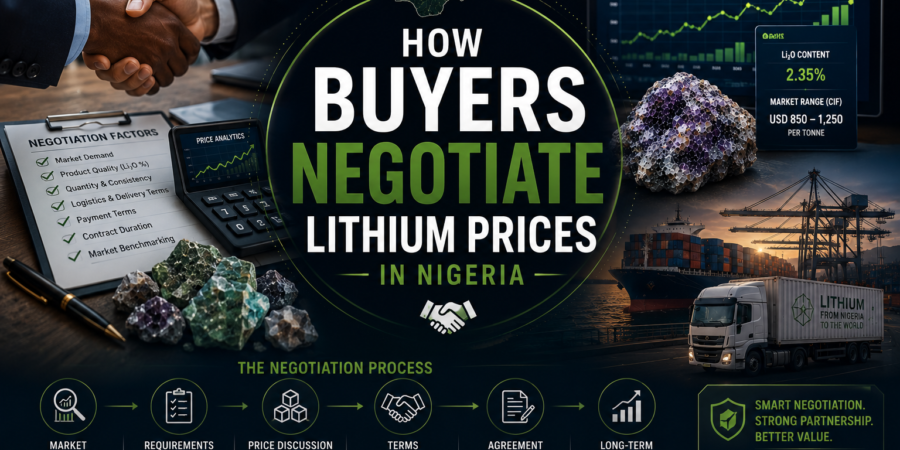
One of the biggest misconceptions in Nigeria’s lithium industry is that buyers arrive at a mine site, inspect the ore, and immediately offer a price based solely on lithium grade. In reality, professional lithium procurement is rarely that simple. Behind every pricing discussion lies a negotiation process shaped by technical assessments, supply-chain considerations, market conditions, logistics realities, and commercial risk. The final price attached to a shipment often reflects a combination of factors that extend far beyond the assay result alone. Understanding how buyers negotiate prices is important for suppliers because it helps explain why two seemingly similar transactions can produce very different outcomes. More importantly, it helps suppliers understand how to position themselves more effectively within an increasingly sophisticated market.
The starting point for most negotiations is usually quality. Before discussing commercial terms, serious buyers typically seek to understand what they are actually purchasing. This is why assay reports have become such an important part of modern lithium procurement. The first question is often not: “What price are you offering?” It is: “What quality of material are we discussing?” Lithium concentration, commonly expressed through Li₂O percentage, provides buyers with an initial indication of potential value. However, experienced procurement teams rarely stop there. They also evaluate ore purity, consistency, moisture content, particle characteristics, and the reliability of available test results.
From the buyer’s perspective, pricing begins with understanding risk. The more uncertainty surrounding the material, the more cautious the negotiation process tends to become. This is one reason why suppliers who invest in proper testing and documentation often find themselves in stronger negotiating positions. They reduce uncertainty before commercial discussions even begin.
Another important factor in price negotiations is volume. Industrial procurement systems generally prefer scale. A buyer evaluating a recurring supply opportunity may approach negotiations differently from a buyer considering a small one-time shipment. Larger volumes can create operational efficiencies involving transportation, inventory management, and procurement planning. For this reason, suppliers capable of supporting meaningful and recurring supply volumes often attract greater attention from serious buyers.
The discussion then shifts from a simple transaction toward a longer-term commercial relationship. This evolution is becoming increasingly visible within Nigeria’s lithium market. Many international buyers are no longer searching only for isolated cargo opportunities. They are seeking suppliers capable of supporting continuity. As a result, negotiations increasingly involve discussions about future supply potential rather than only current inventory.
Logistics also play a surprisingly important role in pricing conversations. From a supplier’s perspective, the focus may naturally remain on the ore itself. Buyers, however, evaluate the entire journey from source to destination. Questions relating to transportation, aggregation, warehousing, inventory accessibility, and shipment coordination often influence commercial decisions.
A buyer may be willing to pay more for material that can move through a reliable and organized supply chain than for similar material associated with logistical uncertainty. This reflects a broader reality within the battery-mineral economy. Procurement is increasingly becoming a supply-chain discipline rather than simply a commodity-purchasing exercise. As Nigeria’s lithium ecosystem matures, this trend is likely to become even more pronounced.
Market conditions also influence negotiation dynamics. Buyers do not negotiate in isolation from the wider lithium market. When global demand is strong and procurement competition increases, buyers may become more flexible in their commercial approach. During periods of market uncertainty or softer demand, they often become more selective and price-sensitive. This means that negotiations taking place in Nigeria are increasingly influenced by developments occurring across international battery supply chains. A procurement manager negotiating a lithium purchase in Abuja may be responding to market signals originating from battery manufacturers, processing facilities, or commodity markets located thousands of kilometers away.
Relationship history can also affect pricing outcomes. In many emerging mineral markets, trust has significant commercial value. A supplier with a proven record of delivering consistent quality, maintaining communication, honoring agreements, and supporting reliable logistics often enjoys advantages that extend beyond individual shipments. Buyers prefer predictability. Every uncertainty introduces risk into the procurement process. As a result, long-term suppliers frequently find themselves negotiating from stronger positions than newcomers whose operational capabilities have not yet been demonstrated. This is one of the reasons the industry is gradually moving away from purely transactional trading and toward relationship-based procurement systems.
Another aspect of negotiation that suppliers sometimes overlook is buyer economics. A buyer is not purchasing lithium ore for the sake of owning lithium ore. The material is expected to move through additional stages involving processing, refining, transportation, inventory management, and downstream industrial applications. Every step introduces costs.
Consequently, buyers negotiate prices based not only on the current characteristics of the material but also on their expectations regarding future expenses and potential returns. Understanding this perspective can help suppliers appreciate why buyers often examine details that may initially appear unrelated to grade. From the buyer’s viewpoint, every factor affecting downstream economics matters.
As Nigeria’s lithium market evolves, one of the most noticeable trends is the increasing sophistication of procurement practices. The earliest phase of the lithium rush was often characterized by limited information, fragmented transactions, and informal pricing discussions. Today’s procurement environment is gradually becoming more structured. Buyers increasingly seek verified suppliers, organized aggregation systems, reliable logistics networks, quality documentation, and supply continuity. These developments are helping create a more professional marketplace where negotiations are based on a broader range of commercial considerations.
The rise of aggregation networks is reinforcing this transformation. Aggregation helps create larger, more organized inventory pools that can satisfy industrial procurement requirements. For buyers, this reduces sourcing complexity. For suppliers, it creates opportunities to participate in larger commercial ecosystems. As these systems mature, pricing negotiations may become increasingly focused on long-term value creation rather than short-term transactional advantages.
The Nigerian Mineral Exchange (NME) is actively supporting this evolution by helping connect suppliers, buyers, aggregators, logistics providers, and procurement networks across Nigeria’s growing lithium ecosystem. For international procurement groups, battery-material companies, commodity traders, mineral processors, and investors evaluating sourcing opportunities in Nigeria, NME provides support in supplier identification, procurement coordination, aggregation access, and market intelligence.
NME also serves as a Foreign Buyer or International Buyer Representative in Nigeria, helping international organizations establish trusted on-ground procurement visibility. Through supplier engagement, due diligence support, sourcing coordination, logistics intelligence, and local market representation, NME helps foreign buyers navigate Nigeria’s evolving lithium market with greater confidence and operational efficiency.
At the same time, NME works with lithium suppliers across Northern Nigeria who are seeking access to serious buyers and structured procurement opportunities. Organizations or individuals seeking buyers, sourcing support, supplier verification, procurement coordination, market-entry guidance, aggregation partnerships, or local buyer representation can engage NME directly through WhatsApp (+2348130799304).
As the industry continues maturing, successful negotiations will increasingly depend on more than simply agreeing on a number. They will depend on trust, information, logistics, quality, and the ability of both parties to participate effectively within a modern battery-mineral supply chain. Because in today’s lithium economy, the best prices are rarely determined by negotiation tactics alone. They are determined by the overall value that each participant brings to the procurement relationship.
Related Articles
- How to Source Lithium Ore in Nigeria in 2026
- How to Secure Large-Scale Lithium Ore Supply in Abuja: The NME Industrial Sourcing Guide
- Strategic States in Nigeria’s Lithium Economy
- How NME Supports Lithium Procurement in Nigeria
- Why Northern Nigeria Could Dominate Lithium Supply
- What Is the Minimum Lithium Grade Buyers Accept?
- Forecasting Nigeria’s Lithium Market Potential
- What Lithium Buyers Look For Before Purchase
- Informal Mining and Lithium Supply Networks in Nigeria
- Why Local Partnerships Matter in Lithium Trade
- Developing Sustainable Lithium Supply Networks in Nigeria
- Lithium Procurement Strategy for Foreign Buyers in Nigeria



Leave a Reply