
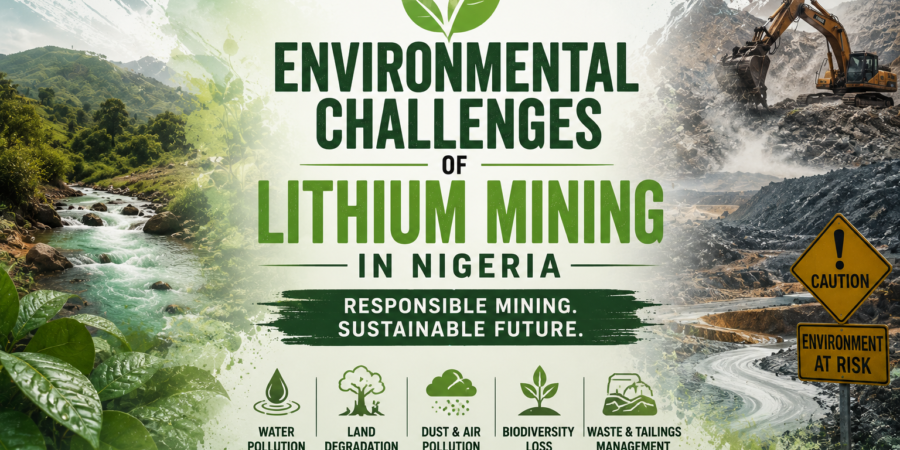
The global enthusiasm surrounding lithium is easy to understand. Lithium has become one of the foundational minerals of the modern energy transition. It supports electric vehicles, battery storage systems, renewable energy infrastructure, consumer electronics, and a growing range of technologies designed to reduce dependence on fossil fuels. Around the world, governments and industries increasingly view lithium as a strategic resource for the future. Yet every mineral opportunity comes with responsibilities. The same lithium that powers clean-energy technologies must first be extracted from the earth, transported through supply chains, processed, and integrated into industrial systems. These activities inevitably interact with the environment.
For Nigeria’s emerging lithium industry, understanding environmental challenges is therefore not simply a regulatory requirement. It is a strategic necessity. The long-term success of the sector will depend not only on how much lithium is produced, but also on how responsibly that production occurs. This is an important point because public discussions about mining often become polarized. One side focuses exclusively on economic opportunity. The other focuses exclusively on environmental concerns. The reality is that sustainable mining requires both perspectives. Economic development and environmental stewardship are not opposing objectives.
The strongest mining industries are those capable of balancing them effectively. As Nigeria’s lithium sector develops, this balance will become increasingly important. One of the most visible environmental challenges associated with mining is land disturbance. Before mineral extraction can occur, access roads, mining areas, stockpiles, and operational infrastructure often need to be established. These activities can alter landscapes and affect existing land uses. In regions where communities depend on land for agriculture, grazing, or other economic activities, careful planning becomes essential. The objective is not to prevent development. The objective is to ensure that development occurs in a way that minimizes unnecessary environmental disruption and supports long-term land management. This is why environmental planning has become a central component of modern mining projects worldwide.
Water management is another important consideration. Mining activities frequently require water for operational purposes, dust control, processing activities, and site management. At the same time, local communities often depend on the same water resources for domestic, agricultural, and economic needs. This creates a need for responsible water management strategies that balance industrial requirements with community interests and environmental protection. As Nigeria’s lithium industry grows, water stewardship is likely to become an increasingly important component of project planning and operational management.
Dust generation can also present environmental and community challenges. Mining operations involve excavation, material handling, transportation, and stockpiling activities that may generate airborne dust if not properly managed. Although dust management is a common issue across many forms of mining, its importance increases when operations occur near communities, agricultural areas, or transportation corridors. Fortunately, the mining industry possesses extensive experience with dust-control measures, and responsible operators increasingly integrate these practices into project design and day-to-day operations.
The management of waste materials is another important consideration. Not every ton of material extracted from a mining area ultimately becomes a marketable product. Mining operations often generate waste rock and other by-products that require proper handling and storage. The effectiveness of waste-management practices can significantly influence the environmental performance of a mining project. As investor expectations continue evolving, mining companies around the world are facing increasing pressure to demonstrate responsible waste-management systems.
Nigeria’s lithium sector is developing within this broader global environment. Community relations also form an important part of the environmental discussion. Environmental challenges rarely exist in isolation from social considerations. Local communities often experience both the benefits and impacts associated with mining activity. Employment opportunities, infrastructure improvements, and increased economic activity may emerge alongside concerns relating to land use, environmental management, and resource access. Successful mining projects increasingly recognize that environmental stewardship and community engagement are closely interconnected. Communities that feel informed, respected, and involved in development processes are often better positioned to participate positively in long-term industry growth. This is particularly relevant in Nigeria, where mining activities frequently occur within rural communities that play an important role in local economic systems.
Another important issue involves informal and unregulated mining activity. Around the world, environmental concerns are often most severe where mining occurs without adequate planning, oversight, or technical guidance. Informal operations may lack the resources, expertise, or incentives required to implement effective environmental management practices. As a result, strengthening formal mining systems can produce environmental benefits alongside economic benefits. The more mining activity moves into structured, regulated, and professionally managed frameworks, the greater the opportunities for implementing environmental standards and best practices. This is one reason why ongoing Federal Government efforts to formalize and strengthen Nigeria’s mining sector are important and commendable.
Improved regulation, stronger industry standards, enhanced monitoring, and increased professionalization can contribute to both environmental protection and industry development. The future of sustainable mining will depend not only on what is mined but also on how it is mined. Fortunately, environmental management is no longer viewed solely as a compliance issue. Increasingly, it is viewed as a competitive advantage. Investors, procurement organizations, battery manufacturers, and international buyers are paying closer attention to the environmental performance of mineral supply chains. Companies seeking long-term access to global markets often find that responsible environmental practices strengthen commercial credibility and improve investment attractiveness.
This trend is particularly important within the battery-mineral sector. The global energy transition is ultimately about sustainability. As a result, stakeholders increasingly expect the minerals supporting that transition to be produced responsibly. For Nigeria, this creates an opportunity. Rather than viewing environmental considerations as obstacles to development, the country can view them as part of building a stronger and more internationally competitive lithium industry. A well-managed sector can simultaneously support economic growth, employment creation, investment attraction, community development, and environmental protection. These objectives are not mutually exclusive. In fact, they are often mutually reinforcing. The future of Nigeria’s lithium industry will depend on creating systems that allow all of them to advance together.
The Nigerian Mineral Exchange (NME) is committed to supporting responsible development across Nigeria’s emerging lithium ecosystem by connecting suppliers, buyers, aggregators, logistics providers, investors, and procurement networks while promoting professional industry standards and long-term sector sustainability. For international procurement groups, battery-material companies, commodity traders, mineral processors, and investors evaluating opportunities in Nigeria, NME provides support in supplier identification, procurement coordination, aggregation access, market intelligence, and supply-chain visibility.
NME also serves as a Foreign or International Buyer Representative in Nigeria, helping international organizations establish trusted local market presence through supplier engagement, due diligence, sourcing coordination, logistics intelligence, procurement support, and market-entry assistance. This enables foreign buyers and investors to gain reliable visibility into Nigeria’s evolving lithium industry while supporting informed sourcing and investment decisions.
At the same time, NME continues to work with lithium suppliers across Northern Nigeria who are seeking access to serious buyers, structured procurement opportunities, and long-term commercial relationships. Organizations seeking sourcing support, supplier verification, procurement coordination, market-entry guidance, aggregation partnerships, or local buyer representation can engage NME directly through WhatsApp (+2348130799304).
Nigeria’s lithium resources present a significant economic opportunity. But the industry’s ultimate success will be measured by more than production volumes alone. It will also be measured by the ability to develop those resources in a manner that supports communities, protects the environment, attracts investment, and creates lasting value for future generations. That is the foundation of sustainable mining. And it is the path most likely to deliver enduring benefits from Nigeria’s growing lithium industry.
Related Articles
- Source Lithium Ore in Nigeria
- Sell Lithium Ore in Nigeria
- Abuja and Regional Lithium Commerce in Nigeria
- Logistics Challenges Across Northern Nigeria’s Lithium Trade
- How to Source Lithium Ore in Nigeria in 2026
- How to Secure Large-Scale Lithium Ore Supply in Abuja: The NME Industrial Sourcing Guide
- Northern Nigeria Lithium Trade Ecosystem
- Lithium Transportation Corridors in Northern Nigeria
- Why Lithium Investors Are Watching Northern Nigeria
- Lithium Mining Investments in Northern Nigeria
- Can Nigeria Become Africa’s Lithium Powerhouse?
- Lithium Deposits in Kogi State
- Why Local Partnerships Matter in Lithium Trade
- Future Lithium Trade Routes Across Nigeria
- Security Considerations in Lithium Operations
- Northern Nigeria’s Lithium Mining Corridors
- Lithium Trade in Kano State
- Niger State and the Nigerian Lithium Economy
- Lithium and Energy Storage Technologies
- Nigeria’s Emerging Battery Minerals Economy
Leave a Reply