
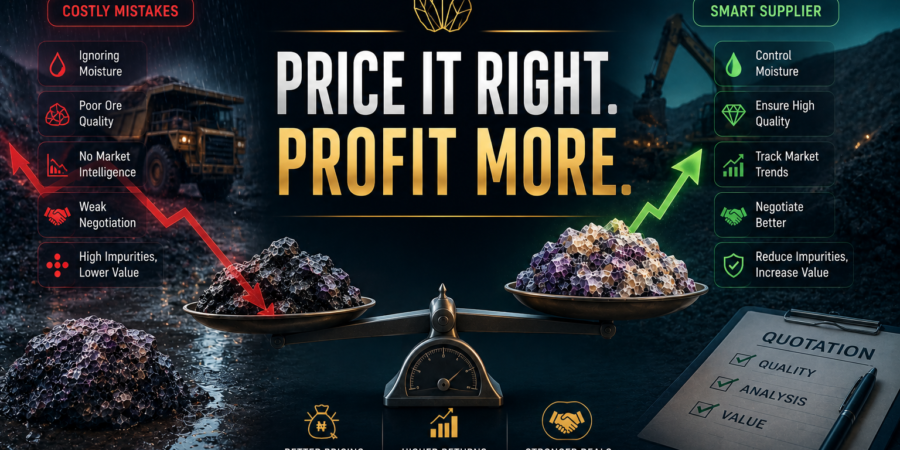
One of the most interesting developments in Nigeria’s lithium industry is that pricing mistakes are no longer limited to buyers. As the market matures, many suppliers are discovering that poor pricing decisions can be just as costly as poor procurement decisions. In some cases, suppliers lose potential revenue because they undervalue their material. In other situations, they lose serious buyers because they overestimate what the market is willing to pay. Between these two extremes lies a wide range of commercial mistakes that can affect profitability, buyer relationships, and long-term market positioning.
Understanding these mistakes is becoming increasingly important because Nigeria’s lithium market is gradually evolving from a speculative environment into a more structured procurement ecosystem. The suppliers who understand how value is created within modern battery-mineral supply chains will often be better positioned than those relying solely on rumors, assumptions, or short-term market excitement.
One of the most common mistakes suppliers make is assuming that lithium pricing is determined exclusively by grade. This misunderstanding is widespread, particularly among new market participants. Once a supplier receives an assay indicating a certain Li₂O percentage, there is often a tendency to focus almost entirely on that number. While grade remains one of the most important factors influencing valuation, professional buyers rarely base procurement decisions on grade alone. Buyers increasingly evaluate ore purity, consistency, moisture content, inventory reliability, logistics requirements, and supply continuity alongside lithium concentration.
A supplier may possess relatively strong assay results but still struggle to secure premium pricing if other aspects of the transaction create uncertainty for the buyer. In today’s market, quality is broader than grade. Another common mistake is pricing based on rumors rather than market realities. Lithium is a globally traded battery mineral, and information about prices often travels rapidly through mining communities, trading networks, and online platforms. Unfortunately, not all of that information is accurate. Suppliers frequently hear reports of exceptionally high-value transactions and assume those figures apply universally across the market.
What is often overlooked is the context behind those transactions. Pricing may vary depending on quality specifications, volume, location, supply-chain costs, contract structure, buyer requirements, and broader market conditions. A price achieved under one set of circumstances cannot automatically be applied to every other transaction. The most successful suppliers tend to focus on understanding market fundamentals rather than chasing rumors.
A third mistake involves ignoring logistics when evaluating value. Many suppliers naturally concentrate on what happens at the mine site. Buyers, however, are concerned with what happens after the material leaves the mine. Transportation, aggregation, warehousing, handling, and shipment coordination all influence procurement economics. A supplier who understands these realities often approaches pricing discussions differently from one who views valuation solely through the lens of extraction. As Nigeria’s lithium industry continues evolving, the market is increasingly rewarding participants who appreciate the full supply-chain picture. This trend is particularly visible in regions where aggregation networks are becoming more established.
Another pricing mistake is focusing exclusively on today’s transaction. The early stages of the lithium rush encouraged a short-term mindset in many markets. Suppliers often sought to maximize the value of individual shipments without considering the long-term implications for buyer relationships. The industry is gradually moving beyond that phase. Many international procurement systems now prioritize continuity over opportunistic purchasing. Buyers increasingly seek suppliers capable of supporting recurring sourcing relationships rather than isolated cargo opportunities. In this environment, a supplier’s long-term commercial reputation can become more valuable than the outcome of any single negotiation. Suppliers who understand this dynamic often place greater emphasis on consistency, communication, transparency, and operational reliability. These qualities help create the trust required for long-term procurement partnerships.
Another common mistake is neglecting quality management. Some suppliers assume that once material has been extracted, the most important work is complete. In reality, the way material is handled, stored, sorted, documented, and presented can significantly influence commercial outcomes. Buyers increasingly evaluate the overall professionalism of supply operations. Poor handling practices can affect moisture levels, inventory consistency, material quality, and buyer confidence. As procurement systems become more sophisticated, operational discipline is becoming an increasingly important component of valuation. The suppliers who invest in quality management may find themselves better positioned as the market matures.
There is also a tendency among some suppliers to underestimate the importance of information. Modern lithium procurement depends heavily on visibility. Buyers want confidence in assay results, inventory availability, logistics arrangements, and supply continuity. Suppliers who cannot provide clear information often create uncertainty during negotiations. Uncertainty introduces risk. And risk generally reduces buyer willingness to pay premium prices. This is one reason supplier verification and due diligence are becoming increasingly important throughout Nigeria’s lithium ecosystem. The market is rewarding transparency. Perhaps the most significant pricing mistake, however, is failing to understand how the lithium industry itself is evolving.
The Nigerian market is gradually transitioning from fragmented trading activity toward structured procurement systems. This shift is changing how value is assessed. In the future, suppliers may find that commercial success depends not only on access to lithium-bearing material but also on their ability to participate effectively within organized supply chains. Aggregation networks, logistics coordination, warehousing systems, procurement visibility, and buyer relationships are becoming increasingly important. The suppliers who recognize this trend early may enjoy significant advantages as the industry develops.
Abuja’s emergence as a lithium commercial hub reflects this broader transformation. Although the city is not primarily a mining center, it is becoming increasingly important as a coordination point where suppliers, aggregators, logistics providers, procurement professionals, and international buyers interact. This concentration of commercial activity is helping create a more sophisticated market environment where pricing is influenced by a wider range of factors than in the industry’s earliest stages.
The Nigerian Mineral Exchange (NME) is actively supporting this evolution by helping connect suppliers, buyers, aggregators, logistics providers, and procurement networks across Nigeria’s growing lithium ecosystem. For international procurement groups, battery-material companies, commodity traders, mineral processors, and investors evaluating sourcing opportunities in Nigeria, NME provides support in supplier identification, procurement coordination, aggregation access, and market intelligence.
NME also serves as a Foreign or International Buyer Representative in Nigeria, helping international organizations establish trusted local market visibility through supplier engagement, due diligence, sourcing coordination, logistics intelligence, and procurement support. This allows foreign buyers to operate more effectively within Nigeria’s lithium sector while reducing many of the uncertainties associated with entering a new market.
At the same time, NME works closely with lithium suppliers across Northern Nigeria who are seeking access to serious buyers, structured procurement opportunities, and long-term commercial relationships. Organizations and individuals seeking lithium buyers, sourcing support, supplier verification, procurement coordination, market-entry guidance, aggregation partnerships, or local buyer representation can engage NME directly through WhatsApp (+2348130799304).
As Nigeria’s lithium industry continues maturing, pricing mistakes will become increasingly costly. The suppliers who succeed over the long term are unlikely to be those who simply chase the highest quoted prices. Rather, they will be those who understand how value is created throughout the entire supply chain and position themselves accordingly. Because in a modern battery-mineral economy, sustainable commercial success depends not only on what is mined, but on how effectively that material is prepared, managed, and delivered to the market.
Related Articles
- Source Lithium Ore in Nigeria
- Sell Lithium Ore in Nigeria
- How to Source Lithium Ore in Nigeria in 2026
- How to Secure Large-Scale Lithium Ore Supply in Abuja: The NME Industrial Sourcing Guide
- We Are Buying Lithium Ore in Nigeria (From 1% Li₂O and Above) | Abuja Warehouse
- Strategic States in Nigeria’s Lithium Economy
- How NME Supports Lithium Procurement in Nigeria
- Why Northern Nigeria Could Dominate Lithium Supply
- What Is the Minimum Lithium Grade Buyers Accept?
- How Moisture Content Affects Lithium Ore Pricing
- Forecasting Nigeria’s Lithium Market Potential
- How Buyers Negotiate Lithium Prices in Nigeria
- How Global Lithium Demand Affects Nigerian Prices
- Spot Market vs Contract Lithium Prices in Nigeria
- What Makes Lithium Ore More Valuable?
- Factors Affecting Lithium Ore Prices in Nigeria
- Why Local Partnerships Matter in Lithium Trade
- Developing Sustainable Lithium Supply Networks in Nigeria
- Lithium Procurement Strategy for Foreign Buyers in Nigeria



Leave a Reply