
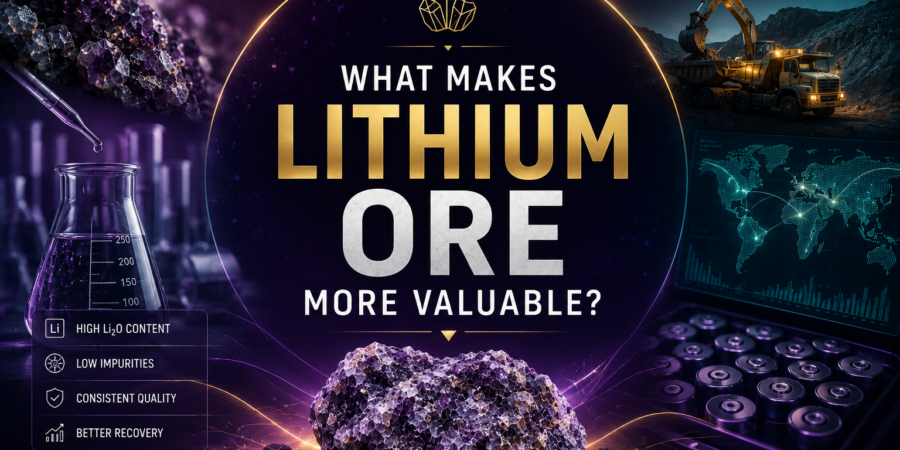
One of the most common questions in Nigeria’s growing lithium industry is deceptively simple: “What makes one lithium ore shipment worth more than another?” At first glance, the answer appears obvious. Many people immediately point to grade and assume that higher lithium concentration automatically translates into higher value. Grade is certainly important. In fact, it remains one of the most influential factors in commercial valuation. Yet the reality of modern lithium procurement is considerably more sophisticated.
Two shipments with similar lithium grades can attract very different levels of buyer interest. Likewise, two suppliers operating within the same region may receive different commercial offers despite apparently producing similar material. The reason is that value in today’s lithium market is determined by a combination of technical quality, commercial reliability, and supply-chain efficiency. As Nigeria becomes increasingly connected to global battery-mineral supply chains, buyers are evaluating lithium ore through a much broader lens than they did during the early stages of the lithium rush.
The first and most obvious contributor to value is lithium concentration. In commercial transactions, buyers are ultimately interested in the amount of lithium contained within the material being purchased. Higher concentrations generally indicate greater potential economic value because more lithium units are available within each ton of ore. This is why assay reports occupy such a central position within procurement discussions. Before serious pricing negotiations begin, buyers typically want to understand the characteristics of the material itself. Lithium Oxide (Li₂O) percentage remains one of the most widely used indicators for evaluating lithium-bearing ore.
However, grade alone rarely tells the entire story. The market increasingly rewards quality rather than concentration alone. A shipment may contain attractive lithium levels but still attract lower buyer interest if the material contains impurities that complicate downstream processing. From the perspective of processors and refiners, ore quality influences operational efficiency. Material that can move more easily through processing systems often carries greater commercial appeal than material requiring additional handling or treatment. This is why discussions surrounding purity are becoming increasingly important within Nigeria’s lithium sector. As procurement systems mature, buyers are paying closer attention not only to how much lithium is present, but also to the overall quality of the material carrying that lithium.
Consistency is another major contributor to value. Many suppliers focus heavily on achieving the highest possible assay result. While strong grades are beneficial, industrial buyers often place equal importance on predictability. A buyer sourcing material for a long-term procurement program needs confidence that future shipments will resemble previous ones. Unexpected fluctuations create operational challenges throughout the supply chain. For this reason, suppliers capable of delivering consistent material over time frequently occupy stronger commercial positions than suppliers whose quality varies significantly between shipments. In modern battery-mineral markets, reliability often carries economic value. This trend is becoming increasingly visible as the industry shifts away from opportunistic transactions and toward long-term procurement relationships.
Logistics also influence valuation in ways that are often overlooked. The value of lithium ore is not determined solely at the mine site. Material must move through a complex network involving transportation, aggregation, warehousing, inventory management, and procurement coordination. Each stage introduces costs and operational considerations. A shipment that can move efficiently through this system is often more attractive than one associated with logistical uncertainty. This is one reason aggregation is becoming increasingly important within Nigeria’s lithium economy.
Aggregation networks help transform fragmented supply into commercially organized inventory capable of supporting industrial procurement requirements. By improving coordination and visibility, these systems can increase buyer confidence and enhance the overall attractiveness of available supply. As the market matures, the organizations capable of improving logistics efficiency may create substantial value across the supply chain.
Moisture content also affects valuation. Although it receives less attention than grade or purity, moisture influences transportation economics, storage conditions, inventory management, and buyer confidence. Procurement systems generally prefer material that can be handled, stored, and transported efficiently. Suppliers who maintain strong inventory-management practices often benefit from improved commercial credibility because they demonstrate an understanding of the broader requirements of industrial procurement. This illustrates an important point. Modern lithium valuation increasingly extends beyond geology. It includes operational discipline.
Another factor that influences value is supply continuity. In the early stages of market development, many buyers focused primarily on securing available inventory. Today, the conversation is changing. Industrial buyers increasingly seek long-term sourcing relationships capable of supporting recurring procurement needs. This means suppliers who can demonstrate resource availability, scalable operations, organized logistics, and recurring supply capability often enjoy advantages that extend beyond individual shipments. The market is gradually rewarding those who can support long-term procurement planning.
Trust itself has become a value driver. In many emerging mineral markets, information gaps create uncertainty. Buyers frequently evaluate not only the material being offered but also the credibility of the supplier providing it. Questions regarding assay reliability, inventory visibility, communication quality, and operational professionalism have become increasingly important. Every factor that reduces uncertainty can strengthen a supplier’s position during negotiations. This is one reason supplier verification and due diligence are becoming more prominent throughout Nigeria’s lithium ecosystem.
The evolution of the market is also changing perceptions of value. During the earliest phase of lithium activity, commercial discussions often focused almost exclusively on access to material. Today, the market is becoming more sophisticated. Buyers are increasingly evaluating entire supply systems rather than isolated shipments. They want confidence in quality, consistency, logistics, inventory management, and future supply potential. As a result, value is increasingly being created through organization as much as through extraction.
Abuja’s growing importance within the lithium economy reflects this shift. Although the city is not primarily a mining center, it is emerging as a coordination hub where suppliers, aggregators, logistics providers, procurement professionals, and international buyers interact. This concentration of commercial activity is helping strengthen the supply-chain infrastructure that ultimately supports valuation. In many ways, the future value of lithium ore in Nigeria will depend not only on what is extracted from the ground but also on the systems built around its movement to market.
The Nigerian Mineral Exchange (NME) is actively supporting this evolution by helping connect suppliers, buyers, aggregators, logistics providers, and procurement networks across Nigeria’s growing lithium ecosystem. For international procurement groups, battery-material companies, commodity traders, mineral processors, and investors evaluating sourcing opportunities in Nigeria, NME provides support in supplier identification, procurement coordination, aggregation access, and market intelligence.
NME also serves as a Foreign or International Buyer Representative in Nigeria, helping international organizations establish trusted local market visibility through supplier engagement, due diligence, sourcing coordination, logistics intelligence, and market-entry support. This enables foreign buyers to navigate Nigeria’s lithium market with greater confidence while developing sourcing relationships aligned with long-term procurement objectives.
At the same time, NME works with lithium suppliers across Northern Nigeria who are seeking access to serious buyers, structured procurement opportunities, and sustainable commercial relationships. Organizations and individuals seeking lithium buyers, sourcing support, supplier verification, procurement coordination, market-entry guidance, aggregation partnerships, or local buyer representation can engage NME directly through WhatsApp (+2348130799304).
As Nigeria’s lithium industry continues maturing, the definition of value is becoming broader. The highest-value lithium ore will not necessarily be the material with the highest grade alone. Increasingly, it will be the material supported by quality, consistency, reliability, logistics efficiency, and supply-chain professionalism. Because in a modern battery-mineral economy, value is created not only by the resource itself, but by the system that delivers that resource to the market.
Related Articles
- Source Lithium Ore in Nigeria
- Sell Lithium Ore in Nigeria
- How to Source Lithium Ore in Nigeria in 2026
- How to Secure Large-Scale Lithium Ore Supply in Abuja: The NME Industrial Sourcing Guide
- We Are Buying Lithium Ore in Nigeria (From 1% Li₂O and Above) | Abuja Warehouse
- Strategic States in Nigeria’s Lithium Economy
- How NME Supports Lithium Procurement in Nigeria
- Why Northern Nigeria Could Dominate Lithium Supply
- What Is the Minimum Lithium Grade Buyers Accept?
- Battery-Grade Lithium Explained
- Forecasting Nigeria’s Lithium Market Potential
- How Buyers Negotiate Lithium Prices in Nigeria
- How Global Lithium Demand Affects Nigerian Prices
- Spot Market vs Contract Lithium Prices in Nigeria
- Factors Affecting Lithium Ore Prices in Nigeria
- Why Local Partnerships Matter in Lithium Trade
- Developing Sustainable Lithium Supply Networks in Nigeria
- Lithium Procurement Strategy for Foreign Buyers in Nigeria


Leave a Reply