
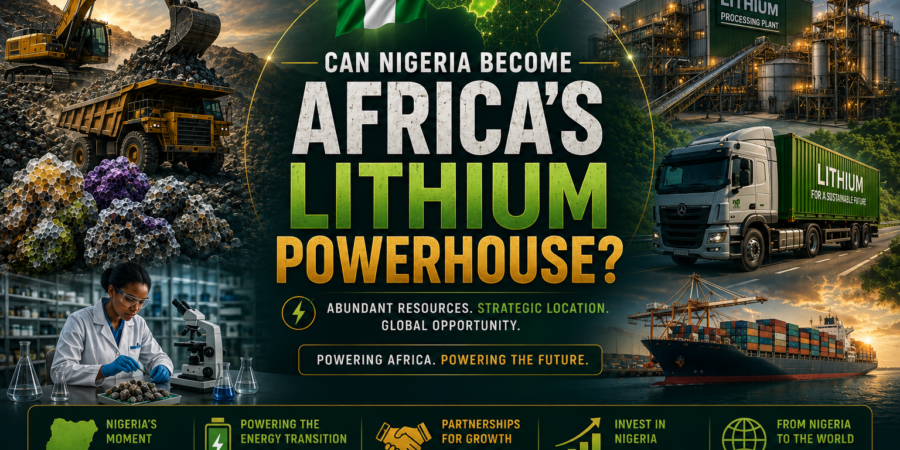
Every emerging industry eventually reaches a defining question. For Nigeria’s lithium sector, that question is becoming increasingly clear: Can Nigeria become Africa’s lithium powerhouse? It is an ambitious question. But it is also a serious one. Over the past few years, Nigeria has moved from being largely absent in global lithium discussions to becoming one of the countries attracting growing attention from investors, buyers, commodity traders, battery-material companies, and mining entrepreneurs. New discoveries, expanding exploration activities, increasing international interest, and rising awareness of the country’s lithium-bearing pegmatites have all contributed to this shift. What was once a relatively niche conversation has evolved into a strategic discussion about Nigeria’s future position within the global battery-mineral economy.
The answer, however, is more complex than simply measuring the size of mineral deposits. Becoming a lithium powerhouse is not just about possessing lithium resources. It is about building an ecosystem capable of transforming those resources into sustained economic influence. The countries that dominate modern industries rarely succeed because of resources alone. They succeed because they develop the infrastructure, institutions, supply chains, expertise, and commercial systems necessary to support long-term growth. Nigeria’s lithium future will likely depend on the same principle.
The first requirement for becoming a lithium powerhouse is geological potential. Without resources, there is no industry. Nigeria’s growing prominence in lithium discussions is largely the result of lithium-bearing pegmatites identified across parts of Northern Nigeria. These discoveries have helped place the country on the radar of international stakeholders seeking new sources of battery minerals. Although exploration activities continue and geological understanding is still evolving, the growing interest in Nigeria’s lithium resources suggests that the country possesses meaningful potential within the broader African mining landscape.
Yet geology alone does not create dominance. Many countries possess mineral wealth. Far fewer successfully convert that wealth into long-term economic leadership. This is where Nigeria’s broader advantages become important. Unlike many resource-producing nations, Nigeria possesses a combination of characteristics that extend well beyond mining. It has one of Africa’s largest economies, the continent’s largest population, a substantial domestic market, an entrepreneurial business culture, and a strategic geographic position linking West Africa to international markets.
These advantages matter because the future lithium industry will require much more than extraction. It will require logistics, procurement, aggregation, market intelligence, processing, trade facilitation, technology, and industrial coordination. Countries capable of developing these supporting systems often become more influential than countries focused solely on production.
This observation is particularly relevant because the global lithium economy is changing. In the early stages of the lithium boom, much of the attention focused on discovering resources. Today, increasing attention is being directed toward supply chains. Manufacturers want reliable suppliers. Investors want transparency. Procurement teams want visibility. Governments want security of supply. And industrial buyers want long-term partnerships. These requirements create opportunities that extend far beyond mining itself.
In many respects, the future lithium industry is becoming an ecosystem industry. The winners will not necessarily be those who mine the most lithium. The winners may be those who build the strongest ecosystems around lithium. Nigeria is uniquely positioned to pursue this path. The country already serves as a commercial center for much of West Africa. Its financial sector, entrepreneurial networks, technology ecosystem, logistics infrastructure, and growing mining industry provide foundations that can support broader industry development. This creates a possibility that is often overlooked. Nigeria’s greatest opportunity may not be limited to becoming a lithium producer. It may involve becoming a lithium marketplace. A lithium intelligence hub. A lithium procurement hub. A lithium logistics hub. And potentially a lithium investment hub. These roles often create value that is more durable than commodity production alone.
Another factor supporting Nigeria’s prospects is timing. The global battery economy remains in a period of rapid evolution. Supply chains are still being established. Procurement networks are expanding. Investment flows are shifting. Processing capacity is being developed. Industrial relationships are being formed. The architecture of the future lithium industry is not yet fixed. This creates opportunities for emerging players to secure influential positions. Countries that move decisively during this period may shape the future structure of the industry rather than merely participating in it. Nigeria has an opportunity to be one of those countries.
Of course, becoming Africa’s lithium powerhouse is not guaranteed. Challenges remain. Infrastructure development must continue. Industry formalization must deepen. Processing capacity must expand. Supply-chain organization must improve. Environmental and community considerations must be managed responsibly. Investment confidence must be strengthened. These are significant tasks. Yet they are also the types of challenges faced by nearly every successful mining jurisdiction during periods of growth. The more important question is whether Nigeria can build the institutions and ecosystems required to address them.
There are reasons for optimism. Government interest in mining-sector development is increasing. Private-sector investment is growing. International attention continues expanding. And perhaps most importantly, an ecosystem of entrepreneurs, service providers, suppliers, aggregators, consultants, and industry participants is beginning to emerge around the sector. This ecosystem may ultimately prove more important than any individual deposit. Because industries are built by networks, not by resources alone.
The future of Nigeria’s lithium sector will therefore depend on more than what lies beneath the ground. It will depend on what is built above it. The countries that become powerhouses are rarely defined solely by natural resources. They are defined by their ability to organize, coordinate, innovate, and create value around those resources. That is the real challenge. And it is also the real opportunity.
The Nigerian Mineral Exchange is actively contributing to this emerging ecosystem by connecting suppliers, buyers, aggregators, logistics providers, investors, processors, and procurement networks across Nigeria’s growing lithium sector. For international procurement groups, battery-material companies, commodity traders, mineral processors, manufacturers, and investors evaluating opportunities in Nigeria, NME provides support in supplier identification, procurement coordination, aggregation access, market intelligence, supplier verification, and supply-chain visibility.
NME also serves as a Foreign or International Buyer Representative in Nigeria, helping international organizations establish trusted local market presence through supplier engagement, due diligence, sourcing coordination, logistics intelligence, procurement support, market-entry assistance, and on-ground representation. This enables foreign buyers and investors to navigate Nigeria’s emerging lithium ecosystem while developing informed sourcing and investment strategies.
At the same time, NME continues to work with suppliers, mining companies, aggregators, and industry stakeholders across Nigeria who are seeking access to serious buyers, structured procurement opportunities, and long-term commercial partnerships.
Organizations and individuals seeking lithium ore buyers, sourcing support, supplier verification, procurement coordination, market-entry guidance, aggregation partnerships, or local buyer representation can engage NME directly through WhatsApp (+2348130799304).
Can Nigeria become Africa’s lithium powerhouse? The answer is yes. But not simply because it has lithium. It can become a lithium powerhouse if it successfully builds the institutions, supply chains, commercial networks, and industry infrastructure that transform mineral resources into economic influence. The race has already begun. The resources are attracting attention. The market is expanding. The ecosystem is emerging. What happens next will determine whether Nigeria merely participates in Africa’s lithium future, or helps lead it.
Related Articles
- Source Lithium Ore in Nigeria
- Sell Lithium Ore in Nigeria
- How to Source Lithium Ore in Nigeria in 2026
- How to Secure Large-Scale Lithium Ore Supply in Abuja: The NME Industrial Sourcing Guide
- Northern Nigeria Lithium Trade Ecosystem
- Lithium Pricing Mistakes Suppliers Make in Nigeria
- How Buyers Negotiate Lithium Prices in Nigeria
- How Global Lithium Demand Affects Nigerian Prices
- Spot Market vs Contract Lithium Prices in Nigeria
- What Makes Lithium Ore More Valuable?
- Factors Affecting Lithium Ore Prices in Nigeria
- Why Local Partnerships Matter in Lithium Trade
- Developing Sustainable Lithium Supply Networks in Nigeria
- Lithium Procurement Strategy for Foreign Buyers in Nigeria
- Lithium and Electric Vehicle Demand
- Lithium and Energy Storage Technologies
- Nigeria’s Emerging Battery Minerals Economy
Leave a Reply