
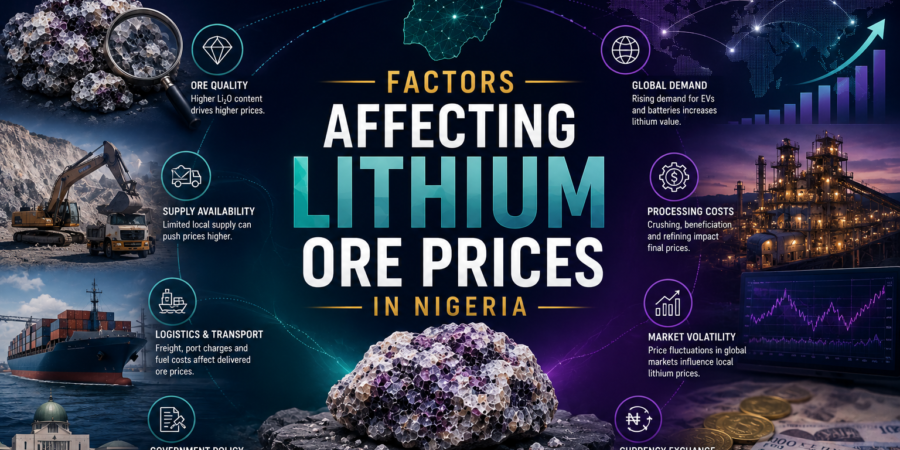
One of the most persistent misconceptions in Nigeria’s lithium market is the belief that lithium ore has a single fixed price. In reality, lithium pricing is far more complex. Two suppliers operating in the same state can receive different offers for apparently similar material. Likewise, two buyers evaluating ore from the same region may arrive at different valuations depending on their procurement objectives, processing requirements, logistics costs, and long-term sourcing strategies.
This often creates confusion among miners and suppliers who are trying to understand why pricing can vary significantly from one transaction to another. The answer lies in the fact that lithium ore pricing is influenced by a combination of technical, commercial, logistical, and market-driven factors. Understanding these variables is becoming increasingly important as Nigeria’s lithium industry matures and becomes more integrated into international battery-mineral supply chains.
Perhaps the most obvious factor affecting lithium prices is grade. In commercial lithium transactions, buyers are primarily interested in the amount of recoverable lithium contained within the ore. This is typically measured through Lithium Oxide (Li₂O) percentage. Higher-grade material generally attracts greater interest because it contains more lithium units per ton, making it potentially more attractive for downstream processing.
However, grade alone does not tell the entire story. A common mistake among suppliers is assuming that once an assay indicates a strong Li₂O percentage, premium pricing automatically follows. Professional buyers rarely evaluate material based on grade alone. They are increasingly focused on consistency. A buyer sourcing for a processing facility or industrial supply chain often prefers a supplier capable of delivering stable quality over multiple shipments rather than one who occasionally delivers exceptionally high-grade material but cannot maintain consistency. For industrial procurement systems, predictability frequently carries significant commercial value. This is one reason long-term suppliers often secure stronger commercial relationships than suppliers focused solely on isolated spot transactions.
Ore purity is another important pricing factor. Two samples may contain similar lithium concentrations but differ substantially in commercial value because of impurities or unwanted mineral content. The presence of certain contaminants can influence processing efficiency, recovery rates, and overall economics for downstream buyers. As global lithium supply chains become increasingly sophisticated, buyers are paying closer attention not only to how much lithium is present, but also to how clean and consistent the material is. This trend is gradually introducing higher technical standards into the Nigerian market.
Location also plays an important role in determining value. Lithium ore does not exist within a vacuum. Once material leaves a mining site, it must be transported, aggregated, stored, and eventually delivered to a buyer or export channel. Every stage introduces costs. As a result, material located closer to aggregation hubs, transportation corridors, or procurement centers may sometimes enjoy commercial advantages compared to material originating from more remote locations. This helps explain why supply-chain infrastructure is becoming increasingly important within Nigeria’s lithium economy.
The value of a ton of ore is influenced not only by its geological characteristics but also by the ease with which that ton can move through the commercial system. Transportation costs can have a particularly strong influence on pricing. Northern Nigeria cover vast geographic areas, and moving mineral inventory across multiple states requires coordination, equipment, fuel, security planning, and logistics management. Buyers naturally incorporate these costs into their procurement calculations. For this reason, logistics efficiency is becoming an increasingly important competitive advantage within the industry. The suppliers and aggregation networks capable of reducing movement costs may ultimately become more attractive to industrial buyers.
Moisture content is another factor that frequently receives less attention than it deserves. From a commercial perspective, buyers are purchasing mineral value, not water weight. Excessive moisture can affect storage conditions, transportation efficiency, handling requirements, and inventory quality. As procurement systems become more sophisticated, moisture management is gradually becoming an important part of commercial evaluation. This is one reason professionally managed warehousing and storage systems are gaining importance throughout Nigeria’s evolving lithium supply chain.
Global market conditions also play a major role in shaping local prices. Nigeria’s lithium market does not operate independently of the wider battery economy. International demand from battery manufacturers, electric vehicle producers, energy-storage companies, and lithium refiners ultimately influences procurement behavior within Nigeria. When global demand strengthens, buyers often become more aggressive in securing supply. When international markets weaken, procurement systems may become more selective and price-sensitive. This means that events occurring in Asia, Europe, North America, or other parts of the global battery ecosystem can eventually influence pricing discussions taking place in Nigerian mining communities.
Another factor that is becoming increasingly important is supply continuity. Many international buyers are gradually shifting away from opportunistic purchasing and toward long-term procurement relationships. In this environment, suppliers who can demonstrate recurring inventory access and dependable supply chains often become more valuable than those offering only occasional availability. This reflects a broader transformation occurring within the lithium economy. The market is slowly moving from a trading-oriented model toward a supply-chain-oriented model. Under this emerging structure, buyers increasingly evaluate supplier reliability, inventory visibility, logistics coordination, communication quality, and procurement professionalism alongside technical specifications.
Trust itself is becoming a pricing factor. A buyer who has confidence in a supplier’s inventory, assay process, logistics capability, and operational discipline may be willing to enter longer-term sourcing arrangements than would otherwise be possible. This is why due diligence, supplier verification, and procurement transparency are becoming increasingly important throughout the industry.
As Nigeria’s lithium ecosystem continues evolving, another factor is beginning to influence pricing: market organization. The earliest phase of the lithium rush was characterized by fragmented transactions, limited information, and inconsistent procurement structures. Over time, aggregation systems, warehousing networks, logistics providers, and procurement platforms are helping create greater market efficiency. As these systems mature, pricing mechanisms themselves may become more transparent and predictable.
In many ways, the future value of lithium ore in Nigeria will depend not only on the quality of the mineral but also on the quality of the commercial infrastructure surrounding it. The organizations capable of improving aggregation, logistics, supplier coordination, procurement visibility, and market intelligence may play a significant role in shaping how lithium is valued across the country in the years ahead.
This is one reason the Nigerian Mineral Exchange (NME) continues to position itself within the evolving lithium ecosystem. By helping connect suppliers, buyers, aggregators, logistics providers, and procurement networks, NME contributes to the development of a more organized and transparent market environment.
For international buyers evaluating sourcing opportunities in Nigeria, NME provides support in supplier identification, procurement coordination, aggregation access, and market intelligence. For suppliers, NME offers opportunities to connect with verified buyers and participate in structured procurement systems designed to support long-term commercial growth.
Organizations and individuals seeking lithium buyers, sourcing support, supplier verification, procurement coordination, market-entry guidance, or aggregation partnerships can engage NME directly through WhatsApp (+2348130799304).
As Nigeria’s lithium industry continues developing, understanding the factors that influence pricing will become increasingly important for everyone involved in the market. Because the price of lithium ore is ultimately shaped by far more than geology alone. It is shaped by the entire ecosystem that moves the material from mine site to market.
Related Articles
- How to Source Lithium Ore in Nigeria in 2026
- How to Secure Large-Scale Lithium Ore Supply in Abuja: The NME Industrial Sourcing Guide
- We Are Buying Lithium Ore in Nigeria (From 1% Li₂O and Above) | Abuja Warehouse
- Strategic States in Nigeria’s Lithium Economy
- How NME Supports Lithium Procurement in Nigeria
- Why Northern Nigeria Could Dominate Lithium Supply
- What Is the Minimum Lithium Grade Buyers Accept?
- Battery-Grade Lithium Explained
- Forecasting Nigeria’s Lithium Market Potential
- How Buyers Negotiate Lithium Prices in Nigeria
- How Global Lithium Demand Affects Nigerian Prices
- Spot Market vs Contract Lithium Prices in Nigeria
- Informal Mining and Lithium Supply Networks in Nigeria
- Why Local Partnerships Matter in Lithium Trade
- Developing Sustainable Lithium Supply Networks in Nigeria
- Lithium Procurement Strategy for Foreign Buyers in Nigeria



Leave a Reply