
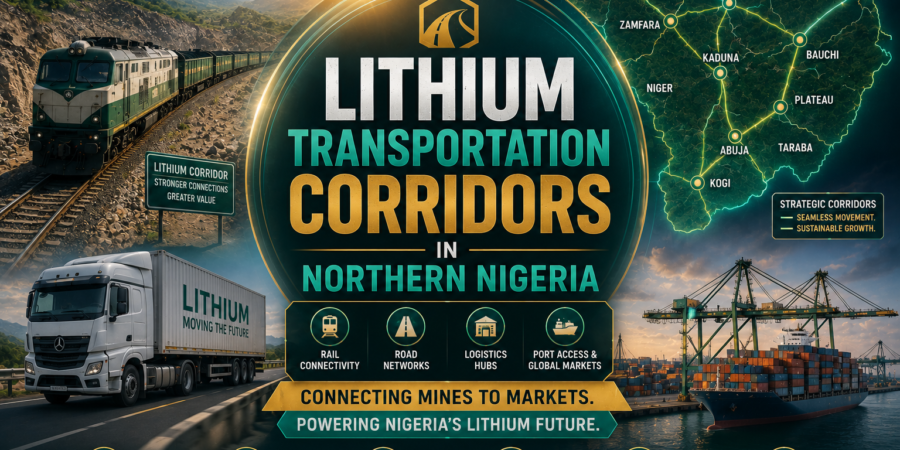
Every successful mining industry depends on one critical capability. The ability to move minerals efficiently. No matter how valuable a lithium deposit may be, it cannot create economic value until the material leaves the mining site and reaches a buyer, processor, warehouse, or export destination. Between those two points lies an often-overlooked component of the battery-mineral economy – transportation. Transportation is the bridge between production and commerce. It transforms mineral resources into marketable commodities and connects remote mining communities with regional, national, and international supply chains.
As Nigeria’s lithium industry continues to develop, transportation corridors across Northern Nigeria are becoming increasingly important to the country’s competitiveness within the global battery-mineral market. Unlike countries where lithium production is concentrated within a handful of large industrial mines, Nigeria’s emerging lithium industry is geographically dispersed. Mining activities occur across multiple states and communities, often separated by considerable distances. This distribution creates opportunities because it broadens the country’s resource base, but it also creates a transportation challenge.
Material must move from numerous production points to centralized commercial hubs before it can enter domestic or international markets. This movement forms the foundation of Northern Nigeria’s transportation corridors. These corridors should not be viewed simply as roads. They are commercial pathways linking mining communities with aggregation centers, warehouses, laboratories, procurement offices, processing facilities, export logistics, and industrial buyers. Every ton of lithium ore entering the market passes through some part of this transportation network. Its efficiency directly influences the cost, reliability, and competitiveness of Nigerian lithium.
One of the most active transportation corridors connects mining communities in Nasarawa State with Abuja. This route has become increasingly significant because Abuja functions as one of Nigeria’s principal commercial centers for lithium procurement. Ore produced in surrounding mining areas frequently moves toward the Federal Capital Territory, where commercial negotiations, supplier verification, logistics coordination, and buyer engagement often take place. The proximity between mining areas and Abuja reduces travel distances and supports faster commercial coordination. It is one reason why the Nasarawa–Abuja axis is becoming a key component of Nigeria’s lithium supply chain.
Another important transportation network links mining areas across Niger State with commercial markets in North Central Nigeria. Given the state’s size and mineral diversity, transportation plays a particularly important role in connecting production areas with aggregation facilities and onward distribution channels. Efficient movement across these routes strengthens the state’s ability to participate in regional procurement networks.
Kogi State occupies another strategic position within Northern Nigeria’s transportation landscape. Its location between Northern and Southern Nigeria allows it to function as a natural transit corridor. Minerals moving toward commercial centers or export infrastructure may pass through transport routes connected to the state, reinforcing Kogi’s importance within the national lithium supply chain. In many respects, transportation geography enhances the state’s commercial significance beyond its geological potential.
Kaduna also contributes to the regional transportation network. As one of Northern Nigeria’s major commercial and industrial centers, Kaduna has long served as a hub for trade and logistics. Existing transportation infrastructure, commercial services, and regional connectivity position the state to support future movements of battery minerals as production volumes increase. For suppliers and buyers alike, accessibility often determines commercial attractiveness.
Plateau State adds another dimension to the transportation network. Its long-established mining sector has created decades of experience in moving mineral commodities between production sites and commercial markets. Although the state’s mining history is traditionally associated with tin and associated minerals, this experience provides valuable logistical knowledge that can support future lithium development.
These individual routes collectively form an interconnected transportation system rather than isolated road networks. Ore rarely moves directly from a mine to an international buyer. Instead, it follows a sequence of carefully coordinated movements. Material is transported from mining communities to aggregation centers. From aggregation centers, it may move to warehouses for inventory management and quality verification. From warehouses, it is prepared for procurement, processing, or export logistics. Each stage depends on reliable transportation. Each stage adds commercial value.
As production expands, transportation corridors will become increasingly sophisticated. Future development may include specialized warehousing facilities, improved loading infrastructure, digital shipment tracking, optimized routing systems, and greater coordination between transport operators and procurement organizations. These improvements will strengthen both operational efficiency and buyer confidence.
Transportation also influences market accessibility. International buyers evaluate more than mineral quality. They consider delivery timelines. Freight reliability. Supply continuity. Inventory availability. And the overall efficiency of domestic logistics systems. Transportation therefore becomes part of Nigeria’s competitive advantage. A well-organized transportation network reduces delays, lowers transaction costs, and improves the reliability of long-term supply agreements. It enables suppliers to compete more effectively in international markets where consistency is often valued as highly as price.
Another important aspect of transportation corridors is the economic activity they generate. Every shipment supports multiple businesses beyond mining itself. Truck operators. Vehicle maintenance companies. Fuel suppliers. Loading contractors. Security providers. Warehouse operators. Freight coordinators. Insurance companies. Technology providers. Each participant contributes to the broader lithium economy. The transportation corridor therefore becomes an economic corridor, supporting employment and commercial activity across numerous sectors.
As Nigeria’s battery-mineral industry continues to evolve, transportation infrastructure will become increasingly strategic. It is no longer sufficient to discover lithium resources. Those resources must also move efficiently through increasingly sophisticated supply chains. Countries capable of combining resource potential with efficient transportation networks are more likely to become reliable long-term suppliers within the global battery-mineral market. Northern Nigeria possesses the foundation for such a system. The challenge now is to strengthen the connections between mining communities, commercial hubs, and international markets.
The Nigerian Mineral Exchange (NME) is actively supporting the development of these transportation corridors by connecting miners, suppliers, aggregators, warehouse operators, logistics providers, investors, processors, and procurement organizations across Northern Nigeria. For international procurement groups, battery-material companies, commodity traders, mineral processors, manufacturers, and investors sourcing lithium from Nigeria, NME provides supplier identification, transportation coordination, procurement management, logistics intelligence, supplier verification, aggregation support, and end-to-end supply-chain visibility.
NME also serves as a Foreign Buyer Representative and International Buyer Representative in Nigeria, helping international organizations establish trusted local market presence through supplier engagement, due diligence, transportation planning, logistics coordination, procurement support, market-entry advisory services, and on-ground commercial representation. At the same time, NME works closely with mining communities, transport operators, aggregators, warehouse managers, and logistics companies to strengthen commercial connectivity and facilitate structured procurement opportunities for both Nigerian suppliers and international buyers. Organizations seeking supplier verification, transportation coordination, procurement management, logistics support, aggregation partnerships, market-entry guidance, or local buyer representation can engage NME directly through WhatsApp (+2348130799304).
Transportation is often viewed as a support function within mining. In reality, it is one of the industry’s defining competitive advantages. Lithium may be discovered beneath the ground. But it is transportation corridors that connect those discoveries to the global battery economy. As Northern Nigeria’s lithium industry matures, these corridors will become the arteries through which the country’s battery-mineral ambitions flow.
Related Articles
- Source Lithium Ore in Nigeria
- Sell Lithium Ore in Nigeria
- Abuja and Regional Lithium Commerce in Nigeria
- How to Source Lithium Ore in Nigeria in 2026
- How to Secure Large-Scale Lithium Ore Supply in Abuja: The NME Industrial Sourcing Guide
- Northern Nigeria Lithium Trade Ecosystem
- Why Lithium Investors Are Watching Northern Nigeria
- Lithium Mining Investments in Northern Nigeria
- Can Nigeria Become Africa’s Lithium Powerhouse?
- Lithium Deposits in Kogi State
- Why Local Partnerships Matter in Lithium Trade
- Future Lithium Trade Routes Across Nigeria
- Security Considerations in Lithium Operations
- Northern Nigeria’s Lithium Mining Corridors
- Lithium Trade in Kano State
- Niger State and the Nigerian Lithium Economy
- Lithium and Energy Storage Technologies
- Nigeria’s Emerging Battery Minerals Economy


Leave a Reply