
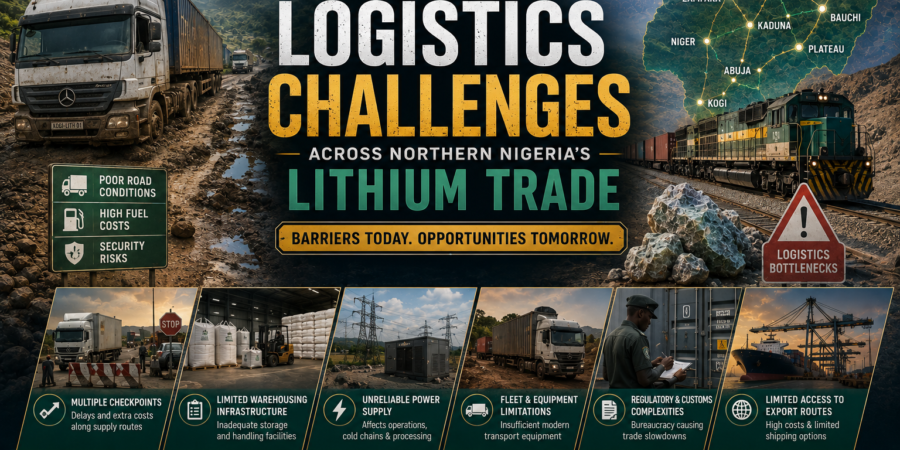
The commercial success of a lithium industry is determined by far more than the quality of its mineral deposits. A region may possess abundant resources, experienced miners, and growing international demand, yet still struggle to compete if its logistics system cannot move materials efficiently from mine to market. This is one of the defining realities of the global battery-mineral economy. Lithium is not purchased because it exists beneath the ground. It is purchased because it can be delivered consistently, efficiently, and predictably.
For Nigeria, and particularly for the lithium-producing regions across the North, logistics has become one of the most important factors influencing the competitiveness of the industry. The challenge extends beyond transportation. It encompasses every stage of moving material through the supply chain, from mining communities and aggregation centers to warehouses, quality verification, procurement, export coordination, and final delivery to industrial buyers. Understanding these logistics challenges is essential because they directly influence pricing, procurement decisions, investment confidence, and the long-term growth of Nigeria’s lithium sector.
One of the defining characteristics of Northern Nigeria’s lithium industry is the geographical distribution of production. Unlike jurisdictions dominated by a handful of large industrial mines, Nigeria’s lithium resources are spread across numerous mining locations and communities. This distribution creates opportunities by expanding the country’s resource base, but it also creates operational complexity. Ore must often be collected from multiple locations before commercially meaningful quantities can be assembled. This makes logistics an integral part of the business model rather than a simple support service.
Aggregation therefore becomes one of the first logistical challenges. Mining communities frequently produce varying quantities of material over different periods. Industrial buyers, however, generally require larger and more consistent volumes. Bridging this gap requires well-organized aggregation systems capable of receiving, sorting, consolidating, documenting, and preparing ore for onward movement. Without effective aggregation, fragmented production can reduce commercial efficiency and increase transaction costs for both suppliers and buyers.
Transportation presents another layer of complexity. The movement of lithium ore begins long before export logistics become relevant. Material must first travel from mining sites to collection points, from collection points to aggregation centers, and from aggregation centers to warehouses or processing locations. Every transfer introduces additional planning requirements, handling costs, scheduling considerations, and commercial risks. As production expands across Northern Nigeria, transportation efficiency will become an increasingly important competitive advantage.
Infrastructure also influences logistics performance. Road conditions, seasonal accessibility, vehicle availability, fuel costs, loading facilities, and travel times all affect the movement of mineral commodities. For buyers operating on international procurement schedules, delays within domestic logistics systems can influence sourcing decisions. Reliability is therefore becoming just as important as capacity.
Warehousing represents another critical but often overlooked aspect of the lithium trade. Many people assume mining ends when ore leaves the ground. Commercially, however, that is only the beginning. Warehouses provide locations where material can be received, inventoried, sampled, verified, consolidated, and prepared for delivery. They create visibility within the supply chain and provide buyers with greater confidence regarding inventory availability. As Nigeria’s lithium industry matures, strategically located warehousing facilities are likely to become increasingly important components of the national supply network.
Quality management introduces another logistical consideration. Lithium procurement depends heavily on accurate information regarding mineral characteristics. Material originating from different mining locations may vary in composition, moisture content, particle size, and other commercial characteristics. Managing these differences requires careful handling throughout the supply chain. Maintaining product integrity during transportation, storage, and aggregation is essential for preserving buyer confidence and supporting efficient commercial transactions.
Information flow is equally important. Physical logistics cannot operate efficiently without information logistics. Procurement teams need accurate inventory data. Buyers require updates on material availability. Transport operators require scheduling information. Warehouse managers require stock visibility. Investors require market intelligence. When information moves slowly, the supply chain also slows. In the modern mining industry, digital information is becoming just as important as physical infrastructure.
Another challenge involves coordination among multiple participants. The lithium supply chain is not controlled by a single organization. It involves miners, transporters, aggregators, warehouse operators, laboratories, procurement specialists, consultants, exporters, regulators, and buyers. Each participant performs a specific function. The efficiency of the overall system depends on how effectively these participants communicate and collaborate. Poor coordination can increase costs, delay deliveries, and reduce market confidence. Strong coordination creates competitive advantage.
International procurement expectations are also changing. Global buyers increasingly expect transparent sourcing, documented supply chains, reliable delivery schedules, and consistent communication. Meeting these expectations requires more than mineral production. It requires logistics systems capable of supporting professional procurement processes. This is one reason why supply-chain organization is becoming one of the defining characteristics of successful battery-mineral industries around the world. For Northern Nigeria, these challenges should also be viewed as opportunities. Every logistical constraint creates demand for new services. Companies specializing in transportation management, warehousing, inventory control, mineral handling, digital tracking, supply-chain software, freight coordination, and procurement support all have opportunities to participate in the industry’s growth.
As the lithium sector expands, logistics itself may become one of the fastest-growing segments of the mining economy. Perhaps the most important observation is that logistics should not be viewed merely as an operational issue. It is a strategic issue. The ability to move minerals efficiently influences investment decisions. It affects supplier competitiveness. It shapes buyer confidence. And ultimately, it determines how effectively Nigeria integrates into global battery-mineral supply chains. Countries that solve logistics challenges often become preferred sourcing destinations. The same principle applies within Northern Nigeria.
The Nigerian Mineral Exchange is actively supporting the development of more efficient lithium supply chains by connecting suppliers, buyers, aggregators, warehouse operators, logistics providers, investors, processors, and procurement networks across Northern Nigeria. For international procurement groups, battery-material companies, commodity traders, mineral processors, manufacturers, and investors evaluating sourcing opportunities in Nigeria, NME provides supplier identification, procurement coordination, logistics intelligence, aggregation support, supplier verification, warehouse coordination, and end-to-end supply-chain visibility.
NME also serves as a Foreign Buyer Representative and International Buyer Representative in Nigeria, helping international organizations establish trusted local market presence through supplier engagement, due diligence, logistics coordination, procurement management, market-entry support, and on-ground commercial representation. At the same time, NME works closely with miners, transport operators, aggregators, warehouse managers, logistics companies, and mining communities across Northern Nigeria to improve commercial connectivity and create structured procurement opportunities for serious domestic and international buyers. Organizations seeking supplier verification, logistics coordination, procurement management, market-entry guidance, aggregation partnerships, or local buyer representation can engage NME directly through WhatsApp (+2348130799304).
The future competitiveness of Northern Nigeria’s lithium industry will depend not only on the quality of its resources but also on the efficiency of its logistics systems. Minerals create demand. Supply chains create markets. But it is logistics that connects the two. As Nigeria’s battery-mineral economy continues to mature, strengthening logistics may become one of the country’s most important investments in building a globally competitive lithium industry.
Related Articles
- Source Lithium Ore in Nigeria
- Sell Lithium Ore in Nigeria
- Abuja and Regional Lithium Commerce in Nigeria
- How to Source Lithium Ore in Nigeria in 2026
- How to Secure Large-Scale Lithium Ore Supply in Abuja: The NME Industrial Sourcing Guide
- Northern Nigeria Lithium Trade Ecosystem
- Lithium Transportation Corridors in Northern Nigeria
- Why Lithium Investors Are Watching Northern Nigeria
- Lithium Mining Investments in Northern Nigeria
- Can Nigeria Become Africa’s Lithium Powerhouse?
- Lithium Deposits in Kogi State
- Why Local Partnerships Matter in Lithium Trade
- Future Lithium Trade Routes Across Nigeria
- Security Considerations in Lithium Operations
- Northern Nigeria’s Lithium Mining Corridors
- Lithium Trade in Kano State
- Niger State and the Nigerian Lithium Economy
- Lithium and Energy Storage Technologies
- Nigeria’s Emerging Battery Minerals Economy


Leave a Reply