
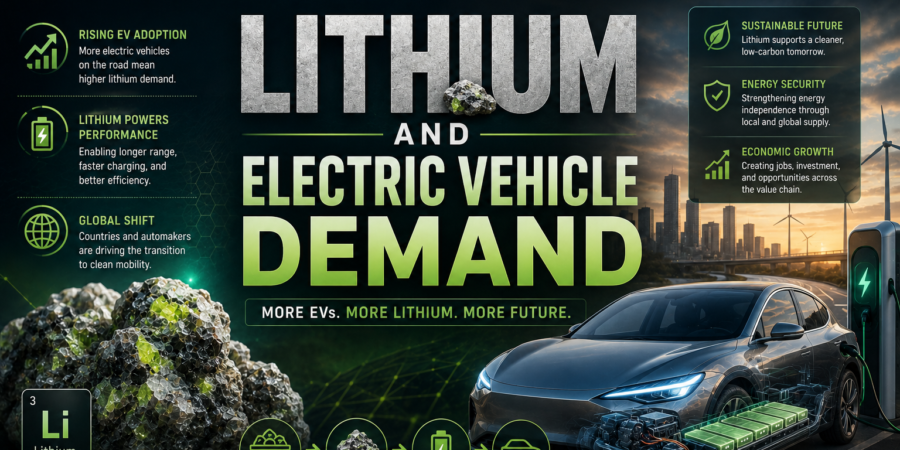
The modern lithium industry can be understood through a simple question: Why has lithium become so important? The answer can be found on roads around the world. Every day, millions of consumers, governments, transportation companies, and manufacturers are participating in one of the largest industrial transitions in modern history – the shift from internal combustion engines to electric vehicles. This transformation is reshaping automotive manufacturing, energy systems, supply chains, industrial policy, and mineral markets. At the center of that transformation sits lithium.
While lithium has various industrial applications, its rise to global prominence is closely tied to the extraordinary growth of electric vehicle demand. The relationship between the two has become so strong that many analysts now view electric vehicles as one of the primary forces driving the future direction of the lithium market.
To understand the future of lithium, therefore, one must first understand the future of electric vehicles. For more than a century, transportation has been dominated by vehicles powered by gasoline and diesel engines. This system created vast industries around oil production, refining, fuel distribution, vehicle manufacturing, and transportation infrastructure. Today, a new system is gradually emerging. Electric vehicles are becoming an increasingly important part of the global transportation landscape. Advances in battery technology, growing environmental awareness, government policy support, technological innovation, and changing consumer preferences have all contributed to their rise.
As electric vehicle adoption expands, demand for battery materials expands alongside it. This is where lithium enters the picture. Lithium is a key component in many rechargeable battery technologies used in electric vehicles. These batteries provide the energy storage necessary to power electric motors, making lithium one of the foundational materials supporting vehicle electrification. Every electric vehicle contains batteries. And every battery creates demand for minerals. This relationship helps explain why lithium demand has grown so rapidly over the past decade.
The growth of electric vehicles has effectively transformed lithium from a relatively specialized industrial mineral into a strategic resource with global significance. The scale of this transformation is difficult to overstate. What began as a niche market has evolved into a global industrial movement involving automobile manufacturers, governments, technology companies, energy providers, mining firms, and investors. Entire supply chains are being redesigned to support the battery economy. New factories are being built. New procurement networks are being established. And new sources of lithium supply are being sought around the world.
This search for supply has brought increasing attention to emerging lithium-producing regions, including parts of Africa. Countries possessing lithium resources are finding themselves drawn into a rapidly evolving global market driven largely by electric vehicle demand. Nigeria is among the countries benefiting from this shift. The growing international interest in Nigerian lithium resources reflects broader changes occurring within the automotive and energy sectors. As manufacturers seek diversified supply sources and procurement organizations expand sourcing networks, countries with lithium potential are attracting increasing attention.
However, the relationship between lithium and electric vehicles extends beyond simple supply and demand. Electric vehicles are influencing the entire structure of the lithium industry. They are shaping investment decisions. They are influencing exploration programs. They are driving processing investments. They are encouraging supply-chain diversification. And they are creating opportunities for countries that can position themselves strategically within the battery economy. This is why discussions about lithium often sound remarkably similar to discussions about the future of transportation. The two have become deeply interconnected.
Yet electric vehicles are not the only factor influencing lithium demand. The same battery technologies used in transportation are also being deployed in energy-storage systems, industrial applications, telecommunications infrastructure, and numerous emerging technologies. Nevertheless, electric vehicles remain one of the most visible and influential drivers of demand growth. In many respects, they serve as the public face of the broader battery revolution.
The implications for Nigeria are significant. As global electric vehicle adoption expands, the importance of reliable lithium supply chains is likely to increase. This creates opportunities not only for mining but also for a wide range of supporting activities. The future battery economy will require exploration, aggregation, logistics, procurement, market intelligence, supplier verification, processing, trade facilitation, and investment support. These activities form the infrastructure connecting mineral resources to global manufacturing systems. This perspective is important because the greatest opportunities often emerge beyond extraction alone. Countries that participate actively across multiple stages of the value chain typically capture more economic value than those focused exclusively on raw-material production.
Nigeria’s growing lithium sector therefore represents more than a mining opportunity. It represents an opportunity to participate in one of the defining industrial trends of the twenty-first century. The growth of electric vehicles is creating a new global economic landscape. The countries that successfully integrate themselves into the supply chains supporting that landscape may enjoy significant advantages in the years ahead.
Another reason the connection between lithium and electric vehicles matters is that it highlights the long-term nature of the opportunity. Electric vehicle adoption remains an evolving process. Many markets around the world are still in the early stages of transition. Infrastructure continues to expand. Technology continues to improve. Manufacturing capacity continues to grow. These developments suggest that demand for battery materials may remain an important theme for years to come. For emerging lithium jurisdictions, this provides an opportunity to build long-term strategies rather than focusing solely on short-term market cycles. The future belongs not only to those who possess resources. It belongs to those who build ecosystems around those resources.
The Nigerian Mineral Exchange (NME) is actively supporting the development of this ecosystem by connecting suppliers, buyers, aggregators, logistics providers, investors, processors, and procurement networks across Nigeria’s growing lithium sector. For international procurement groups, battery-material companies, commodity traders, mineral processors, electric vehicle supply-chain participants, and investors evaluating opportunities in Nigeria, NME provides support in supplier identification, procurement coordination, aggregation access, market intelligence, supplier verification, and supply-chain visibility.
NME also serves as a Foreign or International Buyer Representative in Nigeria, helping international organizations establish trusted local market presence through supplier engagement, due diligence, sourcing coordination, logistics intelligence, procurement support, market-entry assistance, and on-ground representation. This enables foreign buyers and investors to navigate Nigeria’s emerging lithium ecosystem while building informed sourcing and investment strategies.
At the same time, NME continues to work with suppliers, mining companies, aggregators, and industry stakeholders across Nigeria who are seeking access to serious buyers, structured procurement opportunities, and long-term commercial partnerships. Organizations and individuals seeking lithium ore buyers, sourcing support, supplier verification, procurement coordination, market-entry guidance, aggregation partnerships, or local buyer representation can engage NME directly through WhatsApp (+2348130799304).
The rise of lithium is often described as a mining story. But in reality, it is also a transportation story. Every new electric vehicle placed on the road increases the importance of battery minerals. Every expansion of the battery economy reinforces the significance of lithium. And every step toward vehicle electrification strengthens the connection between mineral resources and the future of global industry. That is why understanding electric vehicle demand is essential to understanding the future of lithium itself.
Related Articles
- Source Lithium Ore in Nigeria
- Sell Lithium Ore in Nigeria
- How to Source Lithium Ore in Nigeria in 2026
- How to Secure Large-Scale Lithium Ore Supply in Abuja: The NME Industrial Sourcing Guide
- We Are Buying Lithium Ore in Nigeria (From 1% Li₂O and Above) | Abuja Warehouse
- Lithium Pricing Mistakes Suppliers Make in Nigeria
- How Buyers Negotiate Lithium Prices in Nigeria
- How Global Lithium Demand Affects Nigerian Prices
- Spot Market vs Contract Lithium Prices in Nigeria
- What Makes Lithium Ore More Valuable?
- Factors Affecting Lithium Ore Prices in Nigeria
- Why Local Partnerships Matter in Lithium Trade
- Developing Sustainable Lithium Supply Networks in Nigeria
- Lithium Procurement Strategy for Foreign Buyers in Nigeria
- Lithium and Energy Storage Technologies
- Nigeria’s Emerging Battery Minerals Economy


Leave a Reply