
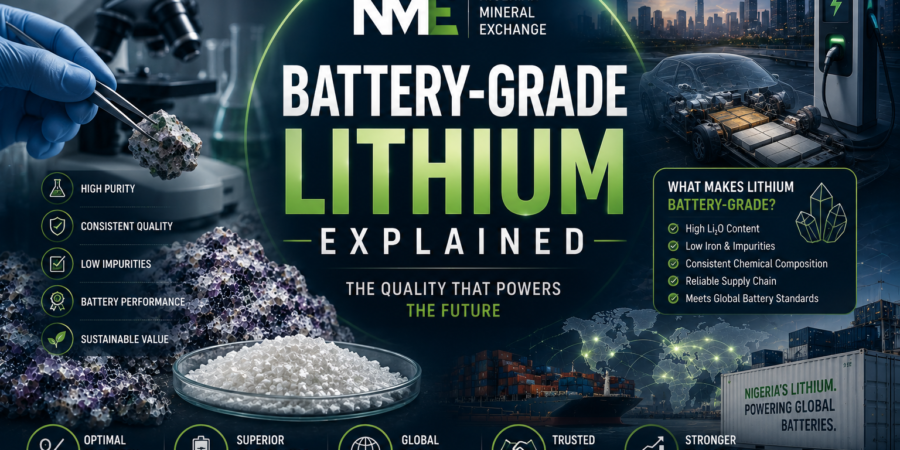
Few terms generate more excitement within the lithium industry than “battery-grade lithium.” The phrase appears regularly in industry reports, investor presentations, procurement discussions, and mining-sector conversations. Suppliers often hear buyers talk about battery-grade material. Investors frequently reference battery-grade production as a sign of value creation. Governments around the world increasingly discuss battery-grade minerals when outlining industrial development strategies.
Yet despite its widespread use, the term is often misunderstood. Many people assume battery-grade lithium simply refers to lithium ore with a high grade. Others believe any lithium-bearing material can be considered battery-grade if it contains enough lithium. The reality is more nuanced. Battery-grade lithium is not merely a mining concept. It is a processing, quality, and industrial manufacturing concept. Understanding that distinction is important because it helps explain how value is created within the global lithium supply chain and why certain materials command greater commercial attention than others.
At the mine site, lithium typically exists within naturally occurring minerals such as spodumene, lepidolite, and amblygonite. These minerals contain lithium-bearing compounds, but they are not immediately suitable for use in battery manufacturing. Before lithium can be used in electric vehicles, energy storage systems, consumer electronics, or industrial battery applications, it must move through multiple stages of beneficiation, concentration, chemical processing, and refining. It is during these downstream stages that battery-grade products emerge.
In simple terms, battery-grade lithium refers to lithium chemicals that have been refined to purity levels suitable for battery production. The emphasis here is on purity. Modern battery manufacturing requires extremely consistent materials because even small variations can affect performance, efficiency, safety, and manufacturing reliability. Battery producers therefore impose strict quality standards on the lithium products entering their production systems. This is one reason why the global lithium industry places so much importance on quality control throughout the supply chain.
The journey from lithium-bearing ore to battery-grade lithium is long and complex. The process usually begins with mining and ore extraction. From there, material often undergoes concentration processes designed to increase the proportion of lithium-bearing minerals. The concentrated material may then move to processing and refining facilities where lithium compounds are produced for industrial use. Each stage adds value. More importantly, each stage introduces quality requirements that influence commercial valuation. This helps explain why discussions about lithium pricing increasingly extend beyond simple ore grades.
A supplier may possess material with attractive lithium concentrations, but buyers often evaluate that material within the context of its downstream processing potential. The easier and more efficiently material can move toward battery-grade specifications, the more attractive it may become within certain procurement systems. This is one reason ore quality, purity, and consistency continue to receive increasing attention throughout Nigeria’s emerging lithium industry. As international buyers become more active in the country, they are not simply searching for lithium-bearing rocks. They are seeking material that can integrate efficiently into larger industrial supply chains.
Battery-grade lithium also highlights an important reality about the global energy transition. Many discussions focus on electric vehicles and battery factories, but these industries depend on extensive upstream supply systems. Every battery begins with a supply chain involving exploration, mining, aggregation, transportation, processing, refining, and manufacturing. Without these supporting systems, battery production cannot occur.
Nigeria’s growing lithium sector is increasingly becoming part of that broader international ecosystem. Although the country is still in the early stages of developing its battery-mineral value chain, growing international interest reflects recognition of its potential role within future supply networks. This creates opportunities not only for mining companies but also for organizations involved in aggregation, logistics, supplier verification, market intelligence, procurement coordination, and mineral processing development.
As the industry evolves, discussions surrounding battery-grade lithium are likely to become increasingly important. Why? Because the future value of lithium may depend not only on resource availability but also on the ability of supply chains to deliver material that meets industrial requirements. This shift is already influencing procurement behavior. International buyers are increasingly looking for suppliers capable of demonstrating: quality, consistency,
reliability, and operational professionalism.
The market is gradually moving away from opportunistic sourcing and toward structured procurement systems built around long-term supply relationships. This evolution favors organizations that understand how the entire value chain operates. It is no longer enough to know that lithium is present. Increasingly, buyers want to understand how the material was sourced, how it was handled, how it was tested, how it moves through the supply chain, and how reliably future shipments can be delivered.
In many respects, battery-grade lithium represents the highest expression of value creation within the lithium economy. It is the point where geology, mining, processing, manufacturing, and industrial demand converge. For Nigeria, this presents both a challenge and an opportunity. The challenge is that battery-grade products require sophisticated industrial systems and technical capabilities. The opportunity is that countries capable of participating more deeply in the value chain often capture greater economic value than those limited to raw-material extraction alone. As policymakers, investors, mining companies, and procurement groups evaluate Nigeria’s future role within the global battery economy, this distinction will become increasingly important. The conversation is gradually shifting from “How much lithium does Nigeria have?” toward “How much value can Nigeria create from its lithium resources?”
The Nigerian Mineral Exchange (NME) is actively positioning itself within this evolving ecosystem by helping connect suppliers, buyers, aggregators, logistics providers, and procurement networks across Nigeria’s growing lithium market.
For international procurement groups, battery-material companies, commodity traders, mineral processors, and investors evaluating opportunities in Nigeria, NME provides support in supplier identification, procurement coordination, aggregation access, and market intelligence.
NME also serves as a Foreign or International Buyer Representative in Nigeria, helping international organizations establish trusted local market visibility through supplier engagement, due diligence, sourcing coordination, logistics intelligence, and market-entry support. This enables foreign buyers to build informed sourcing strategies while navigating Nigeria’s rapidly developing lithium sector.
At the same time, NME works with lithium suppliers across Northern Nigeria who are interested in connecting with serious buyers and participating in structured procurement systems. Organizations or individuals seeking buyers, sourcing support, supplier verification, procurement coordination, market-entry guidance, aggregation partnerships, or local buyer representation can engage NME directly through WhatsApp (+2348130799304).
Battery-grade lithium may sound like a technical term, but its significance extends far beyond chemistry. It represents the bridge between mineral resources in the ground and the technologies powering the global energy transition. And understanding that bridge is essential for anyone seeking to understand the future of the lithium industry itself.
Related Articles
- How to Source Lithium Ore in Nigeria in 2026
- How to Secure Large-Scale Lithium Ore Supply in Abuja: The NME Industrial Sourcing Guide
- Strategic States in Nigeria’s Lithium Economy
- How NME Supports Lithium Procurement in Nigeria
- Why Northern Nigeria Could Dominate Lithium Supply
- What Is the Minimum Lithium Grade Buyers Accept?
- Forecasting Nigeria’s Lithium Market Potential
- What Lithium Buyers Look For Before Purchase
- How Buyers Negotiate Lithium Prices in Nigeria
- Informal Mining and Lithium Supply Networks in Nigeria
- Why Local Partnerships Matter in Lithium Trade
- Developing Sustainable Lithium Supply Networks in Nigeria
- Lithium Procurement Strategy for Foreign Buyers in Nigeria
Leave a Reply