
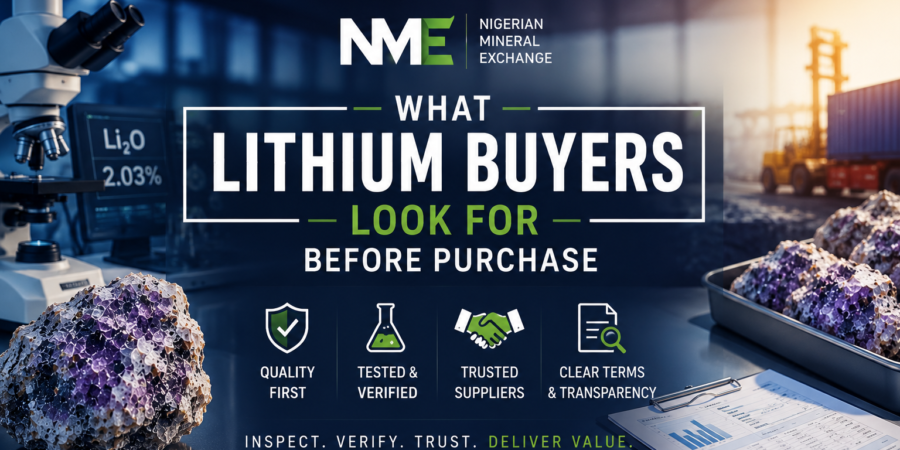
As Nigeria’s lithium industry continues to attract global attention, more suppliers, miners, aggregators, and traders are entering the market hoping to benefit from the growing demand for battery minerals. Across Northern Nigeria especially, increasing lithium activity is creating new commercial opportunities for individuals and communities involved in mining and mineral supply. However, many suppliers still misunderstand one important reality: Lithium buyers do not purchase ore based on excitement alone.
Professional buyers evaluate several technical, commercial, and operational factors before making purchasing decisions. In many cases, suppliers assume that simply having lithium-bearing material automatically guarantees a sale. But in reality, buyers carefully assess ore quality, consistency, logistics, risk, and long-term supply potential before committing funds. Understanding what lithium buyers actually look for can help suppliers negotiate better, avoid rejection, improve ore preparation, build long-term supply relationships, and position themselves more professionally within Nigeria’s growing lithium ecosystem. This guide explains the major factors lithium buyers evaluate before purchasing lithium ore in Nigeria.
Why Lithium Buyers Are Careful
Lithium procurement is highly sensitive because buyers are not simply purchasing rocks or raw materials. They are purchasing lithium content, processing potential, commercial value, and supply reliability. For many buyers, especially exporters and processors, poor-quality ore can create financial losses, processing inefficiencies, transportation waste, and operational problems. This is why professional buyers rely heavily on testing, verification, quality control, and supplier evaluation. As Nigeria’s lithium market matures, suppliers who understand the followin buyer expectations will have stronger opportunities than those operating blindly.
1. Lithium Grade (Li₂O Percentage)
One of the first things buyers evaluate is lithium grade. Lithium grade is usually measured through Li₂O percentage (Lithium Oxide percentage) This helps buyers estimate potential processing value, lithium concentration, and commercial viability. Generally, higher Li₂O percentages attract stronger commercial interest, while low-grade material may require beneficiation or blending. Different buyers have different requirements depending on processing capacity, export strategy, target market, and operational economics. This is why assays are extremely important in lithium trading.
Why Li₂O Matters
Higher-grade lithium ore usually means better processing efficiency, reduced waste, stronger profitability, and lower transportation inefficiencies. For buyers handling large volumes, even small differences in lithium percentage can significantly affect economics. This is why buyers pay close attention to assay reports, consistency, and ore quality verification.
2. Ore Consistency
Many suppliers focus only on achieving a single high assay result. But professional buyers often care more about consistency across supply volumes. If one batch contains strong lithium content while another batch is weak or contaminated, buyers may lose confidence in the supplier. Consistency matters because buyers usually plan around long-term procurement, processing efficiency, and predictable supply chains. Reliable suppliers who maintain stable quality often become more valuable over time.
3. Mineral Composition
Not all lithium-bearing minerals are processed the same way. Buyers often evaluate spodumene/ kunzite, lepidolite, and amblygonite. Different mineral compositions may influence processing methods, extraction efficiency, transportation decisions, and commercial demand. This is one reason why proper mineral identification and testing are important before negotiations begin.
4. Moisture Content
Moisture is another important factor many suppliers overlook. Excessive moisture can reduce effective ore value, increase transportation weight, create storage issues, and affect processing performance. Buyers generally prefer properly handled and reasonably dry material. Inconsistent moisture levels can also create disputes during transactions. This is why some buyers carefully inspect storage conditions, packaging methods, and ore handling practices.
5. Contamination and Impurities
Lithium buyers also evaluate impurities within the ore. Excess contamination may reduce processing efficiency or increase refining costs. Buyers may assess clay contamination, excessive iron, mixed materials, dirt, organic matter, or other unwanted substances. Poor handling and poor separation practices can reduce the commercial attractiveness of lithium ore. Suppliers who improve sorting and material handling often create stronger buyer confidence.
6. Volume Availability
Many buyers are not simply looking for one-time supply opportunities. They are often searching for repeat suppliers, scalable supply sources, aggregation partners, and stable procurement channels. This means buyers frequently ask questions such as:
- How much material can the supplier provide monthly?
- Is the supply sustainable?
- Can volumes increase over time?
- Does the supplier control multiple mining locations?
Large-scale buyers especially value operational stability.
7. Logistics and Accessibility
Logistics play a major role in lithium procurement decisions. Even high-grade ore may become commercially difficult if transportation is unreliable, roads are difficult, security risks are high, or logistics costs become excessive. Buyers therefore evaluate distance, transportation routes, accessibility, and delivery coordination. This is one reason why Abuja is increasingly becoming important within Nigeria’s lithium trade ecosystem because it provides coordination advantages, aggregation possibilities, and logistical accessibility.
8. Supplier Reliability
Professional buyers evaluate suppliers just as suppliers evaluate buyers. They look for honesty, communication, consistency, professionalism, and transparency. Buyers generally prefer suppliers who understand basic industry procedures, communicate clearly, respect agreements, and maintain realistic expectations. In many cases, long-term trust becomes more valuable than one-time pricing advantages.
Looking to Supply Lithium Ore in Nigeria?
The Nigerian Mineral Exchange (NME) is working to support more structured lithium trade relationships across Nigeria through supplier coordination, buyer connections, aggregation support, and growing visibility for Nigeria’s emerging lithium ecosystem. As the market expands, organized supply systems and transparent procurement structures are becoming increasingly important for both suppliers and buyers.
Suppliers and buyers interested in discussing lithium supply opportunities, ore evaluation, or aggregation support can contact NME through WhatsApp (+2348130799304) for further discussions.
9. Proper Testing and Assay Reports
Serious buyers rarely rely on visual inspection alone. Professional procurement systems typically involve sample collection, laboratory analysis, quality verification, and assay interpretation. Assay reports help buyers understand lithium concentration, impurities, mineral composition, and overall ore quality. Suppliers who understand the importance of testing generally position themselves more professionally within the market.
10. Long-Term Supply Potential
Many buyers are thinking beyond immediate transactions. Global lithium demand continues to rise because of electric vehicle production, battery manufacturing, renewable energy systems, and energy storage technologies. As a result, buyers increasingly seek long-term supply relationships, regional supply networks, and stable sourcing partnerships. Suppliers capable of maintaining ongoing production and organized supply systems may attract stronger commercial interest over time.
Why Some Lithium Ore Gets Rejected
Lithium ore may be rejected for several reasons, including low lithium content, inconsistent quality, excessive contamination, high moisture, poor logistics, mixed materials, or unrealistic pricing expectations. Sometimes suppliers misunderstand buyer requirements and assume all lithium-bearing material automatically has strong commercial value. But buyers must consider processing economics, transportation costs, export conditions, and operational efficiency. Understanding this helps suppliers negotiate more realistically and professionally.
The Growing Importance of Structured Supply Chains
Nigeria’s lithium market is gradually becoming more organized. The industry is moving from scattered informal transactions toward structured procurement systems, aggregation networks, buyer-supplier coordination, and long-term commercial relationships. As this transition continues, suppliers who understand buyer expectations will likely perform better within the evolving market. This is especially important as more international interest enters Nigeria’s battery mineral sector.
How Suppliers Can Improve Their Position
Suppliers can improve their attractiveness to buyers by focusing on ore quality, proper handling, consistent supply, realistic pricing, transparency, and operational reliability. Small improvements in material preparation, sorting, packaging, and communication can significantly improve buyer confidence. Professionalism matters increasingly within the lithium trade.
Final Thoughts
Lithium buyers in Nigeria evaluate much more than simply whether a supplier has mineralized material. They look for lithium grade, consistency, mineral composition, logistics, reliability, testing standards, and long-term supply potential.
As Nigeria’s lithium ecosystem continues developing, suppliers who understand these expectations will position themselves more effectively for sustainable commercial opportunities. The future of lithium trade in Nigeria will likely favor organized suppliers, transparent procurement systems, reliable logistics, and long-term supply relationships. Understanding what buyers truly value is one of the first steps toward building success within this growing industry.
Related Articles
- How to Source Lithium Ore in Nigeria in 2026
- How to Secure Large-Scale Lithium Ore Supply in Abuja: The NME Industrial Sourcing Guide
- How NME Supports Lithium Procurement in Nigeria
- Why Northern Nigeria Could Dominate Lithium Supply
- Why Local Partnerships Matter in Lithium Trade
- Understanding Li₂O Percentages in Lithium Trade
- Where to Buy Lithium Ore in Nigeria
- Lithium Ore Sellers in Kebbi State: Supply Your Lithium Ores to the Nigerian Mineral Exchange Abuja Warehouse


Leave a Reply