
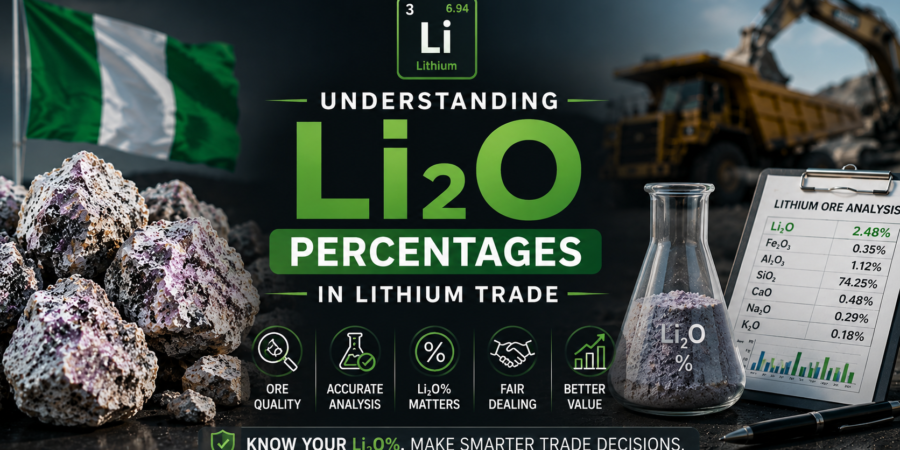
Nigeria is gradually entering the global lithium conversation as international demand for battery minerals intensifies. One technical term that keeps appearing repeatedly in discussions between miners, suppliers, buyers, aggregators, and exporters is Li₂O percentage. For many new participants entering the lithium market, this term can initially seem confusing. Yet within lithium trading, Li₂O percentage is one of the most important factors influencing ore valuation, buyer interest, pricing, processing economics, and commercial negotiations.
Understanding Li₂O percentages is extremely important for anyone involved in lithium mining, aggregation, supply, ore purchasing, or lithium trade in Nigeria. Without understanding lithium grades properly, suppliers may undervalue materials, misunderstand buyer expectations, face ore rejection, or negotiate from a weak position.
This guide explains what Li₂O percentage means, why it matters in lithium trade, how buyers evaluate it, and how it affects the commercial value of lithium ore in Nigeria.
What Does Li₂O Mean?
Li₂O stands for Lithium Oxide. Within lithium trading, lithium concentration is commonly expressed as a percentage of lithium oxide contained within the ore. This percentage helps buyers estimate lithium content, processing potential, recovery efficiency, and overall commercial value.
For example, higher Li₂O percentages generally indicate stronger lithium concentration, while lower percentages may require beneficiation or additional processing. Li₂O percentage is therefore one of the primary measurements used during lithium ore evaluation.
Why Li₂O Percentage Is Important
Lithium buyers are not simply purchasing rocks or mineralized material. They are purchasing lithium concentration, processing potential, and commercial value. The Li₂O percentage helps buyers determine whether the material is commercially viable, how efficiently it can be processed, and whether transportation and refining costs are economically justified. This is why assay results play such an important role in lithium procurement discussions.
How Li₂O Percentage Affects Pricing
Generally higher Li₂O percentages attract stronger commercial interest. This happens because higher-grade ore often offers better processing efficiency, reduced waste, stronger recovery potential, and improved processing economics. For buyers handling large volumes, even small changes in lithium concentration can significantly affect profitability.
However, Li₂O percentage alone does not determine price. Buyers also evaluate mineral type, impurities, consistency, moisture content, logistics, and supply reliability.
Common Lithium Ore Types in Nigeria
Nigeria’s lithium market commonly involves Spodumene/Kunzite, Lepidolite, and Amblygonite. Each mineral type may contain different lithium concentrations, processing characteristics, and commercial demand. This is one reason why buyers carefully evaluate mineral composition alongside Li₂O percentages. Not all lithium-bearing minerals are processed the same way.
How Li₂O Is Measured
Li₂O percentages are usually determined through laboratory assay testing. During the assay process, ore samples are collected, analyzed, and tested to determine lithium concentration and other properties. The assay report may include Li₂O percentage, impurities, mineral composition, and additional analytical data. Serious buyers rely heavily on these reports before making procurement decisions.
Why Visual Appearance Is Not Enough
Many suppliers assume that bright colors, crystal size, or visible pegmatite formations automatically indicate high lithium value. But visual appearance alone cannot reliably determine Li₂O percentage. Some visually attractive materials may contain low lithium concentration, excessive impurities, or poor commercial characteristics. This is why laboratory verification remains extremely important in lithium trading.
Understanding High-Grade vs Low-Grade Ore
Within lithium trade, ore is often discussed in terms of high-grade, medium-grade, or low-grade material. Generally, higher-grade ore attracts more buyer interest because it may reduce processing costs and improve commercial efficiency. Lower-grade material may still have value, but it often depends on beneficiation potential, blending opportunities, logistics, and processing economics. This is why buyers carefully assess both grade and operational practicality.
Why Buyers Prefer Consistent Grades
Consistency is one of the most important factors in lithium supply chains. Some suppliers provide strong initial assay results, but later deliveries contain lower quality material. This creates operational uncertainty for buyers. Professional buyers therefore value suppliers capable of maintaining stable Li₂O percentages, predictable quality, and reliable supply consistency. Long-term supply relationships depend heavily on trust and consistency.
The Role of Assays in Negotiation
Assay reports strongly influence negotiations between buyers and suppliers. Without proper testing, pricing becomes uncertain, misunderstandings increase, and buyer confidence may decline. Suppliers who understand assay results often negotiate more effectively because they better understand ore quality, market expectations, and commercial positioning. Knowledge improves bargaining power within lithium trade.
Looking to Discuss Lithium Ore Evaluation or Supply Opportunities?
The Nigerian Mineral Exchange (NME) is working to support more structured lithium trade systems across Nigeria through supplier coordination, buyer connections, aggregation support, and increasing visibility for Nigeria’s growing battery mineral ecosystem. Suppliers interested in discussing lithium ore evaluation, aggregation opportunities, supply coordination, or structured lithium trade discussions can contact NME for further engagement. (WhatsApp: +2348130799304)
Why Li₂O Alone Does Not Determine Value
Although Li₂O percentage is very important, buyers evaluate several additional factors before purchasing ore. These may include contamination, moisture content, iron levels, mineral type, logistics, accessibility, and processing suitability. For example, ore with moderate Li₂O but low contamination and strong consistency may sometimes attract more interest than inconsistent high-grade material. Commercial evaluation is therefore multidimensional.
Why Moisture and Impurities Matter
Excess moisture can increase transportation costs, reduce effective ore value, and create storage complications. Meanwhile, impurities such as clay, dirt, waste rock, or excessive iron can reduce processing efficiency. This is why buyers assess overall ore quality, not just lithium concentration alone.
The Growing Importance of Quality Control
As Nigeria’s lithium market develops further, quality standards are gradually becoming more structured. The industry is moving toward professional testing systems, organized aggregation, stronger procurement structures, and more advanced quality control. This means suppliers who understand Li₂O percentages, assay interpretation, and buyer expectations may position themselves more effectively within the future lithium economy.
Why Suppliers Should Learn Basic Assay Interpretation
Many suppliers receive assay reports without fully understanding what the numbers mean. Basic understanding of assay interpretation helps suppliers negotiate more confidently, avoid misinformation, understand pricing discussions, and improve commercial awareness. Knowledge reduces vulnerability within mineral trading. As Nigeria’s lithium industry becomes more sophisticated, technical understanding will become increasingly valuable.
The Future of Lithium Trade in Nigeria
Global demand for lithium continues increasing because of electric vehicles, renewable energy systems, battery manufacturing, and energy storage technologies. As international interest in Nigerian lithium grows, structured procurement systems and professional quality evaluation will become more important. Suppliers who understand lithium grades, testing systems, and commercial expectations may gain stronger long-term opportunities within the evolving supply chain.
Final Thoughts
Li₂O percentage is one of the most important measurements within lithium trading because it helps determine lithium concentration, processing potential, and commercial value. However, buyers evaluate more than lithium grade alone. They also assess mineral type, consistency, impurities, moisture, logistics, and supplier reliability.
As Nigeria’s lithium industry continues evolving, suppliers who understand Li₂O percentages and assay interpretation will likely negotiate more effectively and participate more professionally within the growing lithium economy. Understanding lithium grades is not just a technical advantage. It is increasingly becoming a commercial necessity within modern lithium trade.
Related Articles
- Where to Sell Lithium Ore in Abuja: Official 2026 NME Buying Prices and Guide
- Lithium Ore Sellers in Kebbi State: Supply Your Lithium Ores to the Nigerian Mineral Exchange Abuja Warehouse
- Lithium Ore Sellers in Zamfara State: Supply Your Lithium Ores to the Nigerian Mineral Exchange Abuja Warehouse
- How to Sell Lithium Ore in Nigeria: Step-by-Step Guide for Miners
- 10 Common Reasons Lithium Ore Gets Rejected in Nigeria
- Sell Lithium Ore in Abuja, Nigeria – Fast Testing & Payment
- Lithium Buyers Are Back in Nigeria
- How to Find Reliable Lithium Buyers in Nigeria
- How to Avoid Fraud When Selling Lithium Ore in Nigeria



Leave a Reply