
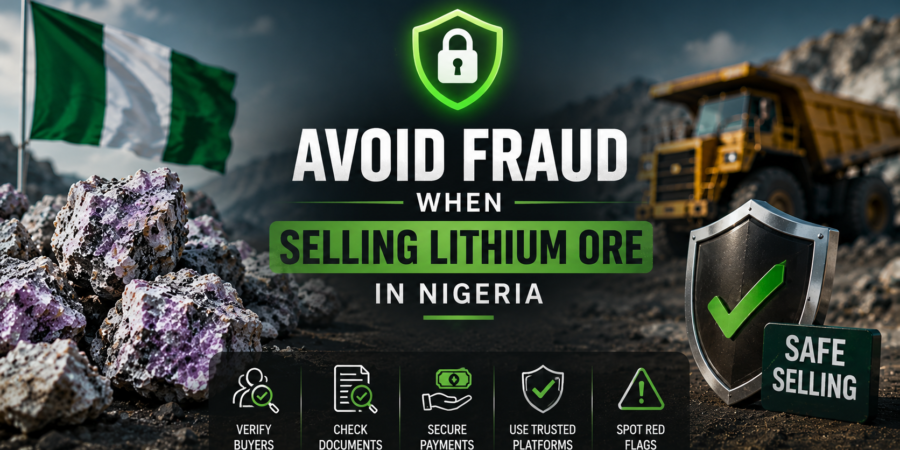
As Nigeria’s lithium industry continues expanding, more miners, suppliers, aggregators, and traders are entering the market hoping to benefit from rising global demand for battery minerals. Across different parts of Northern Nigeria especially, increasing activity around lithium mining and supply is creating new commercial opportunities. However, alongside these opportunities comes a growing challenge:
fraud within lithium trading.
Many suppliers have experienced situations involving fake buyers, manipulated assay results, false promises, payment delays, disappearing middlemen, or dishonest procurement arrangements.
Because Nigeria’s lithium market is still evolving, many transactions remain informal and poorly structured. This creates opportunities for bad actors to exploit inexperienced suppliers. Understanding how fraud happens and how to avoid it is becoming extremely important for anyone participating in Nigeria’s lithium supply chain.
This guide explains common fraud risks within lithium trading and practical ways suppliers can protect themselves while building more professional and secure commercial relationships.
Why Fraud Happens in Lithium Trading
Lithium has become one of the world’s most sought-after battery minerals because of growing demand from electric vehicles, battery manufacturing, renewable energy systems, and energy storage technologies.
As international attention toward Nigerian lithium increases, more individuals are entering the market claiming to be buyers, exporters, procurement agents, aggregators, or international representatives. Unfortunately, not everyone entering the market operates professionally or honestly. Fraud often thrives where information is limited, suppliers are inexperienced, verification systems are weak, and transactions happen informally. This is why suppliers must become increasingly careful and informed.
Common Types of Lithium Trade Fraud
Fraud within lithium trading can happen in several ways. Understanding these patterns helps suppliers recognize warning signs early.
1. Fake Buyers
One of the most common problems involves individuals pretending to be serious buyers without actual procurement capacity.
Some fake buyers promise unrealistic prices, request samples repeatedly, delay transactions, or disappear entirely after gaining supplier trust.
Others pretend to represent foreign companies without verifiable relationships. Reliable buyers usually operate with clearer structures, transparent communication, and identifiable operational systems.
2. Manipulated Assay Results
Another major issue involves assay manipulation. Some dishonest operators may misrepresent lithium grades, provide inaccurate assay reports, or intentionally undervalue materials during negotiations.
Because many suppliers do not fully understand assay interpretation, they may become vulnerable to manipulation. This is why suppliers should understand basic assay concepts, request transparency, and avoid relying entirely on unverifiable verbal explanations.
3. Sample Fraud
Some suppliers unknowingly release valuable samples without proper structure or documentation. In certain situations buyers repeatedly collect samples from multiple suppliers, but never proceed with actual purchases.
Others may use supplier samples to attract other buyers, test market opportunities, or negotiate elsewhere. Suppliers should therefore treat samples professionally and avoid careless distribution of materials.
4. Unrealistic Pricing Promises
One common tactic used by dishonest operators is promising extremely high prices. This often happens because suppliers naturally become attracted to the highest offer. However, unrealistic pricing may later lead to renegotiation, delays, excuses, manipulated assays, or transaction failure.
Professional buyers generally explain how pricing works, how grades are evaluated, and how logistics affect value. Transparency matters.
5. Payment Delays and False Commitments
Some fraudulent operators create endless negotiation cycles, delay payment discussions, or continue making promises without operational readiness. Others may request transportation, handling, or logistical commitments without serious procurement capability. Suppliers should pay attention to operational consistency and realistic transaction structures.
Why Proper Testing Protects Suppliers
Testing and assays are not only important for buyers, they also protect suppliers. Proper testing helps suppliers understand ore quality, negotiate more confidently, reduce manipulation risks, and identify unrealistic buyer behavior. Professional buyers usually support transparent testing procedures because verification improves transaction confidence, and reduces disputes.
Understanding Li₂O percentages, mineral composition, and assay interpretation helps suppliers participate more professionally within lithium trade.
Nigeria’s Common Lithium Ore Types
Nigeria’s growing lithium industry commonly involves Spodumene/Kunzite, Lepidolite, and Amblygonite.
Different buyers may evaluate these minerals differently depending on processing requirements, export demand, and commercial strategy. This is why proper mineral identification and laboratory analysis remain extremely important.
How to Identify Reliable Lithium Buyers
Reliable buyers usually demonstrate structured communication, transparent procedures, operational consistency, realistic pricing, and organized procurement systems. Suppliers should pay attention to professionalism, logistics coordination, assay transparency, and consistency of communication.
Professional procurement systems typically follow testing, evaluation, negotiation, and structured transaction procedures. Disorganized operations often create higher risk.
Looking to Discuss Structured Lithium Supply Opportunities?
The Nigerian Mineral Exchange (NME) is working to support more structured lithium trade systems through supplier coordination, buyer connections, aggregation support, and increasing visibility for Nigeria’s emerging battery mineral ecosystem.
Suppliers and buyers interested in discussing lithium supply opportunities, ore evaluation, buyer coordination, or aggregation support can contact NME for further engagement. (WhatsApp: +2348130799304)
Why Documentation Matters
Even within evolving informal markets, documentation remains important. Suppliers should try to maintain assay records, communication history, delivery records, negotiation details, and basic transaction documentation.
Good documentation reduces misunderstandings, improves professionalism, and strengthens negotiation positions. As the lithium industry becomes more organized, documentation standards will become increasingly important.
Avoid Emotional Negotiations
Many suppliers become vulnerable because they negotiate emotionally rather than commercially. For example desperation, excitement, or fear of losing opportunities can lead to rushed decisions. Professional negotiation requires patience, verification, realistic expectations, and operational awareness. Suppliers should avoid making decisions based solely on rumors, verbal promises, or exaggerated market stories.
Why Long-Term Relationships Matter
Reliable buyers usually focus on repeat procurement, stable supply relationships, and long-term coordination. Fraudulent operators often focus only on short-term extraction, opportunistic deals, or manipulation. Suppliers should therefore evaluate whether buyers appear interested in ongoing supply relationships, operational structure, and commercial consistency. Long-term trust increasingly matters within lithium trade.
The Importance of Market Knowledge
Suppliers who understand lithium grades, assays, buyer expectations, logistics, and market structure are generally less vulnerable to fraud. Knowledge improves bargaining power, commercial awareness, and operational confidence. As Nigeria’s lithium industry evolves, technical and commercial understanding will become increasingly valuable.
Why Aggregation and Coordination Matter
Small-scale miners often face higher fraud risks because market access may be limited, logistics may be fragmented, and direct buyer relationships may be weak. Structured aggregation systems may help improve coordination, buyer access, logistics, and commercial transparency. As Nigeria’s lithium ecosystem becomes more organized, professional coordination systems will likely become increasingly important.
The Future of Transparency in Nigeria’s Lithium Market
Nigeria’s lithium market is gradually transitioning from scattered informal transactions toward structured procurement systems, organized aggregation, professional quality verification, and stronger commercial coordination.
As this evolution continues, transparency and trust will become increasingly valuable within the supply chain. The future market will likely favor verified suppliers, organized buyers, structured logistics, and professional procurement systems.
Final Thoughts
Fraud remains one of the biggest risks within Nigeria’s growing lithium trade. Common problems may involve fake buyers, manipulated assays, unrealistic pricing promises, payment delays, and poor transaction transparency. Suppliers can reduce these risks by focusing on proper testing, verification, documentation, realistic negotiations, and structured commercial relationships.
As Nigeria’s lithium ecosystem continues evolving, suppliers who prioritize transparency, professionalism, quality control, and market understanding will likely build stronger and more sustainable commercial opportunities. In the long run, trust may become one of the most valuable assets within Nigeria’s lithium supply chain.
Related Articles
- Where to Sell Lithium Ore in Abuja: Official 2026 NME Buying Prices and Guide
- Lithium Ore Sellers in Kebbi State: Supply Your Lithium Ores to the Nigerian Mineral Exchange Abuja Warehouse
- Lithium Ore Sellers in Zamfara State: Supply Your Lithium Ores to the Nigerian Mineral Exchange Abuja Warehouse
- How to Sell Lithium Ore in Nigeria: Step-by-Step Guide for Miners
- 10 Common Reasons Lithium Ore Gets Rejected in Nigeria
- Sell Lithium Ore in Abuja, Nigeria – Fast Testing & Payment
- Lithium Buyers Are Back in Nigeria
- How to Find Reliable Lithium Buyers in Nigeria
- How to Test Lithium Ore Before Selling in Nigeria



Leave a Reply