
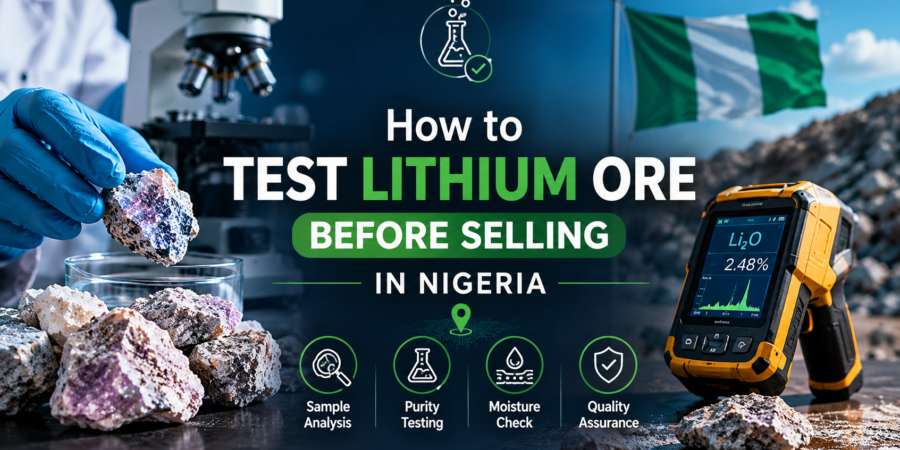
As Nigeria’s lithium industry continues to grow, more miners, suppliers, aggregators, and local traders are entering the market hoping to benefit from rising global demand for battery minerals. Across Northern Nigeria especially, increasing exploration and mining activities are creating new commercial opportunities around lithium supply.
However, one major mistake many suppliers make is attempting to sell lithium ore without proper testing.
In today’s lithium market, buyers rarely rely on appearance alone. Serious buyers want to understand:
- lithium concentration,
- mineral composition,
- impurities,
- moisture levels,
- and commercial quality.
This is why testing and assay verification have become extremely important within lithium trading.
Without proper testing:
- suppliers may undervalue their materials,
- buyers may reject shipments,
- negotiations may fail,
- and disputes can arise over ore quality.
Understanding how lithium ore is tested before sale can help suppliers:
- negotiate more effectively,
- improve buyer confidence,
- reduce rejection risks,
- and participate more professionally in Nigeria’s growing lithium supply chain.
Why Lithium Ore Testing Matters
Lithium buyers are not simply purchasing rocks or mineralized materials.
They are evaluating:
- lithium content,
- processing potential,
- recovery efficiency,
- and commercial value.
Testing helps buyers determine whether the ore is commercially viable and whether it meets procurement requirements.
Proper testing also protects suppliers because it:
- improves pricing transparency,
- reduces manipulation,
- and creates clearer negotiations.
In many cases, suppliers who understand testing procedures are treated more seriously by buyers.
The Most Common Lithium Ore Types in Nigeria
Nigeria hosts several lithium-bearing minerals, but the most commonly encountered commercial lithium ore types currently include:
- Spodumene/Kunzite,
- Lepidolite,
- and Amblygonite.
Each mineral type has different:
- lithium concentrations,
- processing characteristics,
- and commercial demand.
Because of this, proper mineral identification and laboratory analysis are very important before entering supply discussions.
What Buyers Usually Test For
Lithium ore testing generally focuses on several major factors.
These include:
- Li₂O percentage,
- mineral composition,
- impurities,
- contamination,
- moisture content,
- and overall commercial quality.
The most important measurement is usually:
Li₂O percentage (Lithium Oxide percentage).
This helps estimate how much lithium is present within the ore.
Higher Li₂O percentages generally attract stronger commercial interest because they may offer better processing economics.
Step 1 – Proper Sample Collection
One of the most important parts of lithium testing is sample collection.
Poor sampling can produce misleading results.
For example:
- selecting only the best-looking stones,
- collecting from only one small location,
- or ignoring lower-grade sections
may create unrealistic expectations.
Professional sampling should represent the actual material intended for sale.
This helps produce more accurate assay results and reduces future disputes with buyers.
Why Representative Sampling Matters
Many disputes in lithium trading occur because:
- the tested sample differs from the delivered material.
If the bulk material does not match the assay sample, buyers may:
- reject the shipment,
- reduce pricing,
- or lose confidence in the supplier.
Representative sampling therefore helps protect both suppliers and buyers.
Consistency is extremely important within lithium supply relationships.
Step 2 – Basic Visual Inspection
Before laboratory testing, many suppliers and buyers begin with visual inspection.
Although visual inspection alone is not enough, experienced individuals may sometimes identify:
- pegmatite formations,
- spodumene crystals,
- lepidolite coloration,
- mineral textures,
- and associated geological indicators.
However, appearance can be misleading.
Some materials may visually resemble lithium-bearing minerals while containing low commercial lithium concentrations.
This is why laboratory analysis remains necessary.
Step 3 – Laboratory Assay Testing
Laboratory assay testing is one of the most important stages of lithium evaluation.
The purpose of the assay is to determine:
- lithium concentration,
- mineral composition,
- impurities,
- and commercial quality.
Assay laboratories may use different analytical techniques depending on:
- mineral type,
- testing objectives,
- and available equipment.
The results help buyers estimate:
- processing potential,
- recovery efficiency,
- and commercial value.
Understanding Li₂O Percentage
Lithium concentration is commonly expressed as:
Li₂O percentage.
Higher percentages generally indicate stronger lithium concentration.
However, buyers also consider:
- impurities,
- consistency,
- moisture,
- logistics,
- and processing requirements.
This means high Li₂O alone does not automatically guarantee premium pricing.
Commercial evaluation involves several interconnected factors.
Step 4 – Checking for Impurities
Lithium buyers also evaluate contamination and impurities.
Common concerns may include:
- excessive iron,
- clay contamination,
- mixed materials,
- dirt,
- waste rock,
- or organic matter.
Impurities can reduce:
- processing efficiency,
- recovery rates,
- and commercial value.
Proper sorting and material handling can therefore improve buyer confidence significantly.
Step 5 – Moisture Testing
Moisture content is another important factor many suppliers overlook.
Excess moisture can:
- increase transportation costs,
- reduce effective ore value,
- complicate storage,
- and affect processing performance.
Some buyers may reject overly wet materials entirely.
Proper storage and handling practices help reduce these risks.
Why Buyers Prefer Tested Ore
Tested ore gives buyers:
- more confidence,
- better pricing visibility,
- reduced operational risk,
- and clearer procurement planning.
Untested materials create uncertainty.
In many cases, buyers may:
- reduce pricing,
- request additional testing,
- or delay procurement decisions
if proper assay information is unavailable.
Looking to Discuss Lithium Ore Evaluation or Supply Opportunities?
The Nigerian Mineral Exchange (NME) is working to support more structured lithium trade systems through:
- supplier coordination,
- buyer connections,
- aggregation support,
- and growing visibility for Nigeria’s lithium ecosystem.
Suppliers interested in discussing:
- lithium ore evaluation,
- aggregation opportunities,
- buyer coordination,
- or supply discussions
can contact NME on WhatsApp (08130799304) for further engagement.
Common Testing Mistakes Suppliers Make
Many suppliers unintentionally create problems during testing by:
- mixing materials,
- providing non-representative samples,
- contaminating samples,
- or misunderstanding assay procedures.
Some suppliers also assume:
- visual appearance alone determines value.
But buyers rely heavily on laboratory verification before making procurement decisions.
Understanding this helps suppliers negotiate more realistically and professionally.
Why Consistency Matters More Than One Good Sample
One major issue within lithium trading is inconsistency.
Some suppliers present:
- high-grade samples,
- but later deliver lower-quality bulk material.
Professional buyers pay close attention to consistency because:
- processing systems depend on stable quality,
- logistics planning requires predictability,
- and long-term supply relationships rely on trust.
Suppliers who maintain stable quality often attract stronger long-term opportunities.
Portable Testing vs Laboratory Testing
Some field operators use portable devices for preliminary indications.
However:
- portable readings are not always sufficient for commercial transactions.
Most serious buyers still prefer:
- laboratory assays,
- verified testing,
- and formal analytical results.
Portable testing may help during exploration or early evaluation, but laboratory confirmation remains extremely important for commercial supply discussions.
How Testing Helps Suppliers Negotiate Better
Testing protects suppliers as much as buyers.
Without testing:
- suppliers may unknowingly undersell valuable material,
- misunderstand ore quality,
- or enter weak negotiations.
Proper assay information helps suppliers:
- negotiate more confidently,
- understand market expectations,
- and communicate more professionally.
Knowledge improves bargaining power.
The Growing Importance of Assays in Nigeria’s Lithium Market
As Nigeria’s lithium industry evolves, testing and verification systems are becoming more important.
The market is gradually shifting toward:
- structured procurement,
- better quality control,
- professional aggregation,
- and organized supply systems.
This means suppliers who understand:
- assays,
- testing procedures,
- and quality verification
may position themselves more effectively within the future lithium economy.
Final Thoughts
Testing lithium ore before selling is one of the most important steps within modern lithium trading.
Proper testing helps determine:
- lithium concentration,
- mineral composition,
- impurities,
- moisture levels,
- and commercial viability.
It also helps suppliers:
- negotiate better,
- reduce rejection risks,
- improve buyer confidence,
- and participate more professionally within Nigeria’s growing lithium supply chain.
As the industry becomes more organized, suppliers who prioritize:
- proper testing,
- transparency,
- consistency,
- and quality control
will likely build stronger long-term opportunities within the evolving lithium market.
Related Articles
- Where to Sell Lithium Ore in Abuja: Official 2026 NME Buying Prices and Guide
- How to Find Reliable Lithium Buyers in Nigeria
- Lithium Ore Sellers in Kebbi State: Supply Your Lithium Ores to the Nigerian Mineral Exchange Abuja Warehouse
- Lithium Ore Sellers in Zamfara State: Supply Your Lithium Ores to the Nigerian Mineral Exchange Abuja Warehouse
- How to Sell Lithium Ore in Nigeria: Step-by-Step Guide for Miners
- Sell Lithium Ore in Abuja, Nigeria – Fast Testing & Payment
- Lithium Buyers Are Back in Nigeria



Leave a Reply