
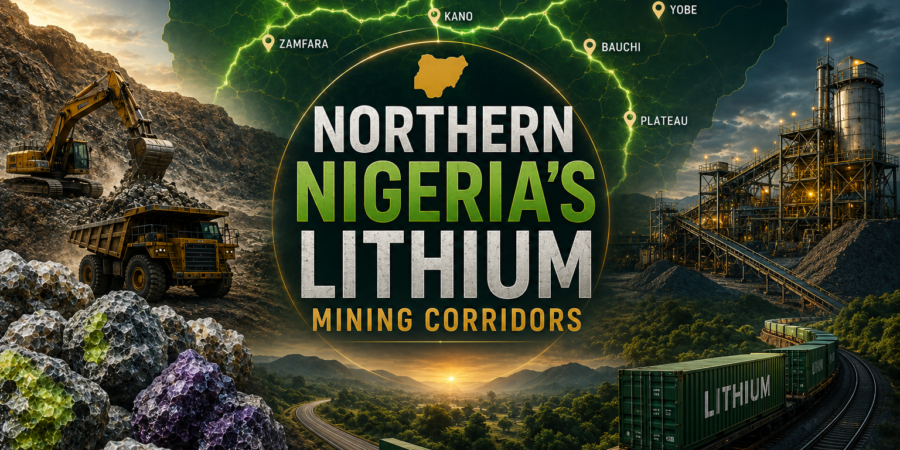
When people think about mineral resources, they often think about locations. A deposit is found in one state. A mine operates in one community. An exploration project focuses on one geological area. While these observations are technically correct, they can also be misleading. Modern mining industries are rarely built around isolated locations. They are built around corridors. A corridor is more than a mining site. It is a network. It is the collection of geological resources, transportation routes, commercial centers, logistics infrastructure, aggregation hubs, service providers, warehouses, buyers, and investment activity that together enable minerals to move from the ground to the market.
Understanding Northern Nigeria’s lithium future therefore requires looking beyond individual states and examining the broader mining corridors that are gradually emerging across the region. This perspective is important because the future lithium economy will not be defined solely by where lithium is found. It will be defined by how efficiently lithium can move through the supply chain. In many ways, the real story of Northern Nigeria’s lithium industry is not just about deposits. It is about connectivity.
Over the past several years, growing global demand for battery minerals has increased attention on lithium-bearing pegmatites across Northern Nigeria. Exploration activities, mining operations, procurement initiatives, and investment discussions have expanded significantly. As this process continues, distinct mining corridors are beginning to take shape. These corridors connect mineralized regions with commercial centers and ultimately with international markets.
The first and perhaps most important corridor can be described as the Nasarawa-Abuja Lithium Corridor. This corridor has become one of the most commercially significant segments of Nigeria’s emerging lithium industry. Nasarawa State has attracted considerable attention because of its mining activities, mineral potential, and proximity to Abuja. The Federal Capital Territory functions as a commercial and coordination hub where buyers, consultants, logistics providers, investors, aggregators, and procurement organizations interact. This relationship creates a natural flow of information, materials, services, and commercial opportunities. In many respects, Abuja is becoming the business capital of Nigeria’s lithium trade while nearby mining regions provide access to supply. The result is a corridor that combines production with commercial coordination.
A second corridor is gradually emerging across parts of Kogi, Niger, and adjoining regions. This corridor benefits from strategic transportation routes linking Northern Nigeria with Southern commercial centers. Its significance lies not only in resource potential but also in logistics. As supply chains mature, transportation efficiency becomes increasingly important. Buyers do not simply evaluate the quality of ore. They evaluate the ease with which that ore can reach warehouses, processing facilities, export channels, and industrial consumers. Regions positioned along major transportation routes often enjoy important advantages. The Kogi-Niger corridor illustrates how geography can influence commercial competitiveness.
Another important corridor involves Kaduna and surrounding areas. Kaduna has long been recognized as one of Northern Nigeria’s major commercial centers. Its transportation networks, industrial base, and business environment provide infrastructure that could support future battery-mineral supply chains. While much attention remains focused on resource locations, commercial cities frequently become critical nodes within mining ecosystems. The future value of Kaduna may therefore lie not only in mineral potential but also in its ability to support logistics, procurement coordination, warehousing, and trade facilitation. This is a reminder that mining corridors are often as much about commerce as they are about geology.
Plateau State contributes another dimension to Northern Nigeria’s corridor network. Historically, Plateau has been one of Nigeria’s most important mining regions. Decades of mining activity created a concentration of industry knowledge, technical expertise, service providers, and mining communities. This human infrastructure remains valuable. As battery-mineral supply chains expand, regions with established mining cultures often possess advantages that newer jurisdictions must spend years developing. The Plateau corridor therefore represents not only geological potential but also accumulated industry experience.
The concept of mining corridors becomes even more important when viewed through the lens of aggregation. One of the defining characteristics of Nigeria’s lithium industry is the distribution of production across multiple locations. Unlike some jurisdictions where production is concentrated within a few large mines, Nigeria’s emerging lithium sector often involves numerous operators, mining communities, and supply points. This creates a need for aggregation. Aggregation centers function as connectors within the corridor system. They consolidate material from different locations, create commercially meaningful inventory volumes, and improve efficiency for buyers seeking larger quantities. Without aggregation, fragmented supply can limit market access. With aggregation, dispersed production can support structured procurement.
The evolution of warehousing infrastructure is another important component of these corridors. As trade volumes grow, the need for inventory management, quality verification, stock visibility, and supply coordination becomes increasingly important. Warehouses often emerge as critical nodes linking production regions with commercial markets. This is one reason why discussions about lithium increasingly include storage facilities and commercial hubs rather than focusing exclusively on mines.
The corridor perspective also highlights the importance of information. Minerals move through physical corridors. Information moves through commercial corridors. Investors need geological intelligence. Buyers need supplier intelligence. Logistics providers need operational intelligence. Procurement teams need market intelligence. The stronger these information networks become, the more efficiently the physical supply chain can function.
In the modern battery-mineral economy, intelligence is becoming a form of infrastructure. Perhaps the most important lesson is that Northern Nigeria’s lithium industry should not be viewed as a collection of isolated projects. It should be viewed as an interconnected system. Mining communities connect to aggregators. Aggregators connect to warehouses. Warehouses connect to buyers. Buyers connect to processors. Processors connect to global supply chains. Every participant forms part of a larger network. The regions that successfully organize these networks often become the most competitive participants within international markets. This is why mining corridors matter. They transform resources into supply chains. And supply chains are what global markets ultimately purchase.
The Nigerian Mineral Exchange (NME) is actively supporting the development of these corridors by connecting suppliers, buyers, aggregators, logistics providers, investors, processors, and procurement networks across Northern Nigeria’s lithium-producing regions. For international procurement groups, battery-material companies, commodity traders, mineral processors, manufacturers, and investors evaluating sourcing opportunities in Nigeria, NME provides support in supplier identification, procurement coordination, aggregation access, market intelligence, supplier verification, and supply-chain visibility.
NME also serves as a Foreign Buyer Representative and International Buyer Representative in Nigeria, helping international organizations establish trusted local market presence through supplier engagement, due diligence, sourcing coordination, logistics intelligence, procurement support, market-entry assistance, and on-ground representation. At the same time, NME continues to work with miners, suppliers, aggregators, warehouse operators, and industry stakeholders across Northern Nigeria who are seeking access to serious buyers, structured procurement opportunities, and long-term commercial partnerships.
Organizations seeking sourcing support, supplier verification, procurement coordination, market-entry guidance, aggregation partnerships, or local buyer representation can engage NME directly through WhatsApp (+2348130799304).
The future of Northern Nigeria’s lithium industry will not be determined solely by what is discovered underground. It will be determined by the corridors built above ground. Because in the global battery economy, resources create opportunities. But corridors create industries.
Related Articles
- Source Lithium Ore in Nigeria
- Sell Lithium Ore in Nigeria
- How to Source Lithium Ore in Nigeria in 2026
- How to Secure Large-Scale Lithium Ore Supply in Abuja: The NME Industrial Sourcing Guide
- Northern Nigeria Lithium Trade Ecosystem
- Spot Market vs Contract Lithium Prices in Nigeria
- What Makes Lithium Ore More Valuable?
- Factors Affecting Lithium Ore Prices in Nigeria
- Can Nigeria Become Africa’s Lithium Powerhouse?
- Why Local Partnerships Matter in Lithium Trade
- Developing Sustainable Lithium Supply Networks in Nigeria
- Lithium Procurement Strategy for Foreign Buyers in Nigeria
- Lithium and Electric Vehicle Demand
- Lithium and Energy Storage Technologies
- Nigeria’s Emerging Battery Minerals Economy

Leave a Reply