
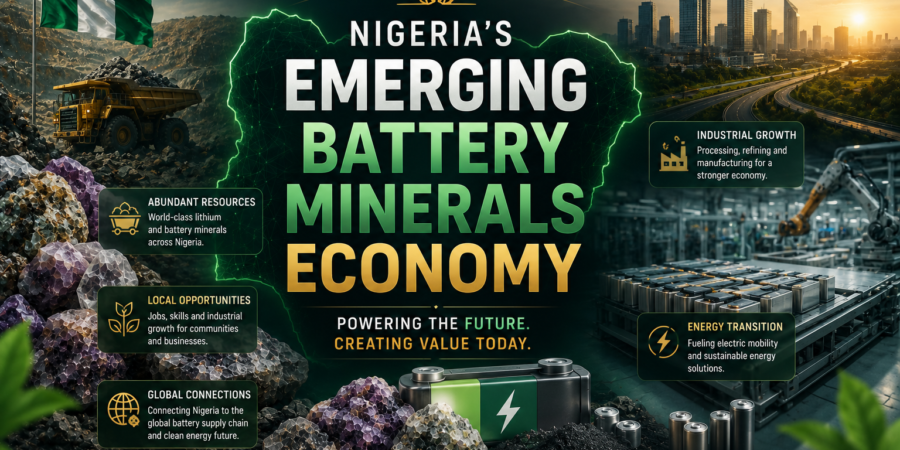
For many years, discussions about Nigeria’s mining future were largely centered on individual commodities. Gold was discussed as a gold opportunity. Coal was discussed as a coal opportunity. Limestone was discussed as a cement opportunity. The focus was typically placed on specific minerals and the industries directly associated with them. Today, a different conversation is beginning to emerge. Increasingly, industry observers, investors, policymakers, and international buyers are looking beyond individual minerals and examining something much larger: the emergence of a battery minerals economy.
This shift is significant because it changes how resources are viewed. Instead of seeing lithium, graphite, manganese, nickel, cobalt, and other critical minerals as isolated commodities, they are increasingly being understood as components of a single industrial ecosystem. The result is a new way of thinking about mining, industrial development, and economic opportunity. For Nigeria, this perspective may prove transformational. The country’s opportunity is no longer limited to extracting minerals. It is increasingly about participating in the supply chains that power the future.
The concept of a battery minerals economy begins with a simple reality. Modern economies are becoming more dependent on energy storage. Electric vehicles are expanding globally. Renewable energy systems are growing. Industrial electrification is accelerating. Digital infrastructure continues to expand. And all of these developments require batteries. Behind every battery is a complex network of mineral supply chains stretching across continents, industries, and markets. These supply chains begin with geology but extend far beyond mining. They involve exploration, extraction, processing, logistics, manufacturing, procurement, financing, technology, and market intelligence. Collectively, they form what is increasingly becoming known as the battery minerals economy.
Lithium is often the most visible part of this story. Its role in rechargeable battery technologies has attracted enormous global attention. As countries seek secure supplies of battery materials, lithium has emerged as one of the world’s most strategically important minerals. However, the battery economy is much broader than lithium alone. Battery technologies depend on multiple materials working together. This creates opportunities for countries capable of participating in various segments of the value chain.
For Nigeria, this broader perspective is important. The country’s growing prominence within lithium discussions is helping attract attention to its wider mineral potential. More importantly, it is encouraging stakeholders to think about mining as part of a larger industrial system rather than as a standalone activity. This distinction matters because the greatest economic value often accumulates around ecosystems rather than individual commodities. The battery economy illustrates this principle clearly. A lithium deposit has value. But a lithium supply chain has greater value. A processing facility creates value. But an entire network of suppliers, logistics providers, technology companies, procurement organizations, and industrial operators creates even more value.
The countries that benefit most from critical minerals are often those that succeed in building these broader ecosystems. Nigeria is increasingly positioned to pursue such a strategy. Several factors support this possibility. The first is scale. Nigeria possesses one of Africa’s largest economies, the continent’s largest population, an expanding entrepreneurial ecosystem, and growing domestic demand for industrial development. These characteristics create a foundation upon which supporting industries can emerge.
The second is geography. Nigeria occupies a strategic position within West Africa and serves as an important commercial hub for the region. This position provides advantages for trade, logistics, procurement coordination, and market development. The third is timing. The global battery economy remains in a period of rapid expansion. Supply chains are being built. Procurement relationships are being established. Investment flows are evolving. New industrial partnerships are emerging. The architecture of the future battery economy is still under construction. This creates opportunities for countries that move strategically during this period.
Nigeria’s emerging battery minerals economy therefore extends far beyond extraction. It encompasses exploration, resource intelligence, aggregation, logistics, processing, supplier verification, procurement support, market intelligence, trade facilitation, and industrial development. Each of these activities represents a potential source of economic value. Taken together, they form an ecosystem capable of generating opportunities for miners, entrepreneurs, investors, consultants, technology providers, logistics operators, researchers, and manufacturers.
Another important aspect of the battery minerals economy is information. As supply chains become more sophisticated, the demand for reliable market intelligence continues to grow. Buyers want supplier visibility. Investors want resource intelligence. Manufacturers want supply-chain transparency. Governments want accurate industry data. In this environment, information itself becomes a strategic asset. This is particularly relevant for Nigeria because the country’s future role may depend not only on producing minerals but also on organizing information around those minerals.
The mining industries of the future will be built on both physical and intellectual infrastructure. Minerals are important. But so are databases. So are procurement networks. So are supplier directories. So are intelligence platforms. And so are market ecosystems. This broader understanding aligns closely with the direction in which the global mining industry is evolving. Increasingly, competitive advantage is created through coordination rather than extraction alone. The battery economy rewards participants capable of connecting resources to markets efficiently and reliably. That connection requires institutions, networks, and systems. This is where Nigeria’s greatest opportunity may lie. The country’s emerging battery minerals economy is not merely a collection of mining projects. It is the gradual formation of an ecosystem capable of supporting future industries.
The significance of this development extends beyond the mining sector. Battery minerals sit at the intersection of energy, transportation, technology, manufacturing, and industrial development. As these sectors continue expanding, the importance of battery-mineral ecosystems is likely to grow. Countries that establish strong positions today may enjoy strategic advantages for decades to come.
The Nigerian Mineral Exchange (NME) is actively helping build this ecosystem by connecting suppliers, buyers, aggregators, logistics providers, investors, processors, and procurement networks across Nigeria’s growing battery-mineral sector. For international procurement groups, battery-material companies, commodity traders, mineral processors, manufacturers, and investors evaluating opportunities in Nigeria, NME provides support in supplier identification, procurement coordination, aggregation access, market intelligence, supplier verification, and supply-chain visibility.
NME also serves as a Foreign Buyer or International Buyer Representative in Nigeria, helping international organizations establish trusted local market presence through supplier engagement, due diligence, sourcing coordination, logistics intelligence, procurement support, market-entry assistance, and on-ground representation. This enables foreign buyers and investors to navigate Nigeria’s emerging battery-mineral ecosystem while building informed sourcing and investment strategies.
At the same time, NME continues to work with suppliers, mining companies, aggregators, and industry stakeholders across Nigeria who are seeking access to serious buyers, structured procurement opportunities, and long-term commercial partnerships. Organizations or individuals seeking lithium buyers, sourcing support, supplier verification, procurement coordination, market-entry guidance, aggregation partnerships, or local buyer representation can engage NME directly through WhatsApp (+2348130799304).
Nigeria’s battery minerals economy is still emerging. But its significance is already becoming apparent. What is taking shape is larger than lithium. Larger than mining. And larger than any single commodity. It is the gradual emergence of an ecosystem connected to some of the most important industrial trends of the twenty-first century. And for countries capable of positioning themselves within that ecosystem, the opportunities may be only beginning.
Related Articles
- Source Lithium Ore in Nigeria
- Sell Lithium Ore in Nigeria
- How to Source Lithium Ore in Nigeria in 2026
- How to Secure Large-Scale Lithium Ore Supply in Abuja: The NME Industrial Sourcing Guide
- We Are Buying Lithium Ore in Nigeria (From 1% Li₂O and Above) | Abuja Warehouse
- Lithium Pricing Mistakes Suppliers Make in Nigeria
- How Buyers Negotiate Lithium Prices in Nigeria
- How Global Lithium Demand Affects Nigerian Prices
- Spot Market vs Contract Lithium Prices in Nigeria
- What Makes Lithium Ore More Valuable?
- Factors Affecting Lithium Ore Prices in Nigeria
- Why Local Partnerships Matter in Lithium Trade
- Developing Sustainable Lithium Supply Networks in Nigeria
- Lithium Procurement Strategy for Foreign Buyers in Nigeria
Leave a Reply