
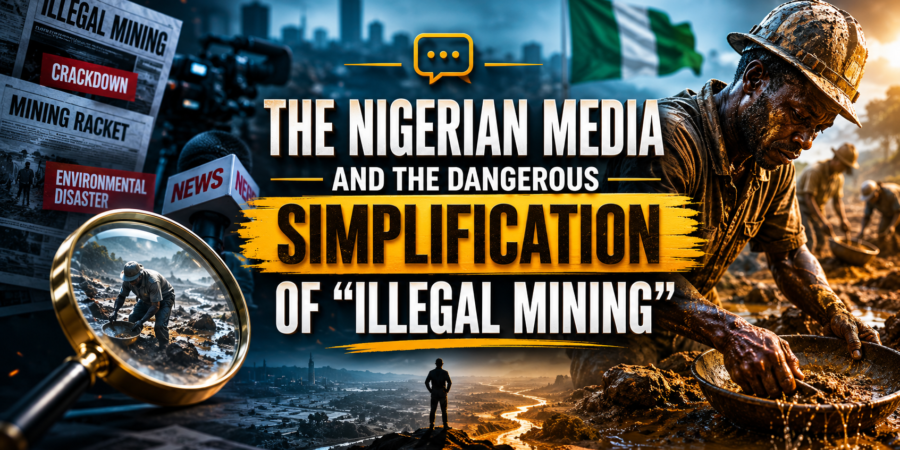
Why Nigeria’s Mining Conversation Needs Depth, Not Sensationalism
By Obinna Ede
Mining Ecosystem Development Strategist, Founder & System Architect of the Nigerian Mineral Exchange (NME)
Nigeria’s mining sector suffers from many problems. Weak infrastructure, limited geological data, low investment, poor formalization systems, environmental concerns, smuggling networks, institutional coordination gaps, and policy inconsistency. But one of the least discussed and most dangerous problems facing the sector today is the collapse of nuance in the national conversation surrounding mining itself.
In recent years, the phrase “illegal mining” has become one of the most aggressively repeated expressions within Nigerian public discourse. Television stations use it. Newspapers amplify it. Online blogs sensationalize it. Social media weaponizes it. Government press briefings recycle it almost daily. Everything has become “illegal mining.” And that is precisely the problem. Nigeria’s media ecosystem has increasingly reduced one of the most complex rural economic and development issues in the country into a simplistic law-enforcement narrative.
This simplification may generate headlines, but it does not generate understanding. And without understanding, there can be no sustainable solution. The Nigerian mining sector cannot be transformed through shallow reporting, emotionally charged language, or sensational storytelling detached from the realities on the ground. A sector this important requires serious journalism, investigative depth, historical context, and development-oriented analysis. Unfortunately, that depth is still largely missing.
The Media’s Simplification Problem
The media plays a powerful role in shaping national consciousness. What the media repeatedly emphasizes eventually becomes public perception. And public perception often shapes policy direction. When the average Nigerian hears the phrase “illegal mining,” certain images immediately come to mind: criminal syndicates, armed groups, environmental destruction, smuggling, violence, and economic sabotage.
While these realities certainly exist in parts of the mining sector, the problem begins when all mining activity occurring outside formal systems is automatically collapsed into the same category. This is where nuance disappears. A foreign-backed criminal smuggling network operating sophisticated illegal extraction systems is not the same thing as a rural artisanal miner digging manually to survive. A violent mineral trafficking syndicate is not the same thing as a community whose members have practiced small-scale mineral extraction for generations without modern regulatory integration. Yet media reporting frequently treats these realities as though they are identical.
The consequence is that millions of Nigerians involved in artisanal and small-scale mining become socially framed primarily as criminals rather than economic actors operating within an underdeveloped and poorly integrated sector. That distinction matters enormously. Because the way a society defines a problem determines the kinds of solutions it pursues.
Sensationalism Cannot Replace Sector Understanding
Part of the challenge is structural because mining journalism in Nigeria remains underdeveloped. Very few media organizations have dedicated mining correspondents with deep sector understanding. Many reports are produced rapidly from government statements, security briefings, or isolated incidents without sufficient field investigation or contextual analysis. As a result, coverage often prioritizes conflict, arrests, raids, violence, controversy, and political accusations.
These stories attract attention, but they rarely explain why informal mining persists, how mining communities survive, why formalization struggles, how supply chains operate, what role local economies play, or how governance failures contribute to informality. The result is a national conversation dominated by symptoms rather than systems. This is dangerous because complex sectors cannot be governed intelligently through emotionally simplified narratives.
Nigeria Is Dealing With Informality as Much as Illegality
One of the biggest conceptual errors in Nigeria’s mining conversation is the refusal to distinguish properly between informality and criminality. Illegal mining exists. That fact should not be denied. There are real criminal actors within the mining sector involved in smuggling, violent operations, environmental abuse, tax evasion, and organized mineral theft. These activities must be addressed decisively. But Nigeria must also recognize another reality: a significant percentage of what is broadly labeled as “illegal mining” is actually informal artisanal and small-scale mining operating outside structured regulatory systems.
That difference is critical. Informality is often a symptom of poverty, weak state presence, limited institutional access, low awareness, poor licensing accessibility, exclusion from formal markets, and historical underdevelopment. Criminality, on the other hand, involves deliberate violation of law for exploitative or destructive purposes. When media narratives fail to distinguish between these categories, policy confusion becomes inevitable. And confused policy produces ineffective outcomes.
Mining Is Also a Rural Livelihood System
Another weakness in Nigerian mining reporting is the absence of socioeconomic context. In many rural communities, mining is not merely an economic activity. It is survival. It is livelihood. It is local commerce. It is household income. It is community economics. Entire local economies often depend on artisanal mining circulation for food vendors, transport operators, equipment repairers, laborers, traders, women-led support businesses, and local merchants all depend on mining activity directly or indirectly.
Yet these realities are rarely explored in mainstream reporting. Instead, the miner is often reduced to a faceless security statistic. This dehumanization creates dangerous consequences. Once society stops seeing miners as citizens within an economic system and begins seeing them only as security threats, policy naturally shifts toward suppression rather than integration. That approach may create temporary headlines, but it does not build sustainable sectors.
The Consequences of Narrative Failure
The simplification of mining narratives carries serious long-term consequences for Nigeria.
1. It Distorts Public Understanding
Many Nigerians now understand mining almost entirely through the lens of criminality rather than development potential.
That weakens broader support for mining sector investment and reform.
2. It Encourages Enforcement-Heavy Policy Responses
If the dominant narrative is criminality, then government institutions will naturally prioritize force over development-oriented formalization strategies.
3. It Discourages Community Trust
Mining communities that constantly hear themselves described as “illegal” become more distrustful of government institutions and media organizations.
Distrust weakens formalization efforts.
4. It Scares Investors
International investors observing Nigeria through exaggerated security narratives may misunderstand the actual structure and potential of the mining sector.
5. It Prevents Intelligent Policy Debate
Nuanced conversations about formalization, rural development, market systems, environmental rehabilitation, community governance, and artisanal mining integration become overshadowed by sensational rhetoric.
Nigeria Needs a New Generation of Mining Journalism
Nigeria’s mining sector needs something different. It needs journalism capable of understanding mining not merely as a security issue, but as a complex economic, environmental, cultural, and developmental ecosystem. The country needs field-based mining reporting, investigative mining journalism, mining documentaries, community storytelling, supply-chain analysis, environmental reporting, data-driven mining intelligence, and deeper policy journalism.
Reporters covering mining should spend time inside mining communities. They should understand how artisanal mining economies function, how mineral trading systems operate, how local governance structures influence mining activity, how miners perceive formalization, and what barriers prevent integration into the formal economy. Without this depth, reporting will continue reproducing shallow narratives incapable of supporting real sector transformation.
Mining Narratives Shape Mining Policy
One of the most overlooked realities in governance is that narratives influence institutions. The way a country talks about a sector often determines how that sector is governed. If mining is discussed only through the language of illegality, then security agencies become the dominant actors. But if mining is understood as a development challenge involving informality, exclusion, poverty, governance gaps, and economic transition, then entirely new policy possibilities emerge. The conversation begins shifting toward formalization, education, incentives, market integration, traceability, community partnerships, and rural economic development. This is why narrative matters. Because language shapes policy imagination. And policy imagination shapes national outcomes.
The Role of Mining Media Platforms and Information Infrastructure
Nigeria also needs stronger mining-focused information institutions capable of producing specialized sector intelligence beyond sensational headlines. Mining ecosystem platforms such as the Nigerian Mineral Exchange (NME), alongside journalists, researchers, civil society organizations, universities, and development institutions, can help build a more informed mining information ecosystem for the country.
This includes mining data systems, educational content, sector analysis, documentary storytelling, market intelligence, stakeholder engagement, and structured public-awareness initiatives. The mining sector cannot mature without information maturity. And information maturity cannot emerge from shallow narratives.
Nigeria Must Learn to See Before It Can Solve
Nigeria cannot solve what it does not properly understand. And the country cannot properly understand mining if its national conversation continues collapsing complex economic realities into simplistic labels. The challenge facing Nigeria’s mining sector is bigger than the phrase “illegal mining.” It involves informality, underdevelopment, exclusion, weak institutions, poor market systems, limited rural integration, environmental pressures, and governance gaps.
These problems require intelligence, not merely outrage. The media therefore carries enormous responsibility. Not to protect wrongdoing, or excuse criminality. But to help society think more deeply, more responsibly, and more strategically about one of the most important emerging sectors in Nigeria’s future economy. Because a nation that misunderstands its miners may ultimately misunderstand its own path to development.
About the Author
Obinna Ede is a Mining Ecosystem Development Strategist and Founder/CEO of the Nigerian Mineral Exchange (NME), a digital marketplace and trade infrastructure platform focused on connecting the Nigerian mining industry through technology, market systems, research, media, and stakeholder collaboration. His work centers on building institutional frameworks, knowledge systems, and market structures capable of accelerating the formalization and sustainable development of Nigeria’s mineral economy.
Related Articles:
Why Nigeria Cannot Solve “Illegal Mining” Until It Understands Informal Mining
Before Licenses and Regulations: The Cultural Roots of Informal Mining in Nigeria
The Missing Link in Nigeria’s Mining Formalization Policy: Traditional Rulers and Local Governments
Building Nigeria’s Mineral Market Infrastructure: The Nigerian Mineral Exchange Vision
Nigeria’s Critical Minerals and the Global Energy Transition
Top Mining Opportunities in Nigeria: A Guide for Investors and Industry Participants
How to Invest in Nigeria’s Mining Sector: A Step-by-Step Guide for Foreign Investors


Leave a Reply