
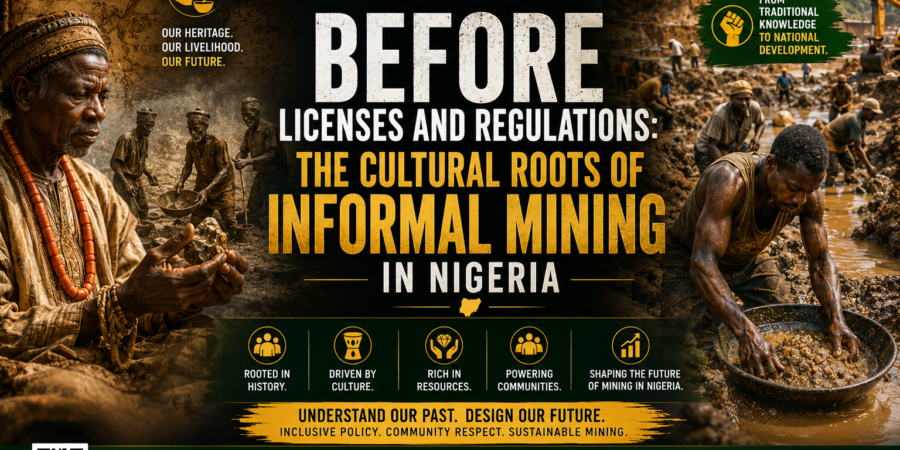
Why Nigeria Cannot Understand Informal Mining Without Understanding History, Culture, and Indigenous Economic Systems
By Obinna Ede
Mining Ecosystem Development Strategist, Founder & System Architect of the Nigerian Mineral Exchange (NME)
One of the greatest mistakes Nigeria continues to make in its mining conversation is the assumption that mining began when the modern state introduced licenses, regulations, and federal oversight systems. It did not. Long before the creation of Abuja. Long before modern ministries. Long before mining cadastres, permits, environmental compliance systems, and formal regulatory institutions, communities across what is now Nigeria were already extracting minerals from the earth.
Mining is not a foreign activity suddenly introduced into Nigerian society by modern industrial systems. In many communities, it is historical. It is inherited. It is cultural. And until Nigeria fully understands this reality, the country will continue misunderstanding large parts of the informal mining challenge itself.
This is because a significant portion of what modern policy language now describes as “illegal mining” did not emerge originally from criminal intent. Much of it evolved from traditional extraction systems, indigenous economic practices, survival economies, and local occupations that existed long before the modern Nigerian state established formal mineral governance structures. This distinction matters enormously. Because societies cannot effectively regulate realities they do not properly understand.
Mining Existed Before Colonial Rule
Long before British colonial administration established centralized mineral governance systems, communities across different parts of Nigeria were already familiar with mineral extraction activities. Gold was mined historically in parts of northern Nigeria. Tin extraction existed around the Jos Plateau region for generations. Iron ore processing and blacksmithing traditions existed in several ancient societies. Salt extraction, gemstone gathering, and other mineral-related economic activities formed part of local livelihood systems across multiple regions.
These activities were not necessarily organized according to modern industrial standards, but they existed. And they existed within cultural, economic, and community structures recognized locally as legitimate forms of occupation and survival. This historical reality is important because it challenges one of the dominant assumptions often embedded within contemporary mining narratives – the assumption that all unlicensed mining activity emerged primarily as criminality.
In many cases, what the modern state now categorizes administratively as informal or illegal mining may be viewed locally through an entirely different lens as ancestral occupation, inherited livelihood, traditional economic activity, or community survival practice. That does not mean modern regulation is unnecessary. But it does mean the pathway toward formalization must recognize the historical and cultural foundations of the sector itself.
The Colonial Disruption of Indigenous Resource Systems
The arrival of colonial administration transformed the relationship between local communities and mineral resources. Colonial governments centralized control over mineral extraction largely to support imperial economic interests. Resource governance increasingly shifted away from local community systems toward externally imposed administrative structures designed to regulate production, taxation, and export activities. Over time, mineral ownership became absorbed into centralized state authority. After independence, Nigeria largely retained many aspects of this centralized resource governance model.
Legally, the modern Nigerian state possesses authority over mineral resources. But cultural memory does not disappear simply because laws change. Many rural communities still maintain historical relationships with land, minerals, and extraction activities that predate modern governance systems. This creates a deep but often ignored tension between centralized legal ownership, and localized historical perception.
For policymakers in Abuja, mining may appear primarily as a matter of licensing and compliance. But for some rural communities, mining remains intertwined with identity, survival, and inherited local economic practice. This disconnect is one of the least discussed dimensions of Nigeria’s mining formalization challenge.
Culture Is Also Economic
Anthropologists often define culture as the totality of a people’s way of life. This includes language, traditions, social structures, occupations, economic systems, and survival practices. In many Nigerian communities, farming is cultural. Fishing is cultural. Blacksmithing is cultural. Trading is cultural. And in certain regions, mining also became embedded within local economic culture over generations.
This is an important point because it changes how society interprets mining informality. When policymakers or media organizations describe entire mining communities simply as “illegal miners,” they often fail to appreciate the cultural complexity underlying these activities. To many urban observers, mining may appear primarily as a regulated industrial activity. But within some rural communities, it may be understood very differently as work, as inheritance, as economic identity, and as community livelihood.
This does not excuse environmental destruction, criminal operations, smuggling, or violent exploitation. But it does mean that sustainable formalization requires more than enforcement language. It requires cultural understanding.
The Danger of Criminalizing Entire Communities
One of the unintended consequences of oversimplified mining narratives is the mass criminalization of communities whose relationship with mining predates modern state structures themselves. This creates resentment, and resentment weakens formalization. Imagine entering a rural farming community and suddenly informing generations of farmers that their ancestral occupation is now illegal because they are outside a new registration framework. Resistance would naturally emerge. Not necessarily because people reject modernization, but because they do not perceive themselves primarily as criminals.
The same psychological reality exists within many mining communities. A miner operating inside a rural community may not view himself as violating national economic systems. He may see himself as participating in an inherited livelihood activity that his family and community have practiced for decades. This is why mining formalization cannot succeed through language that alienates the very communities it seeks to integrate.
Informality Is Often a Stage of Sector Evolution
Another important misunderstanding within Nigeria’s mining conversation is the assumption that informality automatically represents abnormality. Historically, many sectors across the world passed through informal stages before achieving modern institutional organization. Agriculture did. Trade did. Transportation did. Manufacturing did. Mining did.
The issue therefore is not merely the existence of informality. The deeper issue is whether the country possesses systems capable of transitioning informal actors gradually into formal economic participation. Nigeria’s challenge is not that informal mining exists. The challenge is that the country has not yet fully built inclusive formalization systems, rural support infrastructure, accessible market systems, effective community engagement structures, or trust-based integration pathways. As a result, informality persists.
Why Cultural Understanding Matters for Formalization
Formalization efforts that ignore cultural realities often struggle because they approach communities primarily through regulation rather than engagement. But sustainable reform requires legitimacy. And legitimacy depends partly on whether communities feel understood. This is why mining formalization must become more than a technical or bureaucratic exercise. It must also become a social process, a developmental process, and a cultural transition process.
Miners must not simply be told: “You are illegal.” They must also be shown why formalization matters, how it improves economic opportunities, how it protects communities, how it improves market access, and how it creates long-term sustainability. Without this understanding, formalization will continue appearing to many rural miners as external state intrusion rather than economic inclusion.
The Need for Historical Intelligence in Mining Policy
Nigeria’s mining sector urgently needs more historical intelligence. Too many conversations begin from the assumption that the mining problem started recently. It did not. The current mining landscape evolved through centuries of indigenous extraction systems, colonial restructuring, economic survival patterns, rural adaptation, governance gaps, and post-independence institutional weaknesses. Without understanding this historical evolution, policy responses will continue oversimplifying deeply rooted realities. History matters because sectors are shaped over time. And mining in Nigeria is no exception.
Development, Not Denial
Recognizing the cultural and historical roots of informal mining does not mean rejecting regulation. It does not mean romanticizing informality. And it certainly does not mean excusing criminal mining operations. Rather, it means understanding that sustainable formalization cannot emerge from denial of historical realities. It must emerge from intelligent transition.
The goal should not be to erase communities of miners. The goal should be to integrate them. To move mining communities from inherited informality, toward structured participation. From exclusion, toward economic inclusion. From invisible extraction, toward recognized contribution. This transition requires trust, education, incentives, market access, community engagement, and long-term institutional support. Not merely enforcement.
Nigeria Must Understand Its Mining Communities Before It Can Transform Them
At its core, Nigeria’s mining challenge is not only about minerals, it is also about people. Communities, history, identity, livelihoods, culture, and development. The future of mining formalization in Nigeria will depend heavily on whether the country can move beyond simplistic narratives and begin approaching mining communities with greater historical understanding and developmental intelligence. Because mining in Nigeria did not begin with licenses and regulations. And sustainable formalization will not succeed unless policy first recognizes the realities that existed before them.
About the Author
Obinna Ede is a Mining Ecosystem Development Strategist and Founder/CEO of the Nigerian Mineral Exchange (NME), a digital marketplace and trade infrastructure platform focused on connecting the Nigerian mining industry through technology, market systems, research, media, and stakeholder collaboration. His work centers on building institutional frameworks, knowledge systems, and market structures capable of accelerating the formalization and sustainable development of Nigeria’s mineral economy.
Related Articles:
Why Nigeria Cannot Solve “Illegal Mining” Until It Understands Informal Mining
The Nigerian Media and the Dangerous Simplification of “Illegal Mining”
The Missing Link in Nigeria’s Mining Formalization Policy: Traditional Rulers and Local Governments
Building Nigeria’s Mineral Market Infrastructure: The Nigerian Mineral Exchange Vision
Nigeria’s Critical Minerals and the Global Energy Transition
Top Mining Opportunities in Nigeria: A Guide for Investors and Industry Participants
How to Invest in Nigeria’s Mining Sector: A Step-by-Step Guide for Foreign Investors

Leave a Reply