
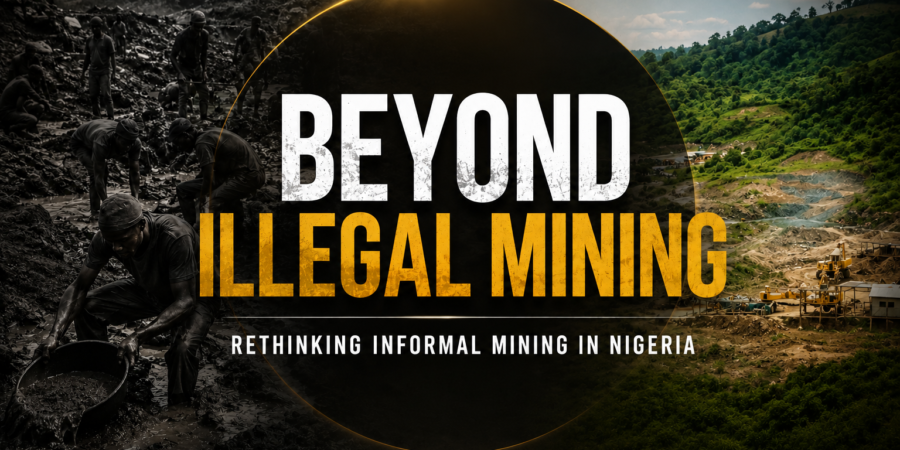
Why Nigeria Cannot Solve “Illegal Mining” Until It Understands Informal Mining
By Obinna Ede
Mining Ecosystem Development Strategist, Founder & System Architect of the Nigerian Mineral Exchange (NME)
For years, Nigeria has approached one of the most important sectors of its economy with the wrong language, the wrong assumptions, and therefore, the wrong solutions. The phrase “illegal mining” has become one of the most repeated expressions in conversations about Nigeria’s mining industry. Government officials use it. Media houses amplify it. Security agencies operationalize it. Public commentary repeats it endlessly. Yet beneath this dominant narrative lies one of the most misunderstood development questions in Nigeria today.
The truth is uncomfortable but necessary: A large percentage of what Nigeria calls “illegal mining” is actually informal mining. And the difference between those two concepts is not semantic. It is foundational. One describes criminality. The other describes underdevelopment. Nigeria’s greatest mistake has been treating a development-stage problem primarily as a law-enforcement problem.
That single misunderstanding explains why decades of crackdowns, raids, task forces, pronouncements, and militarized responses have failed to fundamentally transform the artisanal and small-scale mining ecosystem across the country.
The issue is not simply that people are mining outside regulatory frameworks. The issue is that Nigeria has not yet built an inclusive pathway capable of transitioning millions of mineral-dependent rural citizens from traditional extraction systems into a modernized, formal mining economy. And until the country understands this distinction, the problem will persist indefinitely.
The Reality the Numbers Already Reveal
According to the United Nations Development Programme (UNDP), artisanal and small-scale mining dominates a significant portion of Nigeria’s mining sector, with estimates suggesting that over 70% of mining activities operate within the artisanal and small-scale ecosystem. That statistic alone should completely reshape the national conversation.
Because if over 70% of the sector exists outside formal structures, then Nigeria is not dealing with a marginal criminal phenomenon. Nigeria is dealing with a massive informal economic system. And informal systems cannot be solved through force alone. They are transformed through development, trust-building, incentives, infrastructure, education, inclusion, and gradual institutional integration.
Nigeria Is Misdiagnosing the Problem
When governments define miners primarily as “illegal operators,” the policy response becomes predictable: deploy security agents, conduct raids, arrest miners, seize equipment, shut down sites, increase surveillance, and announce bans. But when governments define miners as participants in an informal economic system, an entirely different policy architecture emerges: community engagement, cooperative development, licensing simplification access to finance, geological support, market access, equipment modernization, environmental education, safety training, supply-chain integration, data registration systems, and local governance partnerships.
One approach criminalizes people. The other transforms systems. This distinction matters enormously because most artisanal miners in Nigeria are not ideological criminals. They are rural economic actors operating within inherited realities. Many were born into mining communities. Many inherited mining knowledge from parents and grandparents. Many live in regions where mining predates the Nigerian state itself. To understand this, Nigeria must confront a difficult but necessary historical truth.
Mining Is Not Foreign to Many Nigerian Communities – It Is Cultural
One of the greatest intellectual failures in the Nigerian mining conversation is the refusal to acknowledge the cultural dimension of mining in many communities. In several parts of Nigeria, mining is not viewed locally as an “illegal activity.” It is viewed as occupation. Livelihood. Inheritance. Identity. Culture.
Anthropologists define culture as the totality of a people’s way of life, including their occupations, economic systems, traditions, and social organization. In many Nigerian communities, mining existed long before colonial administrative systems introduced modern licensing structures. Gold mining communities in northern Nigeria existed before British amalgamation. Tin mining communities on the Jos Plateau existed generations ago. Gemstone extraction traditions in parts of Kaduna, Nasarawa, Oyo, and other regions evolved organically within local economies.
This does not mean regulation is unnecessary. It means the transition from traditional extraction systems to modern formal mining systems must be managed intelligently and respectfully. Because from the perspective of many rural communities, the accusation of “illegal mining” can sound absurd. It is similar to accusing a subsistence farming community of “illegal farming” because they are not integrated into a centralized agricultural registration framework.
The state may legally possess regulatory authority over mineral resources. But governance becomes ineffective when it ignores historical, cultural, and socioeconomic realities on the ground.
Informality Is a Stage of Economic Development
Perhaps the most important argument Nigeria must begin to understand is this: Informal mining is not necessarily evidence of national failure. In many developing economies, it is a stage of sectoral evolution. Every major mining nation in history passed through periods of loosely structured extraction before achieving advanced industrial formalization.
The question is not whether informality exists. The real question is whether the country has a credible pathway for transitioning informal operators into formal economic participants. To its credit, the present administration is actually making observable efforts, but Nigeria currently lacks that pathway at sufficient scale.
And where pathways do exist, they are often inaccessible, poorly communicated, overly bureaucratic, urban-centered, or disconnected from rural realities. A miner operating in a remote village may have no understanding of licensing systems, no internet access, no exposure to geological data, no legal support, no banking infrastructure, no transportation access, no trust in government institutions, and no practical understanding of formalization benefits. Yet policymakers in Abuja frequently assume compliance should happen automatically. Development does not work that way. Formalization is not a decree. It is a process of economic integration.
Why Enforcement-Only Models Keep Failing
Nigeria’s current approach suffers from a structural contradiction. The government wants miners to formalize. But many miners experience the state primarily through harassment, extortion, confiscation, fear, arrests, and uncertainty. That creates institutional distrust. And distrust destroys compliance. No society successfully formalizes large informal sectors by relying primarily on coercion. Not in mining. Not in agriculture. Not in transport. Not in commerce. Not in taxation. Formalization succeeds when people see advantages in entering the formal system. That means the Nigerian state must begin asking different questions:
- What incentives exist for miners to formalize?
- What protections do formal miners receive?
- What financial opportunities become available after formalization?
- What market access improves?
- What training becomes accessible?
- What equipment support exists?
- What environmental assistance is provided?
- What dispute-resolution systems exist?
- What benefits reach mining communities directly?
Without visible benefits, formalization appears to many miners as merely another bureaucratic burden.
The Media Has Deepened the Confusion
The Nigerian media also carries responsibility for the distortion surrounding mining narratives. Much reporting lacks nuance. Complex realities are collapsed into sensational headlines. Everything becomes “illegal mining.” This framing creates several dangerous consequences:
1. It dehumanizes mining communities
Entire populations become associated with criminality rather than economic survival.
2. It oversimplifies policy discussions
Development challenges are reduced to security headlines.
3. It discourages intelligent reform
Fear-driven narratives reward aggressive enforcement rather than structural solutions.
4. It damages investor understanding
Foreign and local investors receive distorted impressions of the sector’s realities.
5. It undermines trust-building
Communities become defensive rather than cooperative. Nigeria urgently needs a new generation of mining journalism capable of investigating informal mining economics, rural livelihood dependence, supply-chain structures, community governance, traditional authority systems, environmental realities, market networks, mineral traceability, cooperative formalization models, and international ASM success stories. The sector cannot be transformed through shallow headlines. It requires deep reporting.
Every Miner Is a National Asset
One of the most damaging consequences of the current narrative is the treatment of miners as enemies of the state rather than potential economic contributors. This is strategically shortsighted. Every Nigerian miner represents economic activity, rural productivity, local employment, mineral intelligence, geological discovery potential, export opportunity, tax potential, and community-level economic circulation
This does not excuse criminal activity. Illegal operations involving armed groups, smuggling syndicates, environmental destruction, child exploitation, or foreign criminal networks must absolutely be addressed decisively. But Nigeria must learn to distinguish between organized criminal mining networks and informal artisanal livelihood mining
Those are not the same phenomenon. Blurring the distinction creates policy confusion. Security agencies must therefore undergo sector-specific orientation and retraining. Law enforcement personnel interacting with mining communities should understand mining economics, community sensitivities, formalization objectives, human rights standards, conflict de-escalation, and development-focused engagement. Because when miners fear authorities, they disappear further into informality.
Formalization Cannot Be Driven from Abuja Alone
One of the greatest weaknesses in Nigeria’s mining governance structure is excessive federal centralization. Mining activities occur inside communities. Inside villages. Inside local government areas. Inside traditional domains. Yet most formalization conversations happen in Abuja conference rooms.
That disconnect is unsustainable. The reality is simple: State governments, local governments, and traditional institutions are the real frontline actors in mining formalization. Without them, national policies will continue struggling.
The Missing Piece: Traditional Institutions
Nigeria already possesses an existing governance infrastructure capable of transforming mining formalization at scale. Traditional rulers, village heads, district leaders, and community institutions. These leaders know where mining occurs, who operates sites, which outsiders enter communities, which conflicts exist, which environmental risks are emerging, which actors comply, or which actors evade oversight.
Ignoring this governance architecture has been a major policy error. If the Nigeria Governors’ Forum coordinated state-level mining formalization directives through ministries responsible for local government and chieftaincy affairs, the impact could be transformational. Traditional rulers could become formalization ambassadors, registration coordinators, community compliance facilitators, environmental accountability partners, conflict mediation actors, and data collection nodes.
Not through militarization. But through community legitimacy. In many rural communities, traditional institutions possess more operational influence than distant federal agencies. Nigeria must use the institutions it already has.
Formalization Must Become a Development Compact
Nigeria needs a completely redesigned national ASM formalization framework built around partnership rather than punishment. The objective should be transition, not suppression. That framework should include:
1. Simplified Licensing Systems
Many miners cannot navigate complex bureaucratic processes.
Formalization systems must become mobile, local, multilingual, and affordable.
2. Cooperative-Based Formalization
Individual formalization is difficult. Cooperative models reduce barriers and improve compliance. The government must accelerate the implementation of the current Formalization Policy framework based on Cooperatives.
3. Incentive Structures
Formalized miners should receive benefits unavailable to informal operators.
4. Community Geological Support
Many miners operate blindly with poor recovery rates and environmental inefficiencies.
5. Environmental Education
Environmental protection must become part of mining culture through practical education, not only enforcement.
6. Financial Inclusion
Banks rarely understand artisanal mining economics.
Dedicated mining finance systems are needed.
7. Mineral Traceability Systems
Traceability improves market legitimacy and export opportunities.
8. Rural Mining Extension Services
Nigeria needs mining extension officers similar to agricultural extension systems.
Building Institutional Pathways for Formalization
One of the biggest weaknesses in Nigeria’s artisanal and small-scale mining ecosystem is not merely the absence of regulation or lack of obedience to law. It is also the absence of accessible support systems capable of connecting miners to the formal economy and the policy direction of the government. Many informal miners operate in isolation. They are disconnected from credible buyers, industry information, regulatory guidance, financing opportunities, training systems, market intelligence, and national visibility.
As a result, informality reproduces itself. A miner who lacks access to structured markets is more likely to sell through unregulated middlemen and smugglers. A miner who lacks information about licensing processes is less likely to formalize. A miner who has no visibility within the national mining ecosystem remains economically invisible to investors, regulators, financial institutions, and development actors. This is why the challenge of informal mining is not only a regulatory problem. It is also an information problem, a connectivity problem, a visibility problem, a market-access problem, and an institutional coordination problem.
Nigeria therefore needs more than enforcement mechanisms. It needs enabling infrastructure capable of gradually integrating informal mining communities into structured economic systems. This is where digital mining ecosystem platforms such as the Nigerian Mineral Exchange (NME) may play an increasingly important role in the future of mining formalization in Nigeria.
Beyond functioning as a marketplace, platforms like NME can help build the informational and commercial bridges required to connect artisanal miners to the wider mining economy. Their contribution could become particularly important in several key areas.
Market Access and Buyer Connectivity
One of the major drivers of informality is the absence of structured market access. Many artisanal miners operate without direct access to verified off-takers, processors, exporters, refiners, or industrial buyers. As a result, they often depend on informal trading networks that provide little transparency, weak pricing structures, and limited long-term economic stability.
Digital mineral exchange systems can help reduce this gap by improving visibility between miners and legitimate buyers while creating more transparent channels for mineral trade and engagement. Over time, improved market connectivity can become a major incentive for formalization itself. When miners see that formal participation improves commercial opportunities, resistance to formalization naturally begins to decline.
Formalization Education and Public Awareness
A significant number of informal miners do not fully understand licensing systems, cooperative structures, environmental obligations, mineral documentation requirements, legal rights, or the long-term economic benefits of formal participation. This makes education extremely important. Nigeria needs sustained mining awareness campaigns delivered in an accessible language and adapted to local realities. Digital platforms, media initiatives, mining associations, NGOs, and community institutions can help produce: multilingual educational materials, explainer videos, community sensitization campaigns, training resources, and practical formalization guides tailored specifically to artisanal miners. Formalization cannot succeed where understanding does not exist.
Visibility and Mining Community Inclusion
One of the hidden problems within the Nigerian mining sector is that many mining communities remain largely invisible within national economic planning. There is insufficient data about who is mining, where activities are occurring, what minerals are being produced, what challenges communities face, and what support structures are needed.
Improving visibility within the mining ecosystem is therefore critical. Mining ecosystem platforms can help create structured industry directories, cooperative databases, mineral intelligence systems, and community mapping initiatives capable of improving communication between miners, regulators, investors, researchers, and development organizations. A sector that cannot properly see itself cannot effectively organize itself.
Media, Information, and Narrative Transformation
Nigeria also needs a fundamental transformation in how mining is discussed publicly. For too long, national conversations around artisanal mining have been dominated almost entirely by security narratives, criminality narratives, and sensational reporting. What is missing is sustained development-oriented mining journalism. The mining sector needs investigative reporting, documentary storytelling, educational programming, field-based reporting, policy analysis, community voices, environmental reporting, and data-driven sector intelligence.
This is important because public narratives influence public policy. And public policy influences institutional behavior. If the only narrative surrounding artisanal mining is illegality, then enforcement will always dominate the policy response. But when the national conversation begins to recognize artisanal mining as a development and economic transition challenge, then broader and more sustainable solutions become possible.
Platforms such as Nigerian Mineral Exchange (NME), alongside journalists, civil society organizations, researchers, mining associations, and development institutions, can help reshape this conversation by building a more informed, balanced, and development-oriented mining information ecosystem for Nigeria.
Nigeria Must Stop Fighting Its Miners and Start Developing Them
No country develops a strategic sector by alienating the people already operating within it. The miners Nigeria calls “illegal” today may become the foundation of tomorrow’s formal mining economy if properly integrated. But integration requires intelligence, patience, respect, systems thinking, and institutional coordination.
Nigeria must stop asking only: “How do we stop illegal mining?” And begin asking: “How do we transition millions of informal mining participants into a structured national mining economy?” Those are fundamentally different questions, and they produce fundamentally different futures.
The Future of Nigerian Mining Depends on This Shift
Nigeria stands at a crossroads. The country possesses enormous mineral potential. But mineral wealth alone does not create development. Institutions do. Systems do. Inclusion does. Trust does. Formalization succeeds when citizens believe the formal economy has a place for them.
If Nigeria continues treating informal mining primarily as criminality, the sector will remain trapped in cycles of enforcement, evasion, distrust, and underdevelopment. But if Nigeria recognizes informal mining as a developmental transition challenge requiring community integration, institutional cooperation, and economic inclusion, then the country may finally unlock the enormous productive power buried beneath its soil.
The future of Nigerian mining will not be determined only by geology. It will be determined by whether Nigeria learns to understand its miners before attempting to regulate them.
About the Author
Obinna Ede is a Mining Ecosystem Development Strategist and Founder/CEO of the Nigerian Mineral Exchange (NME), a digital marketplace and trade infrastructure platform focused on connecting the Nigerian mining industry through technology, market systems, research, media, and stakeholder collaboration. His work centers on building institutional frameworks, knowledge systems, and market structures capable of accelerating the formalization and sustainable development of Nigeria’s mineral economy.
Related Articles:
Before Licenses and Regulations: The Cultural Roots of Informal Mining in Nigeria
The Nigerian Media and the Dangerous Simplification of “Illegal Mining”
The Missing Link in Nigeria’s Mining Formalization Policy: Traditional Rulers and Local Governments
Building Nigeria’s Mineral Market Infrastructure: The Nigerian Mineral Exchange Vision
Nigeria’s Critical Minerals and the Global Energy Transition
Top Mining Opportunities in Nigeria: A Guide for Investors and Industry Participants
How to Invest in Nigeria’s Mining Sector: A Step-by-Step Guide for Foreign Investors


Leave a Reply