
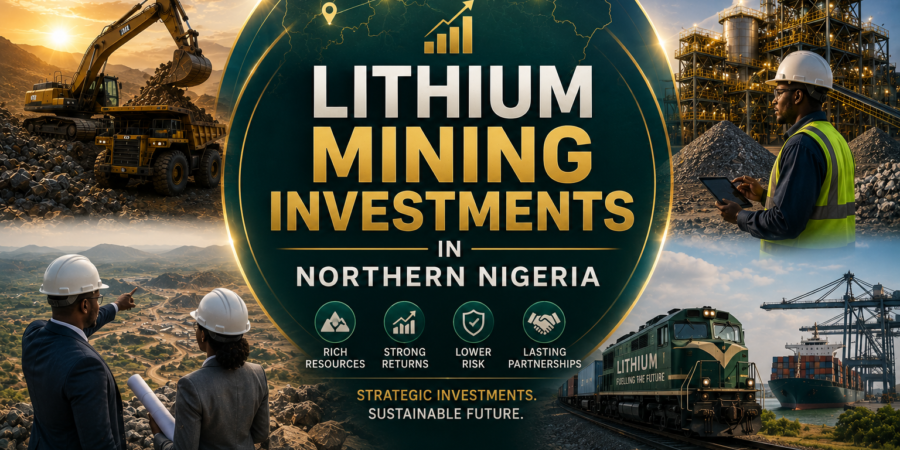
Every major mining industry begins with geology, but it grows through investment. Mineral deposits may create opportunity, but they do not develop themselves. Exploration programs require capital. Mining operations require equipment. Supply chains require infrastructure. Logistics require coordination. Commercial ecosystems require institutions capable of connecting opportunities with investors. This is why investment sits at the centre of Northern Nigeria’s emerging lithium industry.
As global demand for battery minerals continues to increase, the conversation is gradually shifting from Where is lithium found? to a much broader question: Where should investment be directed? The answer extends far beyond the mine itself. Northern Nigeria is increasingly attracting attention because it offers investors the opportunity to participate in an industry that is still in its formative stages. Unlike mature mining jurisdictions where commercial structures are already well established, Nigeria’s lithium sector is still evolving. Exploration is expanding. Supply chains are becoming more organized. Commercial networks are developing. Procurement systems are improving. New business models are emerging. For many investors, this represents one of the most attractive characteristics of the market. It is an opportunity to participate during the industry’s growth phase rather than after the market has fully matured.
The investment opportunities begin with exploration. Every successful mining industry relies on continuous geological work to identify, evaluate, and define mineral resources. Geological mapping, drilling programs, resource estimation, and technical evaluation all require long-term investment before commercial mining becomes possible. As interest in battery minerals continues to grow, exploration companies are increasingly evaluating Northern Nigeria’s pegmatite belts and other prospective geological environments. These early-stage investments provide the foundation upon which future mining operations are built.
Mining itself represents the next level of investment. Once commercially viable resources have been identified, capital is required to establish extraction activities, acquire equipment, develop operational systems, and build responsible mining operations. These investments create employment, stimulate local economies, and generate demand for a wide range of supporting industries. However, limiting investment discussions to mining alone overlooks much of the opportunity.
One of the defining characteristics of the modern battery-mineral economy is that significant value is created outside the mine. Aggregation facilities require investment. Warehousing requires investment. Transportation fleets require investment. Laboratories require investment. Digital procurement platforms require investment. Supply-chain technology requires investment. Market-intelligence systems require investment. Every stage of the lithium value chain presents opportunities for entrepreneurs, institutional investors, strategic partners, and development finance organizations.
In many respects, Northern Nigeria is not simply building a mining industry. It is building an industrial ecosystem. This distinction is important because investors increasingly seek exposure to integrated value chains rather than isolated assets. A logistics company supporting lithium transport may become just as important as a mining contractor. A laboratory providing quality verification may become a critical component of international procurement. A digital platform connecting buyers and suppliers may influence commercial activity across multiple states. The future industry will reward those who understand these interconnections.
Geography also influences investment decisions. Northern Nigeria possesses several advantages that continue to attract attention from domestic and international stakeholders. States such as Nasarawa, Kaduna, Kogi, Niger, and Plateau are increasingly being recognized not only for their geological potential but also for their strategic roles within the broader battery-mineral supply chain. Collectively, these states form an emerging regional ecosystem where mining, logistics, trade, aggregation, and commercial coordination reinforce one another. For investors, ecosystems reduce uncertainty. They create opportunities for collaboration. They strengthen supply-chain resilience. And they improve long-term commercial viability. Infrastructure development represents another important investment frontier.
As lithium production expands, demand will continue to grow for strategically located warehouses, mineral handling facilities, transportation services, equipment maintenance centres, quality-testing laboratories, and commercial coordination hubs. These investments support the entire industry rather than a single operation, making them attractive components of a diversified mining portfolio.
Human capital should not be overlooked either. The future competitiveness of Northern Nigeria’s lithium industry will depend upon skilled geologists, mining engineers, environmental specialists, laboratory professionals, logistics managers, procurement experts, commercial negotiators, data analysts, and technology providers. Investment in skills development is therefore an investment in the industry’s long-term sustainability.
International investors are also paying increasing attention to market transparency. The modern mining industry places significant emphasis on supplier verification, due diligence, commercial governance, environmental responsibility, and reliable market information. Investors want confidence that projects are supported by organized commercial structures capable of facilitating efficient procurement and long-term partnerships. This is why market intelligence has become an increasingly valuable investment asset. Reliable information reduces uncertainty. Reduced uncertainty encourages investment. And investment accelerates industry development.
The broader investment story is therefore larger than lithium itself. It is about positioning Northern Nigeria within the global battery-mineral economy. Countries that successfully attract investment into exploration, mining, logistics, processing, commercial infrastructure, and technology often become long-term participants in international supply chains rather than simply exporters of raw materials. Northern Nigeria has the opportunity to follow that path. Its combination of geological potential, mining experience, strategic location, and expanding commercial ecosystem provides a strong foundation upon which future investment can build. The question is no longer whether investment opportunities exist. The more important question is how effectively those opportunities are identified, organized, and connected with the capital required to develop them.
The Nigerian Mineral Exchange (NME) is actively supporting this investment ecosystem by connecting investors, suppliers, mining companies, aggregators, logistics providers, processors, and procurement organizations across Northern Nigeria’s growing lithium industry. For international mining companies, commodity traders, battery-material manufacturers, institutional investors, private equity firms, strategic partners, and development finance organizations evaluating opportunities in Nigeria, NME provides market intelligence, supplier identification, investment facilitation, procurement coordination, due diligence support, aggregation access, and comprehensive supply-chain visibility.
NME also serves as a Foreign or International Buyer Representative in Nigeria, helping international organizations establish trusted local market presence through investment support, supplier engagement, commercial negotiations, sourcing coordination, logistics intelligence, procurement management, market-entry advisory services, and on-ground representation throughout Nigeria’s lithium-producing regions.
At the same time, NME works closely with miners, exploration companies, suppliers, aggregators, warehouse operators, logistics providers, and mining communities to facilitate structured commercial partnerships and connect investment opportunities with credible participants across the Nigerian lithium sector. Organizations seeking investment opportunities, supplier verification, procurement coordination, market-entry support, due diligence, aggregation partnerships, or local buyer representation can engage NME directly through WhatsApp (+2348130799304).
Northern Nigeria’s lithium industry is still in the early stages of its development. That is precisely what makes it attractive. The foundations of a new battery-mineral economy are being laid today through exploration, infrastructure, commercial organization, and investment. Those who understand this transformation will recognize that the most valuable investment is not simply in a mineral deposit. It is in the ecosystem that allows that deposit to become part of a globally competitive supply chain.
Related Articles
- Source Lithium Ore in Nigeria
- Sell Lithium Ore in Nigeria
- How to Source Lithium Ore in Nigeria in 2026
- How to Secure Large-Scale Lithium Ore Supply in Abuja: The NME Industrial Sourcing Guide
- Northern Nigeria Lithium Trade Ecosystem
- Why Lithium Investors Are Watching Northern Nigeria
- How Lithium Ore Is Measured and Verified
- Can Nigeria Become Africa’s Lithium Powerhouse?
- Why Local Partnerships Matter in Lithium Trade
- Future Lithium Trade Routes Across Nigeria
- Security Considerations in Lithium Operations
- Lithium and Electric Vehicle Demand
- Northern Nigeria’s Lithium Mining Corridors
- Lithium Trade in Kano State
- Niger State and the Nigerian Lithium Economy
- Lithium and Energy Storage Technologies
- Nigeria’s Emerging Battery Minerals Economy
Leave a Reply