
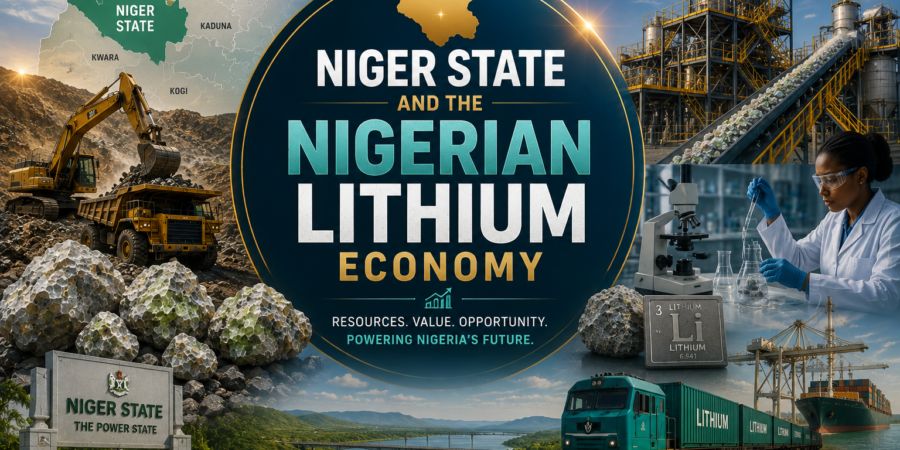
When discussions about Nigeria’s mineral future take place, Niger State is impossible to ignore. The state occupies a unique position within the country’s mining landscape. It is Nigeria’s largest state by landmass, possesses significant mineral diversity, and sits at the intersection of major transportation and commercial corridors. For decades, Niger State has been recognized as one of the country’s most important mining jurisdictions, attracting artisanal miners, exploration companies, investors, and commodity traders seeking access to its vast resource base, especially gold.
Today, a new opportunity is emerging within that resource landscape. The rise of lithium and other battery minerals is creating fresh interest in how Niger State could participate in one of the fastest-growing segments of the global mineral economy. This is not simply a conversation about geology. It is a conversation about economic positioning.
As global industries become increasingly dependent on battery technologies, regions capable of supporting critical-mineral supply chains are attracting growing attention. The question is no longer whether a region possesses mineral resources. The question is whether those resources can be connected to markets, investors, processors, and international supply chains. Niger State possesses several characteristics that make this question particularly relevant.
The state’s importance begins with scale. Its vast geographic size provides extensive opportunities for exploration and resource development. Throughout Nigeria’s mining history, Niger State has been associated with a wide range of mineral commodities, making it one of the most active mining environments in the country. This existing mining culture creates advantages. Mining industries tend to grow more efficiently in regions where knowledge, experience, and supporting services already exist. Local communities understand mining activities. Service providers understand industry requirements. Transportation networks revolve around resource movement. Commercial relationships emerge over time.
These factors may not appear in geological reports, but they often determine how successfully a mining industry develops. The growing global demand for lithium adds a new layer to this dynamic. Across the world, battery manufacturers, commodity traders, investors, and procurement organizations are searching for reliable sources of supply. Electric vehicles, energy storage systems, renewable energy infrastructure, and advanced technologies continue to drive demand for battery minerals. As a result, countries capable of supplying these resources are becoming increasingly important within global supply chains.
Nigeria is gradually entering this conversation. And Niger State is positioned to be part of that transition. Yet the state’s future role may extend beyond extraction. One of the most important shifts occurring within the global mining industry is the recognition that value is increasingly created through ecosystems rather than isolated mining projects. The modern battery-mineral economy depends on a wide network of participants. Miners extract material. Aggregators consolidate supply. Transporters move inventory. Warehouses store material. Laboratories verify quality. Consultants provide market intelligence. Procurement specialists connect buyers with suppliers. Investors provide capital. Together, these activities create a commercial ecosystem.
Niger State has the potential to contribute to multiple parts of that ecosystem. Its strategic location strengthens this possibility. The state sits within a corridor connecting Northern Nigeria to major commercial centers across the country. This geographic advantage supports logistics, transportation, and supply-chain development. In the lithium industry, logistics matter. A mineral resource may have significant value, but commercial success depends on the ability to move material efficiently from production areas to aggregation centers, processing facilities, warehouses, and export channels. Regions capable of supporting these movements often become important supply-chain hubs.
This is where Niger State’s opportunity becomes particularly interesting. The state has the potential not only to participate in mining but also to contribute to the infrastructure supporting Nigeria’s broader lithium economy. As the industry develops, opportunities may emerge in aggregation, logistics, procurement support, warehousing, equipment services, technical consulting, environmental management, and market facilitation. These activities often generate lasting economic benefits because they support the industry regardless of commodity-price fluctuations.
Another important factor is investor interest. Global buyers and investment groups increasingly seek jurisdictions capable of supporting long-term supply relationships. They are not simply searching for resources. They are searching for organized markets. They want supplier visibility. They want procurement reliability. They want due diligence. And they want confidence that supply chains can perform consistently. This is why commercial organization is becoming as important as resource availability. The regions that successfully combine geology with market infrastructure are often the ones that attract sustained investment.
Niger State’s future role in the lithium economy may therefore depend as much on commercial development as on mining itself. The state’s greatest opportunity could lie in helping build the networks that connect resources to markets. That is where long-term value is often created. The evolution of Nigeria’s battery-mineral economy will require states capable of supporting exploration, mining, trade, logistics, and investment simultaneously. Niger State possesses many of the characteristics needed to participate in this transformation. The challenge and the opportunity are to convert those advantages into a structured ecosystem capable of attracting buyers, investors, and industrial partners.
The Nigerian Mineral Exchange is actively supporting this ecosystem by connecting suppliers, buyers, aggregators, logistics providers, investors, processors, and procurement networks across Niger State and the wider Nigerian lithium market. For international procurement groups, battery-material companies, commodity traders, mineral processors, manufacturers, and investors evaluating opportunities in Niger State, NME provides support in supplier identification, procurement coordination, aggregation access, market intelligence, supplier verification, and supply-chain visibility.
NME also serves as a Foreign Buyer Representative and International Buyer Representative in Nigeria, helping international organizations establish trusted local market presence through supplier engagement, due diligence, sourcing coordination, logistics intelligence, procurement support, market-entry assistance, and on-the-ground representation.
At the same time, NME continues to work with miners, suppliers, aggregators, warehouse operators, and industry stakeholders seeking access to serious buyers, structured procurement opportunities, and long-term commercial partnerships. Organizations or individuals seeking lithium ore buyers, sourcing support, supplier verification, procurement coordination, market-entry guidance, aggregation partnerships, or local buyer representation can engage NME directly through WhatsApp (+2348130799304).
The future of Niger State within Nigeria’s lithium economy is still being written. The resources may create the opportunity. But it is the ecosystem built around those resources that will determine the outcome. As global demand for battery minerals continues to expand, Niger State has the potential to become more than a mining destination. It can become an important participant in the commercial networks connecting Nigeria’s mineral wealth to the industries shaping the future.
Related Articles
- Source Lithium Ore in Nigeria
- Sell Lithium Ore in Nigeria
- How to Source Lithium Ore in Nigeria in 2026
- How to Secure Large-Scale Lithium Ore Supply in Abuja: The NME Industrial Sourcing Guide
- Northern Nigeria Lithium Trade Ecosystem
- How Lithium Ore Is Measured and Verified
- What Makes Lithium Ore More Valuable?
- Factors Affecting Lithium Ore Prices in Nigeria
- Can Nigeria Become Africa’s Lithium Powerhouse?
- Why Local Partnerships Matter in Lithium Trade
- Developing Sustainable Lithium Supply Networks in Nigeria
- Lithium Procurement Strategy for Foreign Buyers in Nigeria
- Lithium and Electric Vehicle Demand
- Northern Nigeria’s Lithium Mining Corridors
- Lithium and Energy Storage Technologies
- Nigeria’s Emerging Battery Minerals Economy
Leave a Reply