
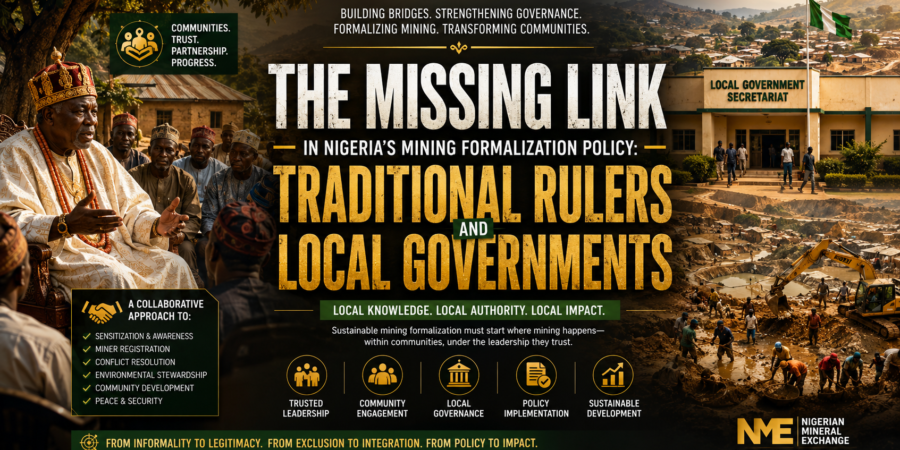
Why Abuja Alone Cannot Formalize Nigeria’s Informal Mining Sector
By Obinna Ede
Mining Ecosystem Development Strategist, Founder & System Architect of the Nigerian Mineral Exchange (NME)
Nigeria’s mining formalization challenge is not because the country lacks policies. It is because the country is trying to implement a deeply local problem through an overwhelmingly centralized framework. For years, discussions around artisanal and small-scale mining formalization have focused heavily on federal regulations, licensing systems, enforcement operations, ministerial pronouncements, task forces, and security interventions.
Yet despite all these efforts, informal mining activities continue expanding across many parts of the country. Why? Because Nigeria is attempting to formalize mining communities from Abuja without fully integrating the governance structures that actually control influence at the grassroots level. Mining activities do not happen inside conference rooms in Abuja. They happen inside villages, inside local government areas, inside traditional domains, inside rural communities, and within local social systems governed daily by traditional rulers, district heads, village leaders, youth structures, and community institutions.
This is the missing link in Nigeria’s mining formalization strategy. The country has not yet fully recognized that artisanal mining formalization is fundamentally a grassroots governance challenge as much as it is a federal regulatory exercise. And until local governance institutions are integrated properly into the formalization framework, Nigeria’s mining sector will continue struggling with informality regardless of how many enforcement operations are launched.
The Limits of Centralized Mining Governance
Nigeria operates one of the most centralized mineral governance systems in the world. Under the Nigerian constitution, mineral resources are controlled primarily by the federal government. Licensing, regulation, and major policy direction are coordinated centrally through federal institutions. Legally, this structure is clear. Operationally, however, reality becomes far more complicated. Because while the federal government controls mineral rights on paper, the physical activities themselves occur inside territories governed socially and politically by local institutions.
This creates a governance gap. The federal government may issue policies. But implementation depends heavily on actors who live inside the communities where mining occurs. This is where many formalization strategies begin to weaken. A federal agency sitting hundreds of kilometers away from a mining village may not know who is mining, who owns land locally, who controls access routes, which community disputes exist, which traditional leaders influence compliance, or how local economic relationships shape mining activities. But traditional rulers and local institutions often know all these things. And that knowledge matters enormously.
Traditional Rulers Already Understand What Is Happening
One of the most misunderstood realities in Nigeria’s mining conversation is that informal mining activities rarely happen invisibly at the community level. In most cases, local communities know where mining is occurring, who the miners are, which outsiders have entered the area, who buys minerals, which sites are expanding, and where conflicts are emerging. Traditional rulers often possess deep awareness of local economic activity within their domains. This is not unique to mining. It applies to farming, land disputes, grazing systems, local commerce, and community security.
Yet Nigeria’s mining formalization architecture has not sufficiently leveraged this governance infrastructure. Instead, policy conversations frequently proceed as though mining formalization can be achieved primarily through federal directives and enforcement campaigns. That assumption ignores how rural governance actually functions in many parts of Nigeria.
Informal Mining Is Also a Community Governance Issue
Many policymakers still approach informal mining almost entirely as a legal compliance issue. But in reality, artisanal mining is also a local governance issue, a rural economic issue, a traditional authority issue, a livelihood issue, and a community coordination issue. This distinction is important because local legitimacy often matters more than distant regulation.
A miner operating in a remote rural community may have little direct relationship with federal institutions. But that same miner may maintain strong relationships with: village heads, district leaders, traditional rulers, local youth leaders, cooperative networks, and local government actors. This means that successful formalization efforts must operate through structures that communities already trust and recognize. Formalization cannot succeed sustainably if it is perceived only as an external government imposition disconnected from local realities.
The Untapped Power of Traditional Institutions
Nigeria already possesses one of the largest decentralized governance networks in Africa. Traditional institutions. These institutions may not always possess constitutional mineral authority, but they possess something equally important: Community legitimacy. In many rural communities, traditional rulers influence dispute resolution, social coordination, land access, community mobilization, local enforcement, and public compliance. This creates enormous potential for mining formalization.
Traditional rulers can become formalization ambassadors, sensitization coordinators, cooperative mobilizers, environmental awareness advocates, conflict mediation actors, and local accountability partners. This approach would be far more sustainable than relying almost exclusively on militarized enforcement systems. Because people are more likely to cooperate with systems introduced through trusted community structures than through fear alone.
Local Governments Are the Forgotten Operational Layer
Another major weakness in Nigeria’s mining formalization architecture is the limited integration of local governments. This is surprising because local governments are theoretically the closest administrative institutions to the people. Mining communities exist inside local government jurisdictions. Yet local governments often remain peripheral within mining governance discussions.
This is a strategic mistake. If properly integrated, local governments could help support miner registration initiatives, community data collection, cooperative verification, awareness campaigns, environmental monitoring, and conflict-resolution systems. More importantly, local governments understand local realities in ways centralized agencies often cannot. Effective mining governance requires proximity. And local governments provide that proximity.
Why Governors Matter More Than Many Realize
State governments also possess enormous untapped influence over mining formalization despite constitutional limitations around mineral ownership. Governors control local political coordination, traditional institution engagement, security collaboration, local administrative systems, rural development programs, and state-level stakeholder mobilization.
This means the Nigeria Governors’ Forum could potentially become one of the most important institutional actors in mining formalization if properly engaged. Imagine a coordinated national initiative where state governments direct ministries responsible for local government and chieftaincy affairs to work with traditional rulers on mining sensitization, formalization campaigns, community registration systems, environmental compliance awareness, and local accountability structures. The impact could be transformational. Because mining activities happen inside their territories. And local institutions already understand the terrain.
Formalization Through Partnership, Not Fear
One of the biggest reasons many formalization efforts struggle is that miners often experience government primarily through raids, arrests, harassment, confiscation, and intimidation. This creates distrust. Distrust drives miners further underground. But when formalization is introduced through community dialogue, local partnerships, traditional institutions, economic incentives, and awareness systems, compliance becomes easier.
People support systems they understand. And they trust systems introduced through familiar structures. This is why formalization must evolve beyond enforcement. It must become a collaborative development process.
The Role of Information and Coordination Platforms
Nigeria also needs stronger coordination systems capable of connecting communities, miners, regulators, traditional institutions, buyers, cooperatives, researchers, and development organizations. Mining ecosystem platforms such as the Nigerian Mineral Exchange (NME) can help support this process by improving mining visibility, information flow, formalization awareness, stakeholder coordination, and market connectivity.
Digital platforms can help bridge the communication gap between rural mining communities and the wider formal mining ecosystem. This is important because formalization is not simply about licenses. It is also about integration. And integration requires information infrastructure.
Nigeria Must Stop Ignoring the Structures Closest to the People
Nigeria cannot formalize artisanal mining successfully while ignoring the institutions closest to mining communities themselves. Traditional rulers. Local governments. Community structures. These actors are not peripheral to the formalization process. They are central to it.
The future of mining formalization in Nigeria will depend not only on federal policies, but on whether the country can build a genuinely decentralized and community-integrated governance framework capable of aligning national objectives with local realities. Because sustainable mining governance cannot be imposed from a distance alone. It must also be rooted in trust, proximity, legitimacy, and grassroots participation. And those foundations already exist inside the communities where mining actually happens. Nigeria simply needs to recognize them.
About the Author
Obinna Ede is a Mining Ecosystem Development Strategist and Founder/CEO of the Nigerian Mineral Exchange (NME), a digital marketplace and trade infrastructure platform focused on connecting the Nigerian mining industry through technology, market systems, research, media, and stakeholder collaboration. His work centers on building institutional frameworks, knowledge systems, and market structures capable of accelerating the formalization and sustainable development of Nigeria’s mineral economy.
Related Articles:
Why Nigeria Cannot Solve “Illegal Mining” Until It Understands Informal Mining
The Nigerian Media and the Dangerous Simplification of “Illegal Mining”
Before Licenses and Regulations: The Cultural Roots of Informal Mining in Nigeria
Building Nigeria’s Mineral Market Infrastructure: The Nigerian Mineral Exchange Vision
Nigeria’s Critical Minerals and the Global Energy Transition
Top Mining Opportunities in Nigeria: A Guide for Investors and Industry Participants
How to Invest in Nigeria’s Mining Sector: A Step-by-Step Guide for Foreign Investors


Leave a Reply