
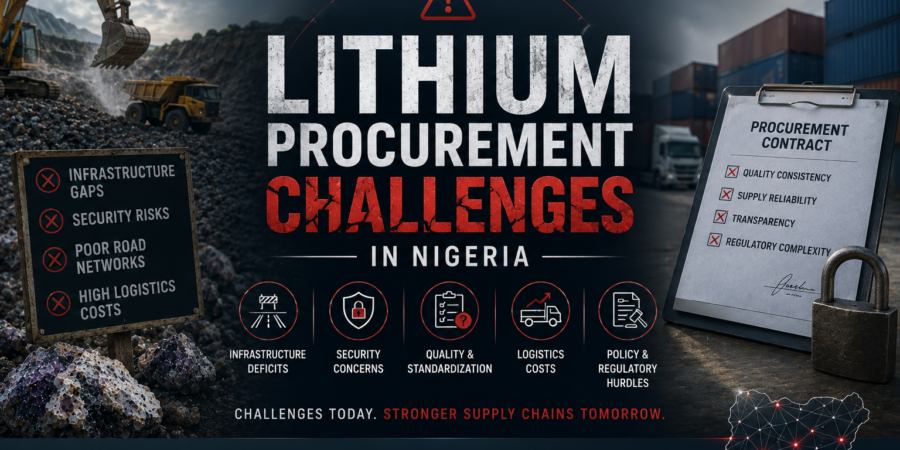
Nigeria’s lithium industry is attracting increasing international attention, but behind the excitement surrounding battery minerals lies a more complicated commercial reality: procurement in Nigeria is still an evolving operational system rather than a fully mature industrial structure. For international buyers entering the market, this distinction is extremely important. Many procurement companies initially approach Nigeria expecting a sourcing environment similar to highly industrialized mining jurisdictions where supply chains are centralized, logistics systems are standardized, inventory visibility is clear, and procurement channels are tightly organized.
The Nigerian market operates differently. What exists today is a rapidly developing lithium ecosystem built around mining communities, artisanal operators, regional suppliers, aggregation systems, transport corridors, warehousing networks, and emerging procurement coordination structures. This creates enormous opportunity, but it also introduces significant procurement challenges that serious buyers must understand before attempting large-scale sourcing operations.
One of the biggest challenges is fragmentation. Much of Nigeria’s current lithium supply still originates from decentralized mining activity spread across parts of Nasarawa, Kaduna, Kogi, Zamfara, Kebbi, Katsina, and surrounding mineral corridors. Unlike centralized industrial mining systems dominated by a few major operators, the Nigerian market often involves multiple local suppliers, artisanal miners, regional traders, and aggregation channels operating simultaneously. For procurement companies seeking industrial-scale sourcing, this fragmentation can create difficulties involving inventory coordination, supplier consistency, logistics planning, and procurement visibility.
This is one reason aggregation is becoming increasingly important within the Nigerian lithium economy. Aggregation helps transform scattered regional supply into commercially organized inventory capable of supporting larger procurement systems. Without effective aggregation structures, large-scale procurement becomes operationally difficult because buyers must coordinate multiple suppliers, fragmented transportation systems, inconsistent inventory flows, and varying communication channels simultaneously. The future of procurement in Nigeria will likely depend heavily on how effectively aggregation networks continue evolving.
Another major challenge involves logistics coordination. Northern Nigeria already support extensive commercial transportation activity tied to agriculture, livestock, construction materials, and solid minerals. However, lithium procurement introduces additional complexity because international buyers increasingly require predictable inventory movement, shipment coordination, logistics visibility, and supply continuity. In fragmented supply environments, transportation inefficiencies can quickly affect: delivery timelines, inventory stability, procurement reliability, and buyer confidence. As the market matures, logistics coordination may become one of the most strategically important aspects of successful lithium procurement in Nigeria.
Warehousing is another area where the market is still developing. In mature battery-mineral supply chains, warehousing supports inventory organization, moisture control, shipment planning, quality preservation, and procurement visibility. Nigeria’s lithium market is gradually moving in this direction, but many supply systems still operate through temporary storage arrangements, fragmented handling systems, and decentralized inventory coordination. This creates procurement risks involving inconsistent inventory tracking, material contamination, moisture instability, and operational inefficiency. As industrial demand increases, professionally coordinated warehousing systems will likely become increasingly important.
Quality verification also remains one of the most sensitive procurement challenges within the market. Professional buyers now commonly evaluate Li₂O percentage, mineral consistency, moisture content, impurity levels, and assay reliability before entering sourcing agreements. Lithium concentration is commonly measured using Li₂O percentage (Lithium Oxide percentage). Most commercially traded lithium-bearing materials currently associated with Nigeria include Spodumene/Kunzite, Lepidolite, and Amblygonite. Inconsistent testing systems or weak assay transparency can create pricing disputes, procurement delays, shipment rejection, and reduced buyer confidence. As procurement systems become more sophisticated, technical verification is becoming increasingly important within serious sourcing operations.
Another major challenge is market information asymmetry. Because the industry is still developing rapidly, many participants operate with limited pricing visibility, technical understanding, procurement intelligence, and direct buyer access. This can create environments where misinformation spreads easily, speculative pricing emerges, and procurement coordination becomes less efficient. Serious buyers increasingly attempt to reduce these risks by working through verified procurement networks, aggregation systems, and trusted sourcing platforms capable of improving supply-chain visibility.
Relationship management is also becoming increasingly important. In an emerging mineral markets like Nigeria, procurement success depends not only on price negotiation, but also on trust, operational consistency, logistics coordination, communication quality, and long-term supplier engagement. International buyers entering Nigeria are gradually realizing that sustainable procurement often depends on building stable regional partnerships, aggregation relationships, and coordinated sourcing systems rather than relying solely on isolated spot transactions. This is gradually transforming the Nigerian lithium market from opportunistic mineral trading into relationship-driven procurement ecosystems.
Abuja’s growing role within the lithium economy reflects this shift clearly. Although Abuja is not necessarily one of Nigeria’s major extraction locations, the city is increasingly functioning as a procurement coordination center, an aggregation destination, a warehousing corridor, and a commercial bridge connecting regional suppliers with international buyers. For many procurement companies, Abuja now serves as one of the most practical operational gateways into the Nigerian lithium market because it offers logistics accessibility, centralized coordination, supplier engagement, and improved commercial visibility. As procurement systems become more organized, centralized coordination hubs like Abuja may become even more strategically important.
The Nigerian Mineral Exchange (NME) is actively positioning within this evolving procurement ecosystem by helping connect verified lithium suppliers, aggregation systems, logistics operators, warehousing networks, and international buyers across Nigeria’s growing lithium market. For battery-material firms, Chinese sourcing companies, commodity traders, mineral processors, and industrial procurement groups seeking verified suppliers, scalable sourcing opportunities, procurement coordination, supplier due diligence, aggregation access, or Nigeria lithium market-entry consulting, NME provides sourcing support designed to simplify procurement operations within Nigeria’s lithium sector.
International buyers seeking reliable lithium procurement relationships in Nigeria can contact NME directly through WhatsApp (+2348130799304) for supplier introductions, procurement coordination, aggregation access, inventory sourcing, logistics visibility, and operational support. At the same time, NME is actively seeking steady lithium suppliers, aggregation partnerships, and long-term procurement relationships across Northern Nigeria. Suppliers capable of supporting scalable inventory, recurring supply, organized logistics, and professional procurement coordination can also engage NME directly for immediate sourcing discussions and commercial partnerships.
Nigeria’s lithium procurement ecosystem is still developing, but the direction is becoming increasingly clear. The future market will likely reward organizations capable of solving logistics inefficiencies, aggregation fragmentation, inventory coordination challenges, and procurement visibility problems across the supply chain. Because in the modern battery-mineral economy, procurement success is no longer determined only by access to minerals. It is increasingly determined by the strength and organization of the systems built around those minerals.
Related Articles
- How to Source Lithium Ore in Nigeria in 2026
- How to Secure Large-Scale Lithium Ore Supply in Abuja: The NME Industrial Sourcing Guide
- How NME Supports Lithium Procurement in Nigeria
- Why Northern Nigeria Could Dominate Lithium Supply
- What Lithium Buyers Look For Before Purchase
- Informal Mining and Lithium Supply Networks in Nigeria
- Why Local Partnerships Matter in Lithium Trade
- Understanding Li₂O Percentages in Lithium Trade
- Where to Buy Lithium Ore in Nigeria
- Building Nigeria’s Mineral Market Infrastructure: The Nigerian Mineral Exchange Vision
- Nigeria’s Critical Minerals and the Global Energy Transition
- Top Mining Opportunities in Nigeria: A Guide for Investors and Industry Participants
- How to Invest in Nigeria’s Mining Sector: A Step-by-Step Guide for Foreign Investors


Leave a Reply