
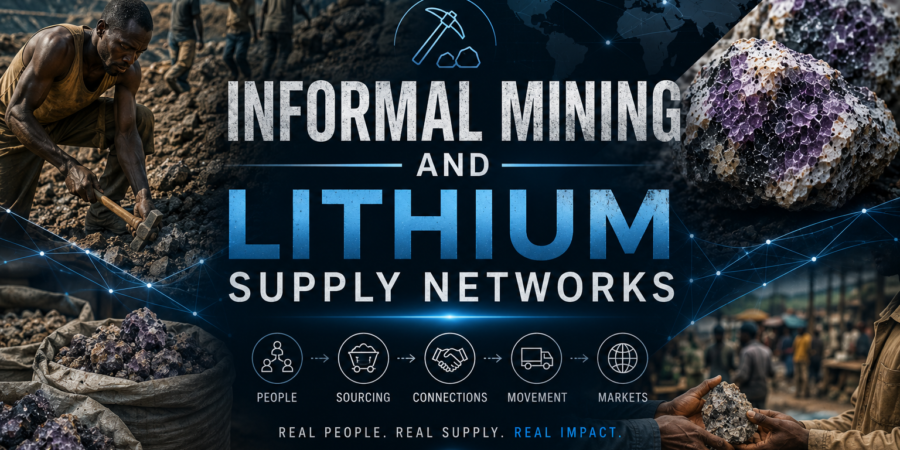
Much of Nigeria’s emerging lithium economy is being built from the ground up through informal and semi-structured mining activity. Before international procurement companies, battery-material firms, and commodity traders began paying close attention to Nigerian lithium, local mining communities across parts of Northern Nigeria were already engaged in small-scale mineral extraction and regional trade networks tied to the broader solid minerals sector.
Today, those same communities are gradually becoming connected to a global supply chain linked to lithium, battery production, renewable energy systems, and electric mobility infrastructure. This transformation is happening rapidly, but it is also unfolding unevenly. One of the defining characteristics of Nigeria’s lithium market is that much of the current supply still originates outside highly industrialized mining systems. Instead, supply often moves through artisanal miners, local cooperatives, informal suppliers, regional traders, and decentralized procurement networks.
For many outside observers, the term “informal mining” immediately suggests disorder or instability. The reality is far more complex. Informal mining networks exist partly because they fill economic and operational gaps that large industrial systems have not yet fully occupied. In many communities, artisanal mining provides livelihoods, local commerce, transportation demand, regional trade activity, and economic participation in areas where alternative opportunities may be limited.
In this sense, informal mining is not operating outside the lithium economy. It is currently one of the foundations of the lithium economy itself. At the same time, the growth of international demand for battery minerals is gradually pushing these informal systems into closer interaction with industrial procurement expectations, logistics coordination, quality verification, and organized supply-chain structures.
This interaction is beginning to reshape the market. One of the most important realities about Nigeria’s lithium supply chain is that it remains highly decentralized. Material often originates from multiple mining communities spread across Nasarawa, Kaduna, Kogi, Kebbi, Zamfara, Katsina, and surrounding mineral corridors. These communities may operate independently, but collectively they form a significant part of the country’s emerging lithium supply ecosystem.
The challenge is not necessarily the existence of informal mining itself. The bigger challenge is coordination. Industrial buyers linked to battery manufacturing, energy storage systems, and international mineral procurement typically require scalable sourcing, procurement visibility, logistics organization, inventory consistency, and reliable movement systems. Fragmented informal supply networks can make these conditions difficult to achieve without aggregation and coordination structures.
This is why aggregation is becoming increasingly important within Nigeria’s lithium trade. Aggregation systems help connect mining communities, suppliers, logistics operators, warehousing infrastructure, and procurement channels into more organized commercial systems. In practical terms, aggregation helps transform scattered artisanal production into scalable commercial inventory. Without these coordination systems, international procurement becomes operationally difficult.
The rise of warehousing is also closely connected to the evolution of informal supply networks. As procurement systems become more sophisticated, buyers increasingly expect inventory organization, material traceability, moisture control, quality verification, and structured logistics coordination. Warehousing helps create these conditions by stabilizing movement between decentralized mining activity and larger procurement systems. This transition is gradually pushing the market toward greater organization without necessarily eliminating the role of local mining communities themselves.
Another major factor shaping informal lithium supply networks is transportation. Mining communities may possess commercially valuable material, but without effective movement systems, supply chains weaken quickly. Across Northern Nigeria, lithium materials increasingly move through local transport systems, trucking corridors, aggregation routes, and procurement channels connected to larger commercial centers. This movement layer is becoming strategically important because modern mineral economies depend heavily on logistics efficiency, inventory coordination, and procurement reliability. In many ways, transportation is becoming just as important as extraction itself.
Abuja’s growing role within the lithium ecosystem reflects this transition clearly. The city is increasingly functioning as an aggregation destination, a procurement coordination hub, a warehousing center, and a commercial bridge connecting informal supply networks with industrial buyers. As the market matures, Abuja’s importance may continue growing because international procurement systems naturally gravitate toward coordination, visibility, and operational organization.
Another major issue shaping informal mining networks is information. In fragmented mineral economies, misinformation and pricing confusion often spread rapidly because suppliers may lack direct buyer access, market visibility, technical knowledge, or procurement intelligence. This creates opportunities for exploitation, speculative middlemen, and inconsistent pricing systems. Over time, the market will likely reward organizations capable of improving transparency, supplier coordination, procurement visibility, and technical understanding across the supply chain.
Quality verification is also becoming increasingly important within informal supply systems. Professional buyers now commonly evaluate Li₂O percentage, impurities, moisture levels, mineral consistency, and assay reliability before entering procurement agreements. Lithium concentration is commonly measured using Li₂O percentage (Lithium Oxide percentage). Most commercially discussed lithium-bearing materials currently associated with Nigerian supply systems include Spodumene/Kunzite, Lepidolite, and Amblygonite.
As procurement standards become more structured, informal mining networks are gradually being pushed toward stronger quality awareness, better material handling, and more organized supply coordination. The future of Nigeria’s lithium economy may therefore depend not on eliminating informal mining entirely, but on integrating local mining networks into more organized supply systems. That integration may involve aggregation, logistics coordination, warehousing, procurement transparency, and stronger buyer-supplier relationships capable of supporting scalable industrial sourcing.
The Nigerian Mineral Exchange (NME) is actively working to strengthen these connections by helping coordinate mining communities, suppliers, aggregation systems, logistics operators, and international procurement relationships across Nigeria’s growing lithium economy. NME is currently seeking steady lithium suppliers, aggregation partnerships, and structured procurement relationships across Northern Nigeria.
Mining cooperatives, artisanal suppliers, regional traders, and local operators seeking verified buyers, organized procurement systems, aggregation opportunities, or direct lithium supply coordination can contact NME directly through WhatsApp (+2348130799304) for immediate sourcing discussions and commercial engagement. At the same time, international buyers, battery-material companies, Chinese sourcing firms, commodity traders, and industrial procurement groups seeking verified suppliers, aggregation coordination, logistics support, procurement visibility, or Nigeria lithium market-entry consulting can also engage NME directly for sourcing assistance and strategic procurement coordination within Nigeria’s evolving lithium ecosystem.
Nigeria’s informal lithium economy is still evolving. But rather than existing outside the future supply chain, these mining networks are increasingly becoming part of the foundation upon which the larger battery-mineral economy may eventually be built. The real question now is not whether informal mining will influence Nigeria’s lithium future. It already does. The more important question is how effectively these decentralized networks become integrated into organized, scalable, and commercially sustainable supply systems over the coming years.
Related Articles
- How to Source Lithium Ore in Nigeria in 2026
- How to Secure Large-Scale Lithium Ore Supply in Abuja: The NME Industrial Sourcing Guide
- How NME Supports Lithium Procurement in Nigeria
- Why Northern Nigeria Could Dominate Lithium Supply
- What Lithium Buyers Look For Before Purchase
- Why Local Partnerships Matter in Lithium Trade
- Understanding Li₂O Percentages in Lithium Trade
- Where to Buy Lithium Ore in Nigeria
- Building Nigeria’s Mineral Market Infrastructure: The Nigerian Mineral Exchange Vision
- Nigeria’s Critical Minerals and the Global Energy Transition
- Top Mining Opportunities in Nigeria: A Guide for Investors and Industry Participants
- How to Invest in Nigeria’s Mining Sector: A Step-by-Step Guide for Foreign Investors


Leave a Reply