
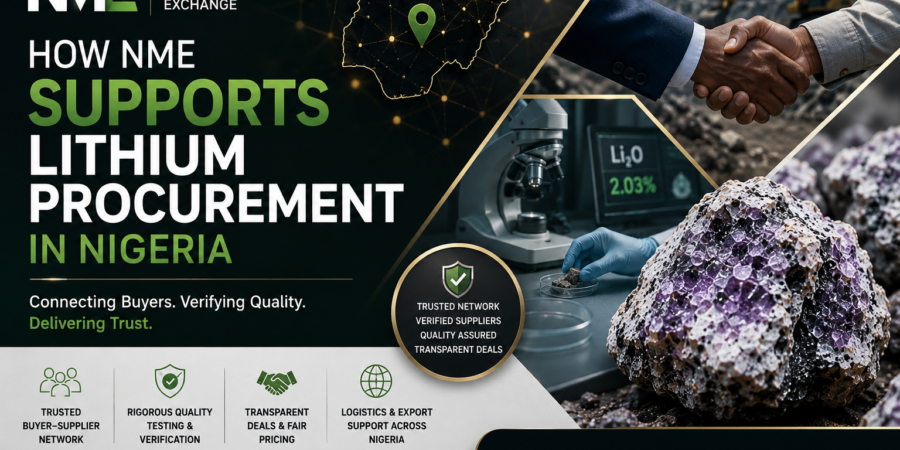
Nigeria’s lithium industry is evolving rapidly, but one of the biggest realities shaping the market today is that procurement has become far more complex than simply buying mineral material. As international demand for lithium continues expanding, serious procurement now depends heavily on supply-chain coordination, aggregation systems, logistics visibility, supplier verification, warehousing infrastructure, and long-term sourcing relationships. This shift is transforming the Nigerian lithium economy from fragmented mineral trading into a more organized procurement ecosystem connected to global battery supply chains.
Within this evolving environment, the Nigerian Mineral Exchange (NME) is positioning itself as a procurement coordination and supply-chain support platform helping bridge the gap between local suppliers, aggregation networks, and international industrial buyers. The role NME plays within the lithium market is not limited to simply listing suppliers or connecting buyers casually. The broader objective is to help build structured procurement systems, stronger aggregation coordination, supply-chain visibility, and long-term sourcing relationships capable of supporting industrial demand over time.
This is becoming increasingly important because Nigeria’s lithium ecosystem remains highly decentralized. Across parts of Northern Nigeria, lithium-bearing materials associated with Spodumene/Kunzite, Lepidolite, and Amblygonite continue moving through artisanal mining communities, local cooperatives, regional suppliers, transport corridors, aggregation systems, and emerging commercial procurement networks. For international buyers entering the market, navigating this fragmented ecosystem can be operationally difficult without local coordination structures.
This is where NME increasingly provides value. One of the primary ways NME supports lithium procurement is through supplier coordination and market connectivity. International procurement groups often struggle with fragmented supplier access, inconsistent communication, unreliable inventory visibility, and weak operational coordination. NME helps simplify this process by creating structured pathways between verified suppliers, aggregation systems, logistics operators, and industrial buyers seeking scalable sourcing opportunities in Nigeria. As the market matures, procurement success is increasingly depending on operational organization, continuity, and coordinated sourcing systems rather than isolated spot transactions.
Another important area where NME supports procurement is aggregation coordination. Because much of Nigeria’s lithium supply still originates from decentralized mining systems, aggregation has become one of the most strategically important layers within the market. Aggregation helps transform fragmented regional supply into organized commercial inventory capable of supporting industrial procurement relationships. NME actively supports this evolving ecosystem by helping connect regional suppliers, aggregation partners, warehouse operators, and procurement systems capable of supporting recurring supply continuity.
This is particularly important for international buyers searching for scalable inventory, long-term sourcing relationships, and organized procurement coordination. Without aggregation systems, industrial-scale procurement becomes significantly more difficult in fragmented supply environments.
Logistics coordination is another major challenge within the Nigerian lithium market, and it is an area where NME increasingly positions itself as a support platform. Successful lithium procurement depends heavily on transportation planning, inventory movement, warehousing coordination, shipment visibility, and operational communication across the supply chain. As procurement systems become more industrialized, buyers increasingly require predictable movement, logistics transparency, and organized coordination capable of supporting recurring industrial demand. NME supports this process by helping facilitate connections between suppliers, transport operators, aggregation centers, warehouses, and procurement systems operating across multiple regional corridors.
Abuja’s rise within the lithium economy is also central to NME’s positioning strategy. Although Abuja is not necessarily one of Nigeria’s primary extraction zones, the city is rapidly emerging as a procurement coordination center, an aggregation destination, a warehousing corridor, and a commercial bridge linking regional suppliers with international buyers. NME’s operational positioning around Abuja aligns with this broader market evolution. The city provides logistics accessibility, centralized coordination, supplier engagement, operational visibility, and easier commercial organization for procurement systems operating across Northern Nigeria. As the market matures, Abuja’s importance within Nigeria’s lithium ecosystem may continue expanding significantly.
Another major area where NME supports procurement is supplier verification and due diligence coordination. International buyers increasingly evaluate supplier reliability, inventory consistency, logistics capability, assay transparency, and operational professionalism before entering sourcing agreements. Professional buyers now commonly assess Li₂O percentage, mineral consistency, moisture content, impurity levels, and assay reliability during procurement processes. Lithium concentration is commonly measured using Li₂O percentage (Lithium Oxide percentage).
As procurement systems become more selective globally, supplier verification and quality coordination are becoming increasingly important. NME helps improve procurement visibility by supporting supplier introductions, sourcing coordination, aggregation visibility, and procurement communication between buyers and suppliers.
Another important shift happening within the industry is the growing movement away from speculative spot-market trading toward long-term procurement ecosystems built around continuity and operational coordination. International buyers increasingly prefer working with procurement systems capable of supporting recurring supply, organized sourcing, scalable aggregation, and relationship-driven procurement structures. This transition aligns closely with NME’s broader positioning strategy. Rather than focusing only on short-term transactional activity, NME is actively seeking to support long-term supplier relationships, aggregation partnerships, recurring procurement systems, and sustainable supply-chain coordination across Nigeria’s growing battery-mineral economy.
For international buyers, battery-material firms, Chinese sourcing companies, commodity traders, mineral processors, and industrial procurement groups seeking verified lithium suppliers, scalable sourcing opportunities, procurement coordination, aggregation access, supplier due diligence, logistics support, or Nigeria lithium market-entry consulting, NME provides procurement support designed to simplify sourcing operations and improve supply-chain visibility within the Nigerian lithium sector.
International buyers seeking reliable lithium sourcing relationships in Nigeria can contact NME directly through WhatsApp (+2348130799304) for supplier introductions, procurement coordination, aggregation access, logistics visibility, inventory sourcing, and operational support. At the same time, NME is actively seeking steady lithium suppliers, aggregation partnerships, recurring procurement relationships, and strategic commercial collaborations across Northern Nigeria.
Suppliers capable of supporting scalable inventory, recurring supply, organized logistics, and professional procurement coordination can also engage NME directly for immediate sourcing discussions and partnership opportunities. Nigeria’s lithium industry is still developing, but the future market will likely be shaped not only by those extracting minerals from the ground.
Increasingly, long-term commercial advantage may belong to organizations capable of coordinating procurement systems, aggregation infrastructure, logistics movement, supplier relationships, and operational visibility across the broader supply chain. That is the strategic space NME is positioning itself to occupy within Nigeria’s evolving battery-mineral economy.
Related Articles
- How to Source Lithium Ore in Nigeria in 2026
- How to Secure Large-Scale Lithium Ore Supply in Abuja: The NME Industrial Sourcing Guide
- Why Northern Nigeria Could Dominate Lithium Supply
- Understanding Li₂O Percentages in Lithium Trade
- Where to Buy Lithium Ore in Nigeria
- Lithium Ore Sellers in Kebbi State: Supply Your Lithium Ores to the Nigerian Mineral Exchange Abuja Warehouse


Leave a Reply