
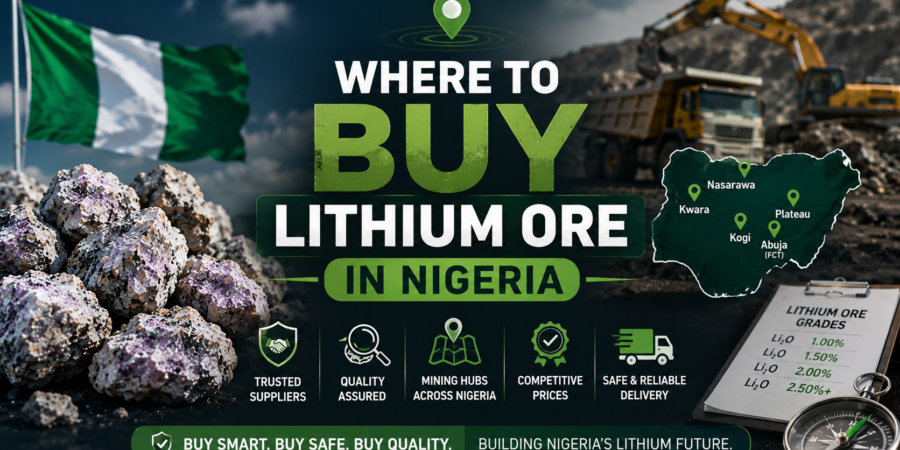
Nigeria is rapidly emerging as one of Africa’s most closely watched lithium sourcing destinations. Over the last few years, growing global demand for battery minerals has pushed international buyers, commodity traders, processors, and sourcing companies to look beyond traditional lithium-producing jurisdictions in search of new supply corridors, scalable procurement opportunities, and long-term sourcing relationships.
Within that global search, Nigeria has begun attracting increasing attention because of its expanding lithium activity across parts of Northern and Central Nigeria. But for many foreign buyers and procurement companies, one major question continues to arise:
Where exactly can lithium ore be sourced or purchased in Nigeria?
The answer is more complex than many first-time buyers expect. Unlike highly industrialized mining jurisdictions where supply is concentrated within a few centralized operators, Nigeria’s lithium market is still evolving through a combination of artisanal mining systems, regional aggregation networks, decentralized suppliers, local procurement channels, and emerging commercial coordination structures.
This means buying lithium ore in Nigeria is not simply about locating mineral deposits. It is largely about understanding supply-chain movement, aggregation systems, logistics coordination, supplier verification, and procurement networks.
That distinction is extremely important. Many buyers entering the Nigerian market initially assume that sourcing lithium is mainly a geological challenge. In reality, the bigger challenge is often procurement coordination. The supply exists across multiple corridors, but successful sourcing depends on knowing where aggregation occurs, how supply moves, who coordinates inventory, and which procurement systems are capable of supporting scalable commercial relationships.
Across parts of Northern and Central Nigeria, lithium-related activity is increasingly associated with states such as Nasarawa, Kaduna, Kogi, Kebbi, Zamfara, Katsina, and neighboring mineral corridors. These regions are becoming increasingly important because they form part of Nigeria’s expanding lithium supply ecosystem.
However, material rarely moves directly from isolated mining communities into large international transactions without passing through aggregation systems, logistics channels, warehousing networks, and procurement coordination structures.
This is one reason Abuja is becoming increasingly important within the lithium trade. Although Abuja is not necessarily one of Nigeria’s primary extraction zones, it is rapidly evolving into a lithium commercial hub, an aggregation destination, a warehousing corridor, and a procurement coordination center linking regional suppliers with international buyers.
For many buyers, Abuja is increasingly becoming the most practical entry point into Nigeria’s lithium market. The city offers advantages involving logistics accessibility, commercial coordination, inventory aggregation, supplier engagement, and operational visibility. As the market matures, more procurement activity is naturally gravitating toward environments capable of supporting structured sourcing, inventory coordination, and commercial organization.
This is especially important because much of Nigeria’s current lithium supply still originates from artisanal miners, local cooperatives, regional suppliers, and fragmented extraction communities. Without aggregation and coordination systems, sourcing at industrial scale becomes difficult. This is why buyers increasingly rely on procurement coordinators, aggregation networks, warehousing systems, and local commercial partners capable of organizing supply efficiently.
The role of aggregation is becoming particularly important within the Nigerian lithium economy. Aggregation helps transform scattered regional supply into commercially organized inventory capable of supporting larger procurement relationships. For international buyers, this reduces many operational challenges involving fragmented sourcing, inconsistent logistics, inventory visibility, and supplier coordination.
In practical terms, the future of lithium procurement in Nigeria may depend less on isolated mine ownership and more on supply-chain organization. Another important consideration for buyers is quality verification. Industrial procurement systems linked to battery manufacturing, mineral processing, and energy-transition supply chains increasingly require assay reliability, inventory consistency, procurement transparency, and technical verification before entering sourcing agreements.
Professional buyers commonly evaluate Li₂O percentage, impurity levels, moisture content, mineral consistency, and material composition. Lithium concentration is commonly measured using Li₂O percentage (Lithium Oxide percentage). Most commercially discussed lithium-bearing materials currently associated with Nigeria include Spodumene/Kunzite, Lepidolite, and Amblygonite.
Understanding the characteristics of these materials is becoming increasingly important because different industrial buyers prioritize different mineral types, processing requirements, and impurity thresholds. This is one reason serious procurement systems increasingly prefer working through verified aggregation structures, organized sourcing networks, and local commercial partners with operational visibility.
The Nigerian lithium market is also becoming more sophisticated. The first phase of the lithium rush was dominated heavily by speculative transactions, rapid sourcing behavior, and opportunistic mineral trading. That environment is gradually changing. Today, industrial buyers increasingly prioritize long-term supply continuity, logistics coordination, warehousing systems, procurement transparency, and scalable sourcing relationships.
This transition is reshaping how lithium ore is bought and sold across Nigeria. Buyers who approach the market strategically often focus not only on where lithium exists, but also on who can coordinate supply reliably. The Nigerian Mineral Exchange (NME) is actively positioning within this evolving procurement ecosystem by helping connect lithium suppliers, aggregation systems, warehousing networks, logistics operators, and international buyers across Nigeria’s growing lithium market.
For international buyers, battery-material companies, Chinese sourcing firms, commodity traders, and industrial procurement groups seeking verified lithium suppliers, bulk sourcing opportunities, aggregation coordination, logistics support, supplier due diligence, or Nigeria lithium market-entry consulting, NME provides procurement coordination and sourcing support designed to simplify entry into the Nigerian lithium market.
Buyers seeking reliable lithium sourcing relationships in Nigeria can contact NME directly through WhatsApp (+2348130799304) for supplier introductions, procurement coordination, aggregation access, inventory sourcing, and operational support.
At the same time, NME is actively seeking steady lithium suppliers, regional aggregation partnerships, and long-term procurement relationships across Northern and Central Nigeria. Suppliers looking for verified buyers, organized procurement systems, aggregation support, or direct lithium supply opportunities can also engage NME directly for immediate sourcing discussions.
Nigeria’s lithium market is still developing, but the direction is becoming increasingly clear. The future of lithium procurement in the country will likely revolve around aggregation, logistics coordination, warehousing infrastructure, supplier verification, and organized commercial systems capable of supporting industrial-scale sourcing.
For serious buyers, understanding these supply-chain dynamics may ultimately matter more than simply locating lithium deposits themselves. Because in the emerging battery-mineral economy, procurement success increasingly belongs to those who understand how supply moves, how inventory is coordinated, and how commercial networks operate behind the scenes.
Related Articles
- Understanding Li₂O Percentages in Lithium Trade
- Lithium Ore Sellers in Kebbi State: Supply Your Lithium Ores to the Nigerian Mineral Exchange Abuja Warehouse
- Lithium Ore Sellers in Zamfara State: Supply Your Lithium Ores to the Nigerian Mineral Exchange Abuja Warehouse
- How to Sell Lithium Ore in Nigeria: Step-by-Step Guide for Miners
- 10 Common Reasons Lithium Ore Gets Rejected in Nigeria
- Sell Lithium Ore in Abuja, Nigeria – Fast Testing & Payment
- Lithium Buyers Are Back in Nigeria
- How to Find Reliable Lithium Buyers in Nigeria
- How to Avoid Fraud When Selling Lithium Ore in Nigeria

Leave a Reply