
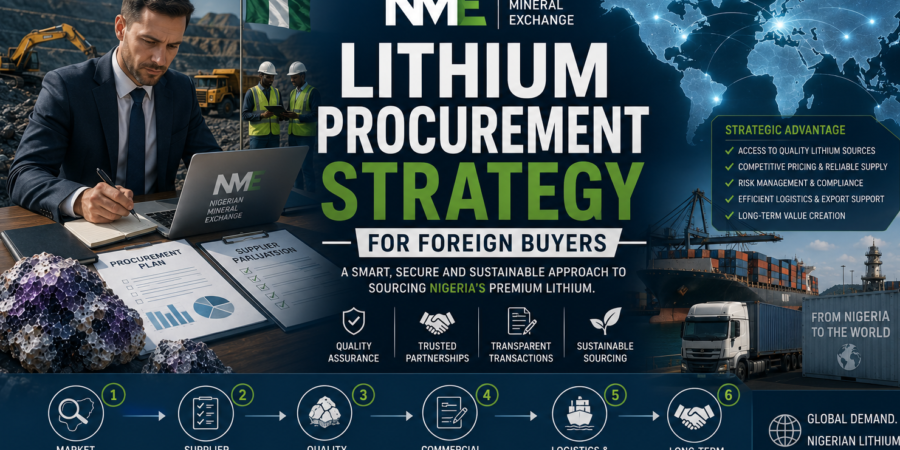
Foreign companies entering Nigeria’s lithium market often arrive with one primary objective: secure reliable lithium supply. But many quickly discover that sourcing lithium in Nigeria requires far more than finding miners, collecting samples, or negotiating prices. Nigeria’s lithium ecosystem is still developing. Supply remains fragmented, regionally dispersed, relationship-driven, and operationally complex. As a result, successful procurement in Nigeria increasingly depends on local coordination, aggregation systems, supplier verification, logistics planning, and procurement intelligence.
For international buyers, battery-material companies, commodity traders, and sourcing teams, having the right procurement strategy can determine whether operations become scalable and sustainable, or chaotic and commercially risky. This guide explains the major strategic considerations foreign buyers should understand before sourcing lithium in Nigeria.
Nigeria Is Not a Simple Spot-Buying Market
One of the first mistakes many foreign buyers make is treating Nigeria like a centralized commodity exchange. Nigeria’s lithium market currently operates through artisanal mining networks, regional suppliers, aggregation systems, cooperatives, local traders, and decentralized procurement structures. This means sourcing usually requires relationship-building, operational coordination, and structured local engagement. Buyers who approach the market casually often encounter inconsistent supply, logistics difficulties, supplier confusion, and operational inefficiencies.
Procurement Strategy Begins With Supply Structure
Before sourcing begins, buyers must first determine what type of supply system they want to build. Some buyers focus on short-term spot procurement. Others prioritize long-term sourcing relationships, aggregation partnerships, or scalable procurement infrastructure.
This strategic decision influences logistics planning, warehousing needs, supplier selection, and operational coordination. Long-term procurement usually requires deeper market integration.
Why Aggregation Is Central to Procurement Strategy
Much of Nigeria’s lithium supply comes from artisanal miners, small-scale suppliers, and fragmented mining communities. Very few individual operators can independently provide large consistent volumes, organized logistics, or stable procurement continuity.
This is why aggregation is becoming one of the most important components of foreign procurement strategy. Aggregation helps improve supply scalability, logistics coordination, warehousing efficiency, and procurement reliability. Without aggregation systems, large-scale sourcing becomes difficult.
Abuja’s Strategic Importance in Procurement Operations
Many foreign procurement teams increasingly use Abuja as a coordination center, aggregation point, logistics hub, and operational gateway into Nigeria’s lithium market. Abuja provides transportation accessibility, easier supplier coordination, warehousing opportunities, and central access to Northern Nigerian supply corridors. For many international sourcing operations, Abuja now functions as a strategic procurement base. This trend is likely to continue as the market matures.
Supplier Verification Must Be a Core Priority
One of the biggest procurement risks in emerging lithium markets is unreliable supply relationships. Foreign buyers entering Nigeria often encounter fake suppliers, exaggerated claims, inconsistent quality, middleman confusion, and weak operational coordination.
Professional procurement strategies therefore increasingly emphasize supplier verification, due diligence, operational assessments, and relationship screening. Verification reduces supply risk, logistics uncertainty, and procurement instability.
Assays Are Fundamental to Procurement Decisions
No serious lithium procurement strategy can function without reliable assays. Foreign buyers typically evaluate Li₂O percentage, impurities, moisture content, consistency, and mineral composition before entering major procurement discussions. Lithium concentration is commonly measured using Li₂O percentage (Lithium Oxide percentage). Without structured testing procurement planning weakens, pricing becomes uncertain, and commercial risk increases. Assay transparency is becoming central to professional sourcing systems.
Nigeria’s Main Lithium Ore Types
Most commercially discussed lithium-bearing materials associated with Nigeria currently involve Spodumene/Kunzite, Lepidolite, and Amblygonite. Different buyers may prioritize different ore types, processing characteristics, or grade ranges depending on downstream industrial requirements. Proper mineral identification remains essential within procurement planning.
Logistics Strategy Matters as Much as Ore Quality
Many new buyers focus heavily on lithium concentration, while underestimating logistics complexity. But logistics strongly influence procurement cost, transportation efficiency, warehousing coordination, and operational scalability.
Foreign buyers should carefully evaluate road access, transportation routes, warehousing systems, security considerations, and aggregation logistics. Even strong ore can become commercially difficult if logistics systems are weak.
Why Long-Term Relationships Matter
Modern lithium procurement increasingly depends on continuity, operational trust, and repeat sourcing relationships. Many foreign buyers now prioritize long-term supplier partnerships, aggregation coordination, and stable procurement ecosystems rather than random one-time purchases. Suppliers who demonstrate operational discipline, representative assays, reliable communication, and consistent quality often become strategically valuable over time.
Looking to Source Lithium in Nigeria?
The Nigerian Mineral Exchange (NME) is helping coordinate structured lithium procurement systems across Nigeria through supplier matchmaking, aggregation support, warehousing coordination, sourcing advisory, and procurement intelligence. Foreign buyers, battery-material firms, commodity traders, and sourcing teams seeking reliable lithium suppliers, aggregation networks, due diligence support, logistics coordination, or market-entry assistance in Nigeria can engage with NME for end-to-end procurement coordination, buyer representation, supplier verification, warehousing support, and structured sourcing advisory services.
WhatsApp remains the fastest communication pathway for active procurement coordination. Contact NME on: +2348130799304
Nigerian Suppliers Looking for Long-Term Buyers?
Miners, cooperatives, suppliers, and aggregators interested in supplying lithium ore consistently, accessing international buyers, joining organized aggregation systems, or building long-term supply relationships can also contact NME directly through WhatsApp for operational coordination and supply discussions.
Warehousing Is Becoming Strategically Important
As procurement systems scale, warehousing is becoming increasingly important within Nigeria’s lithium ecosystem. Warehousing supports aggregation, moisture management, logistics coordination, inventory organization, and shipment planning. Professional buyers increasingly prefer organized storage systems, cleaner handling processes, and structured operational coordination. Warehousing infrastructure is gradually becoming part of procurement strategy itself.
Procurement Intelligence Is a Competitive Advantage
Foreign buyers entering Nigeria often face information gaps involving supplier visibility, logistics realities, regional mining activity, and procurement reliability. As a result, procurement intelligence is becoming commercially valuable. Organizations capable of providing supplier networks, sourcing coordination, aggregation visibility, and operational guidance are increasingly important within the market. In emerging lithium economies, information itself becomes strategic infrastructure.
The Future of Lithium Procurement in Nigeria
Nigeria’s lithium market is gradually evolving toward structured sourcing systems, organized aggregation, professional warehousing, and industrial procurement coordination. As global lithium competition intensifies, successful procurement strategies will likely increasingly depend on local partnerships, operational coordination, verification systems, and long-term supply-chain integration. The future market will favor buyers who build structured relationships, scalable sourcing systems, and trusted operational networks.
Final Thoughts
Foreign lithium procurement in Nigeria requires much more than locating mineralized material. Successful sourcing increasingly depends on aggregation, supplier verification, logistics planning, procurement intelligence, warehousing, and long-term relationship-building.
As Nigeria’s lithium ecosystem continues evolving, procurement strategies based on operational structure, trust, consistency, and coordinated supply systems will likely become far more effective than opportunistic spot-buying approaches. In the future lithium economy, the strongest procurement advantage may not simply be access to ore, but access to organized supply-chain infrastructure.
Related Articles
- How to Source Lithium Ore in Nigeria in 2026
- How to Secure Large-Scale Lithium Ore Supply in Abuja: The NME Industrial Sourcing Guide
- Strategic States in Nigeria’s Lithium Economy
- How NME Supports Lithium Procurement in Nigeria
- Why Northern Nigeria Could Dominate Lithium Supply
- What Lithium Buyers Look For Before Purchase
- Informal Mining and Lithium Supply Networks in Nigeria
- Why Local Partnerships Matter in Lithium Trade
- Developing Sustainable Lithium Supply Networks in Nigeria


Leave a Reply