
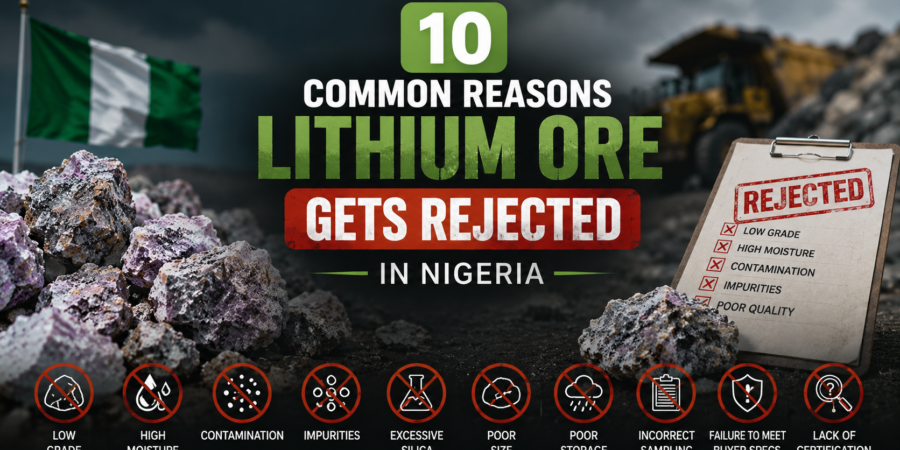
Nigeria’s lithium industry is expanding rapidly as global demand for battery minerals continues to increase. Across different parts of Northern Nigeria, miners, suppliers, aggregators, and traders are increasingly participating in the growing lithium economy. However, many suppliers still experience one frustrating challenge:
Lithium ore rejection.
In many cases, suppliers transport materials over long distances only to discover that buyers are unwilling to purchase the ore after inspection or testing. Sometimes the issue is low lithium content. In other situations, the problem may involve contamination, moisture, inconsistent quality, or poor understanding of market requirements.
For many new suppliers, these rejections can be confusing and financially painful.
Understanding why lithium ore gets rejected is extremely important because it helps suppliers:
- reduce losses,
- improve ore quality,
- negotiate more effectively,
- and build stronger long-term buyer relationships.
This guide explains the most common reasons lithium ore gets rejected in Nigeria and how suppliers can improve their chances of successful transactions.
Nigeria’s Major Lithium Ore Types
Nigeria hosts several lithium-bearing minerals, but the most commonly encountered commercial lithium ore types currently include:
- Spodumene/Kunzite,
- Lepidolite,
- and Amblygonite.
Each mineral type has different:
- lithium concentrations,
- processing characteristics,
- commercial demand,
- and market preferences.
Buyers may evaluate these minerals differently depending on:
- processing requirements,
- export markets,
- refining capabilities,
- and commercial objectives.
This is why proper mineral identification and testing are extremely important before supply discussions begin.
Why Lithium Ore Rejection Happens
Lithium buyers are not simply purchasing raw stones or mineralized material.
They are evaluating:
- commercial value,
- lithium concentration,
- processing efficiency,
- logistics economics,
- and operational risk.
If the ore fails to meet buyer expectations or processing requirements, rejection becomes likely.
As Nigeria’s lithium market becomes more structured, quality expectations are gradually increasing.
Suppliers who understand buyer standards are therefore better positioned for successful transactions. Lithium ores are rejected for the following reasons:
1. Low Li₂O Percentage
One of the most common reasons lithium ore gets rejected is low lithium content.
Lithium concentration is usually measured through:
Li₂O percentage (Lithium Oxide percentage).
If the assay result falls below a buyer’s minimum acceptable grade, the material may become commercially unattractive.
This is especially important because:
- transportation costs,
- handling costs,
- processing costs,
- and export costs
all affect profitability.
Even if ore visually appears promising, buyers rely heavily on assay results before making serious commitments.
Why High Li₂O Matters
Higher-grade lithium ore generally provides:
- better processing economics,
- lower waste,
- stronger recovery potential,
- and improved commercial value.
This is why buyers pay close attention to:
- assay reports,
- mineral concentration,
- and consistency.
Suppliers should avoid assuming that appearance alone determines value.
Laboratory testing remains extremely important.
2. Excessive Contamination
Another major reason for rejection is contamination.
Lithium buyers often reject ore containing:
- excessive clay,
- dirt,
- iron contamination,
- organic materials,
- mixed waste rock,
- or foreign materials.
Contaminated ore increases:
- processing difficulty,
- refining costs,
- transportation inefficiencies,
- and operational waste.
Poor separation practices during mining and aggregation commonly create this problem.
Suppliers who improve sorting and material handling often increase buyer confidence significantly.
3. Inconsistent Ore Quality
Consistency is extremely important in lithium trading.
Some suppliers present:
- high-grade samples,
- but later deliver lower-quality bulk material.
This creates trust problems.
Professional buyers prefer suppliers capable of maintaining:
- stable lithium grades,
- consistent mineral composition,
- and predictable quality across batches.
Inconsistent quality increases commercial risk and may damage long-term supply relationships.
4. High Moisture Content
Moisture is frequently overlooked by suppliers, yet it can strongly affect buyer decisions.
Excess moisture can:
- increase transportation weight,
- reduce effective ore value,
- create storage complications,
- and affect processing performance.
Some buyers may reject overly wet materials entirely.
Proper storage and handling therefore matter greatly within lithium supply operations.
5. Poor Mineral Identification
Many suppliers mistakenly assume all lithium-bearing rocks are commercially attractive.
However, buyers usually evaluate:
- mineral type,
- processing suitability,
- lithium concentration,
- and commercial demand.
Nigeria’s common lithium-bearing minerals such as Spodumene/Kunzite, Lepidolite, and Amblygonite may attract different levels of buyer interest depending on market conditions and processing requirements. Improper mineral identification can create unrealistic pricing expectations and failed negotiations.
6. Lack of Proper Assay Reports
Serious buyers rarely purchase lithium ore based only on visual inspection.
Without proper assay reports, buyers may struggle to determine:
- lithium concentration,
- impurities,
- mineral composition,
- and commercial viability.
Reliable testing helps reduce disputes and improves transaction transparency.
Ore without credible assay verification may therefore face rejection or reduced pricing.
Looking to Discuss Lithium Supply Opportunities?
The Nigerian Mineral Exchange (NME) is working to support more structured lithium trade systems across Nigeria through:
- supplier coordination,
- buyer connections,
- aggregation support,
- and growing visibility for Nigeria’s emerging battery mineral sector.
Suppliers interested in discussing:
- lithium supply opportunities,
- ore evaluation,
- aggregation,
- or structured procurement discussions
can contact NME for further engagement. (WhatsApp: 08130799304)
7. Mixed Materials and Poor Sorting
Poor sorting practices often reduce ore value.
Some suppliers mix:
- different ore types,
- waste rock,
- low-grade material,
- or unrelated minerals
within the same shipment.
This creates:
- quality inconsistency,
- processing inefficiencies,
- and reduced buyer confidence.
Professional buyers generally prefer:
- cleaner material,
- better separation,
- and more organized ore preparation.
Even basic improvements in sorting can significantly improve commercial attractiveness.
8. Unrealistic Pricing Expectations
Another common issue involves unrealistic pricing demands.
Some suppliers:
- hear exaggerated market stories,
- misunderstand global pricing,
- or assume all lithium ore commands premium value.
But buyers must consider:
- grade,
- impurities,
- transportation,
- processing costs,
- and export economics.
When supplier expectations become disconnected from commercial realities, negotiations often fail.
9. Logistics Challenges
Logistics can heavily influence purchasing decisions.
Buyers evaluate:
- accessibility,
- transportation routes,
- security conditions,
- and delivery coordination.
Ore located in difficult or insecure areas may face:
- increased transportation costs,
- delays,
- or operational risks.
This is one reason why aggregation hubs and logistics coordination are becoming increasingly important within Nigeria’s lithium supply chain.
10. Poor Communication and Lack of Professionalism
Professionalism matters increasingly within lithium trading.
Buyers generally prefer suppliers who:
- communicate clearly,
- understand basic procedures,
- respect agreements,
- and maintain realistic expectations.
Disorganized communication can create:
- misunderstandings,
- delays,
- and operational uncertainty.
As the lithium industry becomes more structured, professionalism becomes more valuable.
Why Buyers Prefer Structured Supply Relationships
Many buyers are moving away from random one-time purchases toward organized supply networks, aggregation systems, and repeat procurement relationships.
This shift is happening because buyers increasingly value:
- consistency,
- transparency,
- logistics coordination,
- and reduced operational risk.
Suppliers who position themselves professionally may therefore gain stronger long-term opportunities.
How Suppliers Can Reduce Rejection Risks
Suppliers can improve their chances of successful transactions by focusing on:
- proper testing,
- realistic pricing,
- good sorting practices,
- quality consistency,
- proper storage,
- and professional communication.
Even small operational improvements can significantly affect buyer confidence.
Understanding buyer expectations helps suppliers transition from informal trading toward more structured commercial participation.
The Future of Lithium Quality Standards in Nigeria
As international interest in Nigerian lithium continues growing, quality standards are likely to become stricter.
The market is gradually evolving toward:
- better testing systems,
- more professional aggregation,
- structured procurement,
- and stronger quality control processes.
This means suppliers who improve operational standards early may position themselves more competitively within the future market.
Final Thoughts
Lithium ore rejection is often connected to low lithium content, contamination, poor handling, inconsistent quality, moisture issues, weak logistics, or unrealistic commercial expectations. Understanding these challenges helps suppliers reduce losses, improve negotiations, and participate more effectively within Nigeria’s growing lithium economy.
As the industry becomes more organized, suppliers who focus on quality, transparency, consistency, and professionalism will likely have stronger long-term opportunities within the evolving lithium supply chain.
Related Articles
- Where to Sell Lithium Ore in Abuja: Official 2026 NME Buying Prices and Guide
- Lithium Ore Sellers in Kebbi State: Supply Your Lithium Ores to the Nigerian Mineral Exchange Abuja Warehouse
- Lithium Ore Sellers in Zamfara State: Supply Your Lithium Ores to the Nigerian Mineral Exchange Abuja Warehouse
- How to Sell Lithium Ore in Nigeria: Step-by-Step Guide for Miners
- Sell Lithium Ore in Abuja, Nigeria – Fast Testing & Payment
- Lithium Buyers Are Back in Nigeria
- How to Find Reliable Lithium Buyers in Nigeria
- How to Test Lithium Ore Before Selling in Nigeria



Leave a Reply