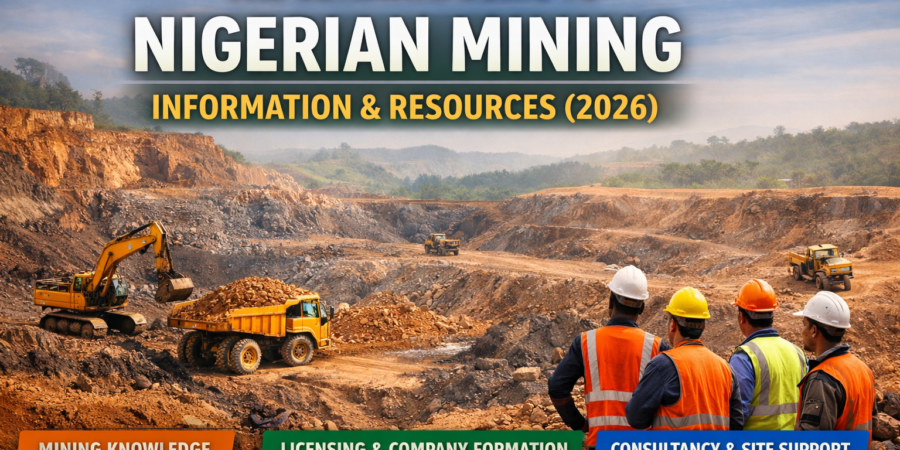
Nigeria’s mining industry is no longer sleeping.
With renewed government attention, increasing foreign investor interest, and growing global demand for critical minerals, the Nigerian solid minerals sector is entering a new era.
But here is the truth:
Mining in Nigeria is not limited by mineral deposits.
It is limited by information.
Whether you are:
- An investor exploring opportunities
- A mining site owner
- A mineral trader
- A geology or mining student
- A service provider
- A policy analyst
- A diaspora investor returning home
Your success depends on access to accurate, structured, and actionable Nigerian mining information.
This guide provides a comprehensive roadmap to Nigerian mining knowledge in 2026 – and shows you where to find reliable resources and professional support.
Why Mining Information in Nigeria Is Difficult to Access
Unlike the oil and gas sector, Nigeria’s mining industry has historically suffered from:
- Fragmented data sources
- Poor documentation culture
- Limited digitization
- Weak public access to geological data
- Inconsistent regulatory interpretation
- Minimal structured industry knowledge repositories
As a result, many people rely on:
- Word-of-mouth field stories
- WhatsApp broadcasts
- Unverified “site opportunities”
- Outdated policy interpretations
Mining is capital intensive. Mistakes are expensive.
Inaccurate information can cost millions.
Access to structured knowledge is not optional – it is a competitive advantage.
The Five Pillars of Mining Information You Must Understand
To operate effectively in Nigeria’s mining ecosystem, you must understand five major information pillars.
1️⃣ Geological & Mineral Occurrence Information
This includes:
- Geological maps
- Mineral occurrence data
- Geophysical survey interpretation
- Ore body characterization
- Mineralization reports
- Exploration methodologies
Without geological intelligence, mining becomes speculation.
Serious operators rely on structured manuals and interpretation guides before committing resources.
2️⃣ Legal & Regulatory Framework
Nigeria’s mining industry operates under defined laws and regulations including:
- Licensing categories
- Lease structures
- Royalty obligations
- Community engagement requirements
- Environmental compliance standards
Understanding the legal framework determines whether your operation survives or gets shut down.
Licensing mistakes, incorrect documentation, or poor compliance can result in:
- Revoked licenses
- Heavy penalties
- Operational suspension
Mining knowledge must include regulatory clarity.
3️⃣ Mining Company Formation & Structuring
Many people want to invest in mining but do not understand how to structure properly.
Key considerations include:
- Company registration requirements
- Shareholding structure
- Mining object clauses
- Regulatory registration with relevant agencies
- Compliance documentation
- Corporate governance setup
Improper structuring creates long-term operational risks.
Company formation is not just paperwork — it is the foundation of sustainable mining and mineral trading operations.
4️⃣ Mining Site Acquisition & Due Diligence
Acquiring a mining site requires more than enthusiasm and money.
You must evaluate:
- Title validity
- Overlapping claims
- Geological viability
- Community relationships
- Environmental exposure
- Infrastructure access
Many investors lose capital by acquiring sites without structured due diligence.
Mining site acquisition support and professional assessment significantly reduce risk exposure.
5️⃣ Investment & Operational Intelligence
Mining is both geology and economics.
You must understand:
- Capital requirements
- Equipment financing
- Operational budgeting
- Mineral pricing trends
- Export regulations
- Risk management frameworks
The difference between a profitable mine and a failed one often lies in strategic planning.
The Problem with Random Online Information
Search engines provide information, but not structure.
Most online mining content is:
- Outdated
- Generic
- Lacking technical depth
- Unverified
- Disconnected from Nigerian field realities
Mining requires organized, industry-specific knowledge.
That is why structured mining knowledge platforms are becoming essential in 2026.
Introducing the Nigerian Mining Resource Hub
The Nigerian Mining Resource Hub was developed by the Nigerian Mineral Exchange (NME), as a structured knowledge and advisory platform designed to support serious stakeholders across Nigeria’s mining value chain.
It is not just a collection of digital books.
It is a curated ecosystem of:
- Mining manuals
- Technical guides
- Industry reports
- Investment resources
- Field reference materials
- Operational templates
- Regulatory guidance materials
Instead of searching across dozens of disconnected websites, users can access organized mining intelligence in one place.
👉 Explore the Resource Hub here:
https://selar.com/m/NigerianMiningResourceHub
Beyond Digital Resources: Professional Consultancy & Advisory Services
The Resource Hub goes beyond downloadable materials.
For many stakeholders, reading is only the first step; implementation requires professional guidance.
Through the Resource Hub ecosystem, individuals and organizations can access structured consultancy and advisory services, including:
✔ Mining Company Formation Support
- Structuring mining companies properly
- Regulatory compliance alignment
- Shareholding advisory
- Corporate setup guidance
✔ Licensing & Regulatory Support Services
- Assistance with mining license applications
- Documentation guidance
- Compliance advisory
- Regulatory clarification
✔ Mining Site Acquisition Support
- Due diligence guidance
- Title verification support
- Site viability evaluation
- Risk assessment advisory
✔ Investment & Project Structuring Advisory
- Capital planning
- Strategic partnerships
- Business modeling
- Project development frameworks
✔ Geological & Technical Advisory
- Data interpretation
- Exploration guidance
- Operational planning
✔ Environmental & Sustainability Advisory
- EIA process guidance
- Rehabilitation planning
- Responsible mining frameworks
This dual structure – knowledge + execution support – ensures users are not left alone after acquiring information.
In many cases, a digital resource purchase becomes the foundation for deeper advisory engagement.
That is the difference between information and transformation.
Who Should Use the Nigerian Mining Resource Hub?
🔹 New Investors Entering Mining
Reduce risk by understanding structure before deploying capital.
🔹 Existing Site Owners
Improve efficiency and compliance through structured guidance.
🔹 Mining Entrepreneurs
Access templates, frameworks, and professional advisory to build correctly.
🔹 Students & Researchers
Bridge the gap between classroom theory and field realities.
🔹 Foreign & Diaspora Nigerians Exploring Mining Opportunities
Gain clarity before coming to invest.
Why 2026 Is a Critical Year for Mining Knowledge
Nigeria is repositioning mining as a major economic diversification pillar.
Key drivers include:
- Growing interest in critical minerals
- Increased policy focus
- Rising foreign investment inquiries
- Technology-driven exploration methods
- Expanding local mineral processing ambitions
As competition increases, knowledge gaps become more dangerous.
Prepared stakeholders will dominate the next cycle.
How to Use Mining Information Strategically
Follow this framework:
Step 1: Define Your Objective
Investment? Licensing? Site acquisition? Research?
Step 2: Acquire Structured Resources
Use curated guides instead of random downloads.
Step 3: Validate Before Committing Capital
Always combine knowledge with professional advisory where necessary.
Step 4: Continue Learning
Mining evolves. Regulations change. Technology advances.
Continuous knowledge creates long-term advantage.
Frequently Asked Questions
Where can I access structured Nigerian mining information?
Curated mining knowledge platforms provide more reliable insight than scattered blog content.
Do I need consultancy if I have digital resources?
Digital resources build understanding. Consultancy reduces implementation risk.
Can I acquire a mining site without due diligence?
Technically yes. Strategically no.
Is company formation in mining different from regular company registration?
Yes. Mining companies require structured regulatory alignment beyond basic registration.
Final Thoughts: Mining Is a Knowledge Industry
Mining is not guesswork.
It is geology, law, finance, engineering, compliance, and strategy combined.
In 2026, the winners in Nigeria’s mining sector will not just be those who own land or licenses – but those who understand structure.
Knowledge is leverage.
Structure is protection.
Preparation is power.
Explore the Nigerian Mining Resource Hub
Access structured mining manuals, guides, reports, and professional advisory services here:
👉 https://selar.com/m/NigerianMiningResourceHub
Build knowledge before deploying capital.
Because in mining, information is not optional.
It is strategic infrastructure.
READ ALSO:
Nigeria Mining Investment Intelligence Report
Requirements for License to Purchase and Possess Minerals in Nigeria (2026)
17 Gold-Rich States in Nigeria: A Comprehensive Guide
The Ultimate Guide to Starting a Mining Company in Nigeria
10 Smart Ways to Find Gold on Your Land in Nigeria
Need a Mining License or Mineral Trade Permit in Nigeria? Here’s How We Can Help