
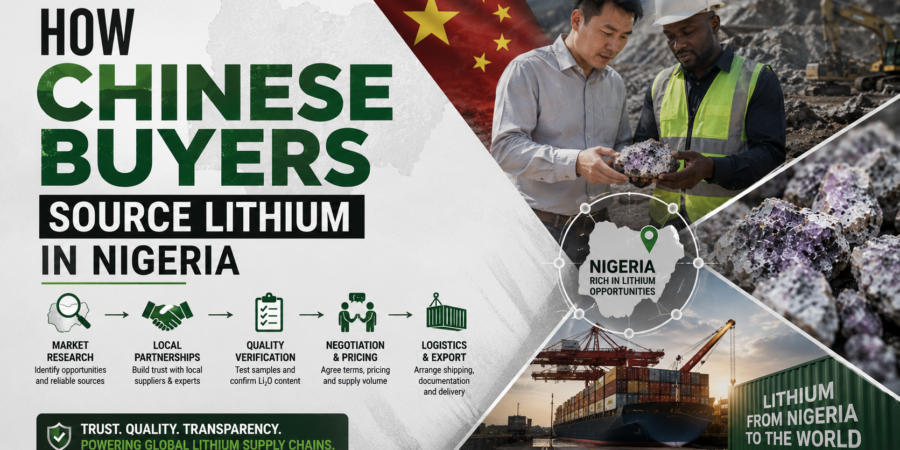
Chinese companies have become some of the most active players in Nigeria’s emerging lithium economy. This is not happening in isolation. China already occupies a dominant position across large parts of the global battery supply chain through lithium processing, battery manufacturing, electric vehicle production, mineral refining, and industrial procurement networks tied to energy-transition technologies. As global lithium demand continues rising, Chinese buyers are increasingly searching for new sourcing corridors, diversified mineral supply, and long-term procurement relationships across Africa.
Nigeria has gradually entered that strategic equation. Across parts of Northern Nigeria, growing lithium activity has attracted increasing attention from Chinese sourcing companies, mineral traders, battery-material firms, processing groups, and procurement agents seeking scalable supply opportunities. But contrary to what many people assume, Chinese buyers do not typically source lithium in Nigeria through simple direct mine purchases alone. The sourcing process is far more layered and commercially organized than many local suppliers realize.
In practice, Chinese procurement systems usually operate through a combination of local partnerships, aggregation networks, procurement coordinators, regional sourcing agents, warehousing systems, and logistics structures capable of organizing fragmented supply into scalable commercial inventory. This approach exists because Nigeria’s lithium market is still highly decentralized. Much of the current supply originates from artisanal miners, local cooperatives, regional suppliers, and fragmented extraction communities spread across multiple states.
For large industrial procurement systems, directly coordinating dozens or hundreds of scattered suppliers independently would be operationally inefficient. Aggregation solves that problem. This is one reason Chinese buyers increasingly focus on procurement coordination, supply-chain visibility, and aggregation access rather than isolated transactions alone. In many cases, the most valuable relationships in the Nigerian lithium market are no longer simply miner-to-buyer relationships. Increasingly, value sits within supply coordination systems.
Across Northern Nigeria, lithium-bearing materials associated with Spodumene/Kunzite, Lepidolite, and Amblygonite are gradually moving through expanding procurement and aggregation networks tied to international demand. As this movement increases, procurement systems are becoming more structured. Chinese buyers entering Nigeria today are generally far more strategic than during the early phase of the lithium rush. Initially, many sourcing activities were driven by rapid acquisition, speculative procurement, and short-term inventory accumulation. But the market is evolving. Today, serious industrial buyers increasingly prioritize long-term supply continuity, logistics coordination, inventory visibility, warehousing access, supplier verification, and procurement stability. This shift is changing how sourcing relationships are built across the Nigerian lithium market.
Another important aspect of Chinese procurement strategy is local operational presence. Many of the buyers entering this emerging mineral economy prefer working through local sourcing partners, procurement representatives, regional aggregators, and commercial intermediaries familiar with logistics systems, supplier networks, transportation corridors, and operational realities on the ground. This reduces procurement risk while improving sourcing efficiency, inventory coordination, and commercial visibility.
In practical terms, successful sourcing in Nigeria increasingly depends on understanding the supply chain itself. This is one reason Abuja is becoming strategically important within the lithium trade. Although Abuja is not necessarily one of Nigeria’s largest extraction locations, it is increasingly emerging as a procurement coordination center, an aggregation destination, a warehousing corridor, and a commercial bridge connecting regional suppliers with international buyers.
Many procurement discussions, supplier meetings, inventory coordination activities, and logistics arrangements are gradually gravitating toward Abuja because the city offers accessibility, centralized coordination, operational visibility, and stronger commercial infrastructure. As the market matures, centralized coordination environments like Abuja may become even more important within international sourcing systems.
Quality verification is another major area where Chinese buyers are becoming increasingly selective. Industrial procurement systems now commonly evaluate Li₂O percentage, mineral consistency, impurities, moisture content, and assay reliability before entering sourcing agreements. Lithium concentration is commonly measured using Li₂O percentage (Lithium Oxide percentage). As competition for quality lithium supply intensifies globally, procurement systems are becoming more disciplined and technically structured. This is gradually pushing the Nigerian market toward stronger aggregation systems, improved warehousing, more organized logistics, and better supplier coordination.
Transportation and export logistics also play a major role in sourcing decisions. Chinese procurement systems increasingly prioritize movement efficiency, inventory coordination, shipment planning, and logistics reliability because large-scale battery supply chains depend heavily on procurement continuity. This means suppliers capable of supporting organized transportation, scalable inventory, and procurement coordination may gain increasing commercial advantage over fragmented transactional operators.
The broader Nigerian lithium market is also becoming more competitive. As international interest continues expanding, buyers are increasingly searching for stable supplier relationships, scalable sourcing systems, and procurement partners capable of supporting long-term industrial demand rather than one-time opportunistic transactions. This transition is gradually transforming the market from speculative mineral trading into infrastructure-driven procurement ecosystems.
The Nigerian Mineral Exchange (NME) is actively positioning within this evolving sourcing environment by helping connect verified lithium suppliers, aggregation systems, warehousing networks, logistics operators, and international procurement groups across Nigeria’s growing lithium economy. For Chinese buyers, battery-material firms, commodity traders, and industrial procurement groups seeking verified lithium suppliers, bulk sourcing opportunities, aggregation coordination, supplier due diligence, logistics support, or Nigeria lithium market-entry consulting, NME provides procurement coordination and sourcing support designed to simplify lithium sourcing within Nigeria.
Chinese procurement groups seeking reliable lithium sourcing relationships in Nigeria can contact NME directly through WhatsApp (+2348130799304) for supplier introductions, aggregation access, inventory sourcing, procurement coordination, logistics visibility, and operational support. At the same time, NME is actively seeking steady lithium suppliers, aggregation partnerships, and long-term procurement relationships across Northern Nigeria. Suppliers looking for verified buyers, organized procurement systems, aggregation support, or direct lithium supply opportunities can also engage NME directly for immediate sourcing discussions.
The future of Chinese lithium sourcing in Nigeria will likely depend less on isolated mineral purchases and more on supply-chain coordination, logistics organization, warehousing systems, aggregation efficiency, and long-term procurement relationships. Because in today’s battery-mineral economy, successful sourcing increasingly belongs to those who understand not only where minerals exist, but how supply networks function, how inventory moves, and how procurement systems are coordinated across the market.
Related Articles
- How to Source Lithium Ore in Nigeria in 2026
- How to Secure Large-Scale Lithium Ore Supply in Abuja: The NME Industrial Sourcing Guide
- Understanding Li₂O Percentages in Lithium Trade
- Where to Buy Lithium Ore in Nigeria
- Lithium Ore Sellers in Kebbi State: Supply Your Lithium Ores to the Nigerian Mineral Exchange Abuja Warehouse
- Lithium Ore Sellers in Zamfara State: Supply Your Lithium Ores to the Nigerian Mineral Exchange Abuja Warehouse
- How to Sell Lithium Ore in Nigeria: Step-by-Step Guide for Miners
- 10 Common Reasons Lithium Ore Gets Rejected in Nigeria


Leave a Reply